Loading...
Michiel de Ruyter vs Napoleon Bonaparte
Napoleon Bonaparte leads by 9.9 pts · 2 figures compared
…
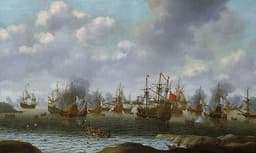
Michiel de Ruyter
General · Modern
61.0Total

Napoleon Bonaparte
General · Modern
70.9Total
Basic Information
Born
1607
1769
Died
1676
1821
Era
Modern
Modern
Nationality
Netherlands
France
Occupation
General
General
Civilization
Western
Western
Score Comparison
Military (10%)
74.0
94.0
Political (20%)
45.0
72.0
Influence (20%)
40.0
40.0
Legacy (20%)
80.0
80.0
Leadership (15%)
62.0
78.0
Strategy (15%)
75.3
90.0
TOTAL
61.0
70.9
Michiel de Ruyter — Complete Timeline
1639 AD
Battle of the DownsWar
De Ruyter served as a captain in the Dutch fleet under Maarten Tromp at the Battle of the Downs, where the Dutch decisively defeated a Spanish fleet. This battle established Dutch naval dominance and marked de Ruyter's early combat experience.
Eighty Years' WarNaval BattleDutch Victory
Impact: regional
1661 AD
Expedition to the MediterraneanWar
De Ruyter led a Dutch fleet to the Mediterranean to protect Dutch merchant shipping from Barbary pirates and to assert Dutch naval presence. He negotiated treaties with Algiers and Tunis, securing safer passage for Dutch trade.
Barbary PiratesNaval DiplomacyTrade Protection
Impact: regionalconstructive
1667 AD
Raid on the MedwayWar
De Ruyter led a Dutch fleet up the River Medway, attacking the English navy at its Chatham Dockyard. The Dutch burned or captured several major English warships, including the flagship HMS Royal Charles, a humiliating defeat for England.
Second Anglo-Dutch WarNaval RaidEnglish Defeat
Impact: regional
1672 AD
Battle of SolebayWar◆ Major
De Ruyter attacked the Anglo-French fleet at Solebay, preventing a blockade of the Dutch coast. The battle was tactically indecisive but strategically important as it thwarted Allied plans to invade the Netherlands.
Third Anglo-Dutch WarNaval BattleStrategic Defense
Impact: regional
1673 AD
Battle of the TexelWar◆ Major
De Ruyter commanded the Dutch fleet to a tactical victory over a combined Anglo-French fleet at the Battle of the Texel. This victory prevented an invasion of the Netherlands and secured Dutch independence during the Franco-Dutch War.
Franco-Dutch WarNaval BattleDutch Victory
Impact: regional
1676 AD
Death at the Battle of AugustaWar◆ Major
De Ruyter was mortally wounded by a cannonball during the Battle of Augusta against a French fleet. He died several days later. His death was a major loss for the Dutch navy and he was given a state funeral with great honors.
Franco-Dutch WarNaval BattleDeath in Battle
Impact: nationaltragic
Napoleon Bonaparte — Complete Timeline
1799 AD
Coup of 18 BrumaireOther◆ Major
Napoleon Bonaparte, with support from his brother Lucien and key political figures, overthrew the Directory in a bloodless coup. He established the Consulate with himself as First Consul, effectively becoming the ruler of France. This event ended the French Revolution's most unstable period.
French RevolutionCoupRise to Power
Impact: regional
1804 AD
Promulgation of the Napoleonic CodeOther◆ Major
Napoleon enacted the Civil Code of the French, known as the Napoleonic Code, a comprehensive set of laws that replaced the fragmented feudal legal systems. The code established legal equality, protected property rights, and secularized law. It became the basis for legal systems in many European and world countries.
Legal ReformNapoleonic CodeCivil Law
Impact: globalconstructive
1805 AD
Battle of AusterlitzWar◆ Major
Napoleon's Grande Arm
Napoleonic WarsBattleDecisive Victory
Impact: global
1812 AD
Invasion of RussiaWar◆ Major
Napoleon led the Grande Arm
Napoleonic WarsInvasionDisaster
Impact: globaldestructive
1815 AD
Battle of WaterlooWar◆ Major
Napoleon's French army was defeated by the combined forces of the Duke of Wellington's Anglo-Allied army and Gebhard Leberecht von Bl
Napoleonic WarsBattleFinal Defeat
Impact: globaldestructive
Expert Analysis
michiel-de-ruyter-vs-napoleon-bonaparte
# The Emperor and the Admiral
On a June morning in 1815, a short man in a grey coat watched his imperial guard march into the mists of Waterloo. Three miles of cornfields, mud, and dying men would decide the fate of Europe. One hundred and forty-eight years earlier, on a June night in 1667, a tall Dutchman with a weathered face had sailed his fleet up the River Medway, past English forts that had never imagined an enemy could come so far, and burned the heart of the Royal Navy at its own dockyard. Napoleon Bonaparte and Michiel de Ruyter never met, never could have met—they belonged to different centuries, different worlds. Yet both rose from modest beginnings to command the greatest fighting forces of their age. One ended in exile on a remote Atlantic island. The other died on the deck of his flagship, struck by a cannonball at sixty-nine. What separated them was not skill or courage, but the shape of the world they tried to master.
Origins
Napoleon was born in 1769 on Corsica, an island that had become French only the year before. His family was minor nobility, poor enough that young Napoleon wore threadbare clothes to military school, where he was mocked by wealthy classmates for his Italian accent and small stature. He devoured books on military history and artillery mathematics, and by the age of sixteen he was a second lieutenant in the French army. The French Revolution, which erupted when he was twenty, shattered the old order and opened paths that birth alone could never have granted. A Corsican outsider in a nation remaking itself: this was the crucible that forged him.
Michiel de Ruyter was born in 1607 in Vlissingen, a port town in the Dutch Republic. His father was a beer porter who died when Michiel was young. He went to sea at eleven, first as a rope-maker's apprentice, then as a cabin boy. He taught himself navigation and seamanship through sheer experience. By his twenties he was a merchant captain, trading in salt and herring, fighting Barbary pirates on the side. He was never a theorist, never wrote a military treatise. He learned war the way a fisherman learns weather: by watching, by feeling, by surviving.
Rise to Power
Napoleon's ascent was meteoric. In 1793, at twenty-four, he drove the British fleet out of Toulon with a brilliant artillery plan. In 1796 he was given command of the starving, ragged Army of Italy—and within months he had crossed the Alps, crushed the Austrians, and made himself the most famous man in France. He understood something that the old generals did not: that speed, concentration, and the morale of the common soldier could shatter armies that outnumbered him. By 1804 he had crowned himself Emperor, and by 1809 he controlled Europe from Spain to Poland.
De Ruyter's rise was slower, harder, and never complete. He refused high command three times before accepting it. He had no ambition for crowns. In 1639 he served as a captain under Maarten Tromp at the Battle of the Downs, where the Dutch destroyed a Spanish fleet. In 1661 he led an expedition to the Mediterranean to protect Dutch merchants from Barbary pirates. He was not a conqueror; he was a protector. His power came not from conquest but from trust—the trust of the States General, the trust of his captains, the trust of common sailors who knew he would share their rations and their risks.
Leadership & Governance
Napoleon governed like a thunderstorm. He centralized everything. He rewrote French law into the Napoleonic Code, which still shapes legal systems across Europe. He built roads, standardized education, reformed the tax system. But he also created a new aristocracy, censored the press, and put his brothers on thrones. His genius was administrative as much as military, but it was a genius that demanded total control. He could not share power, could not tolerate equals, could not stop.
De Ruyter led differently. At the Battle of Solebay in 1672, he attacked an Anglo-French fleet that outnumbered him, preventing a blockade of the Dutch coast. At the Battle of the Texel in 1673, he outmaneuvered a combined fleet so skillfully that the English and French blamed each other for the defeat. He won not by overwhelming force but by discipline, timing, and the ability to read wind and tide. His political score of 70 reflects a man who navigated the factions of the Dutch Republic—the Orangists and the Republicans, the merchants and the princes—without ever becoming their prisoner. He served, and when his service was no longer wanted, he went home.
Triumph & Tragedy
Napoleon's greatest triumph was Austerlitz in 1805, where he destroyed the combined armies of Russia and Austria in a single day. His greatest tragedy was the invasion of Russia in 1812, where he lost half a million men to winter, hunger, and Cossack raids. He never recovered. He was exiled to Elba in 1814, escaped in 1815, raised another army, and was defeated at Waterloo—a battle that was close, that might have gone differently, but that ended in the whimper of the Imperial Guard crying "The Old Guard dies, but does not surrender."
De Ruyter's greatest triumph was the Raid on the Medway in 1667, where he sailed into the heart of England and burned three capital ships and ten smaller vessels, including the flagship *Royal Charles*, which he towed back to the Netherlands as a trophy. It was the worst defeat the Royal Navy ever suffered. His tragedy came nine years later, at the Battle of Augusta in 1676. He was mortally wounded by a cannonball while fighting the French. He died several days later, and his body was taken home to Amsterdam, where he was buried with honors that no Dutch admiral had ever received.
Character & Destiny
Napoleon was driven by an insatiable hunger. He once said, "I am not a man, but a thing. I have no heart." He was not entirely wrong. He saw the world as a problem to be solved, an enemy to be crushed, a throne to be filled. His military score of 94 and strategy of 93 reflect a mind that could calculate the movement of a hundred thousand men across a continent. But his leadership score of 80 hints at the flaw: he could inspire, but he could not listen. He burned through men and nations like a fire that cannot stop because stopping means dying.
De Ruyter was driven by duty. He was a Calvinist, a family man, a man who wept when his wife died and who wrote letters home full of affection for his children. He was not a philosopher, not a reformer, not a builder of empires. He was a sailor who did his job so well that the Dutch Republic survived the combined assault of England and France. His military score of 78 and strategy of 83 are lower than Napoleon's, but they were enough—because he did not need to conquer the world. He only needed to keep the sea lanes open, the merchants safe, the Republic free.
Legacy
Napoleon's legacy is written in law codes, in the shape of modern Europe, in the very idea of the "great man" who bends history to his will. He is remembered in statues, in books, in the name of a brandy. His total score of 82.4 reflects a figure of enormous impact, but also of enormous destruction. He is a warning as much as an inspiration.
De Ruyter's legacy is quieter. He is remembered in the Netherlands as a national hero, his statue standing in Vlissingen, his name given to ships and streets. His total score of 78.2 is lower, but it reflects a different kind of greatness: not the greatness of conquest, but the greatness of defense. He saved his country. He did not need to rule it.
Conclusion
Standing on the deck of his flagship, watching the French fleet approach at Augusta, Michiel de Ruyter knew he would probably die. He went anyway. Napoleon, standing on the hill at Waterloo, watched his last reserves advance into the British squares. He did not die. He lived to write his memoirs on Saint Helena, rewriting history to make himself its hero. One man gave his life for a republic that would not last. The other gave his soul for an empire that would not last either. Perhaps the difference between them is not greatness, but the answer to a single question: What are you willing to lose?
Rankings
🥇
Napoleon BonaparteLeader
Mil: 94.0Pol: 72.0Inf: 40.0
70.9
🥈
Michiel de Ruyter
Mil: 74.0Pol: 45.0Inf: 40.0
61.0
+9.9 behind
How This Comparison Works
Algorithm
Each figure is scored on 6 dimensions (0—100 scale) based on structured historical data: Military (10%), Political (20%), Influence (20%), Legacy (20%), Leadership (15%), Strategy (15%). The weighted total produces the final ranking.
Data Sources
Scores are computed from structured sub-indicators in the database. Scale factors adjust for era (Ancient ×0.85, Modern ×1.0) and civilization size (Eastern ×1.05, Other ×0.80) to account for differences in population and military scale.
Maximum 3 Figures
Comparisons are limited to 2—3 figures to ensure readability and statistical meaningfulness.
Error Margins
±5 points per dimension — Sub-scores are derived from historical records with inherent uncertainty. Two figures within 5 points on a dimension should be considered roughly equivalent in that area.
Total Score Accuracy
±3 points overall — The weighted combination of 6 dimensions produces a total score with approximately ±3 points of uncertainty. Differences of less than 3 points are not statistically significant— the figures are effectively tied.
Known Limitations
- Historical records are incomplete and uneven across civilizations
- Figures from oral-tradition societies may be underrepresented
- Occupation labels can misclassify multi-role figures
- Scores measure capability and impact, not moral character
- Quantitative scoring is a comparison tool, not absolute truth
Capability Radar
Military (10%) — Battles & Warfare
Battles
85
95
Win Rate
90
90
Expansion
60
95
Political (20%) — Governance & Reform
Reform
40
95
Diplomacy
70
80
Economy
55
85
Influence (20%) — Cultural & Global Reach
Cultural
75
85
Global
70
90
Legacy (20%) — Historical Impact
Historical
80
95
Longevity
75
90
Leadership (15%) — Power & Stability
Tenure
50
85
Stability
60
70
Strategy (15%) — Tactics & Innovation
Strategy
88
95
Tactics
95
98
Reform
75
92
Similar Comparisons
Comments & Discussion
No comments yet. Be the first to share your thoughts!