Loading...
Merneptah vs Napoleon Bonaparte
Napoleon Bonaparte leads by 21.0 pts · 2 figures compared
…
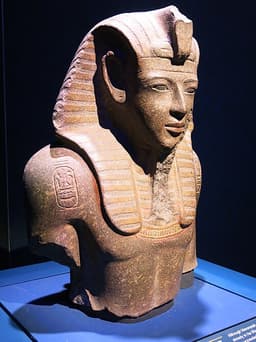
Merneptah
Emperor · Ancient
49.9Total

Napoleon Bonaparte
General · Modern
70.9Total
Basic Information
Born
-1213
1769
Died
-1203
1821
Era
Ancient
Modern
Nationality
Egypt
France
Occupation
Emperor
General
Civilization
Middle Eastern
Western
Score Comparison
Military (10%)
52.5
94.0
Political (20%)
48.0
72.0
Influence (20%)
52.5
40.0
Legacy (20%)
49.2
80.0
Leadership (15%)
40.0
78.0
Strategy (15%)
60.0
90.0
TOTAL
49.9
70.9
Merneptah — Complete Timeline
1210 BC
Libyan War campaignWar◆ Major
Merneptah repelled an invasion by Libyan tribes and their Sea Peoples allies in the western Delta. The victory was recorded in the Great Karnak Inscription. This campaign secured Egypt's western borders and prevented a major incursion into the Nile Valley.
LibyaSea PeoplesDefense
Impact: regional
Suppression of the revolt in CanaanWar
Merneptah conducted a military campaign in Canaan to suppress rebellions against Egyptian control. The campaign included the capture of the cities of Gezer, Yanoam, and Ashkelon. This reasserted Egyptian authority over the region for the remainder of his reign.
CanaanRevoltMilitary
Impact: regional
1208 BC
Merneptah Stele inscriptionCultural◆ Major
Merneptah commissioned a victory stele at Thebes that contains the earliest known extrabiblical reference to Israel. The stele describes a military campaign in Canaan and states 'Israel is laid waste, its seed is not.' This provides the first historical evidence of Israel as a people in the region.
IsraelSteleCanaan
Impact: global
Napoleon Bonaparte — Complete Timeline
1799 AD
Coup of 18 BrumaireOther◆ Major
Napoleon Bonaparte, with support from his brother Lucien and key political figures, overthrew the Directory in a bloodless coup. He established the Consulate with himself as First Consul, effectively becoming the ruler of France. This event ended the French Revolution's most unstable period.
French RevolutionCoupRise to Power
Impact: regional
1804 AD
Promulgation of the Napoleonic CodeOther◆ Major
Napoleon enacted the Civil Code of the French, known as the Napoleonic Code, a comprehensive set of laws that replaced the fragmented feudal legal systems. The code established legal equality, protected property rights, and secularized law. It became the basis for legal systems in many European and world countries.
Legal ReformNapoleonic CodeCivil Law
Impact: globalconstructive
1805 AD
Battle of AusterlitzWar◆ Major
Napoleon's Grande Arm
Napoleonic WarsBattleDecisive Victory
Impact: global
1812 AD
Invasion of RussiaWar◆ Major
Napoleon led the Grande Arm
Napoleonic WarsInvasionDisaster
Impact: globaldestructive
1815 AD
Battle of WaterlooWar◆ Major
Napoleon's French army was defeated by the combined forces of the Duke of Wellington's Anglo-Allied army and Gebhard Leberecht von Bl
Napoleonic WarsBattleFinal Defeat
Impact: globaldestructive
Expert Analysis
Origins
Merneptah, born around 1273 BC, was the thirteenth son of Ramesses II, one of Egypt's most prolific builders and military leaders. His mother was Isetnofret, a queen of high status. Merneptah likely received military training and administrative experience as a prince, but his ascension was not assured given the many elder brothers. He became pharaoh in his sixties, after the death of his father, who had reigned for 66 years. In contrast, Napoleon Bonaparte was born in 1769 on Corsica, shortly after its annexation by France. His family was of minor nobility, and he was educated at military schools in Brienne and Paris. Napoleon graduated in 1785 as a second lieutenant in artillery. His early life was marked by ambition and resentment of the French establishment, which he later came to dominate.
Rise to Power
Merneptah's rise was the result of surviving his father and brothers. He became pharaoh in 1213 BC, inheriting a stable but overextended empire. His early reign faced threats from Libyan tribes and Sea Peoples. He defeated them in a campaign in 1209 BC, recorded on the Great Karnak Inscription. This victory secured his rule and allowed him to focus on internal affairs. Napoleon's rise was far more dramatic. He came to prominence during the French Revolution, capturing Toulon in 1793 at age 24. He then suppressed a royalist uprising in Paris in 1795, gaining command of the Army of Italy. In 1796, he led a stunning campaign that defeated the Austrian Empire, making him a national hero. In 1799, he staged the Coup of 18 Brumaire, overthrowing the Directory and becoming First Consul. By 1804, he crowned himself Emperor of the French.
Leadership & Governance
Merneptah governed as a traditional pharaoh, emphasizing continuity with the past. He commissioned the Merneptah Stele, which boasts of his victories and includes the first known mention of Israel. His governance focused on maintaining Egyptian control over Canaan and repelling external threats. He undertook building projects, including his mortuary temple, but these were modest compared to his father's. Merneptah's leadership style was reactive, responding to invasions rather than expanding the empire. Napoleon, by contrast, was a revolutionary reformer. He centralized the French state, established the Napoleonic Code (1804) which standardized laws, promoted meritocracy in the military, and reorganized education. His governance was proactive and transformative, but also autocratic. He created a new nobility and suppressed dissent. While Merneptah's scores in leadership (45.0) and political (47.3) are moderate, Napoleon scored 80.0 and 75.0 respectively, reflecting his more direct and influential governance.
Triumph & Tragedy
Merneptah's greatest triumph was repelling the Libyan invasion and the Sea Peoples, securing Egypt's borders. His stele also provides the earliest extrabiblical reference to Israel, a significant historical artifact. However, his reign was largely defensive; he did not expand Egypt's territory. His greatest failure may be that his successes were overshadowed by Ramesses II's legacy. Egypt declined after his death due to weak successors. Napoleon's triumphs are numerous: the Battle of Austerlitz (1805) is considered his masterpiece, crushing the Third Coalition. The Napoleonic Code remains a foundation of civil law in many countries. But his tragedies are equally profound: the disastrous Invasion of Russia in 1812, where the Grande Armée was destroyed, and the final defeat at Waterloo in 1815. Napoleon died in exile on Saint Helena. His military score of 94.0 contrasts with Merneptah's 38.6, reflecting the scale of his campaigns and his strategic brilliance.
Character & Destiny
Merneptah appears as a capable but cautious ruler, content to maintain his father's empire. His stele shows a desire to assert his own legacy, but his character was not one of grand ambition. He likely saw himself as a steward of Egypt's traditions. Napoleon's character was the opposite: driven, ambitious, and restless. He believed in his own destiny and sought to dominate Europe. His strategic mind (93.0) and leadership (80.0) were matched by a tendency to overreach, as seen in his invasion of Spain and Russia. His character led to both his rise and his fall. Historians note that Napoleon's inability to delegate and his insatiable need for control contributed to his downfall.
Legacy
Merneptah's legacy rests largely on the Merneptah Stele, which is crucial for biblical archaeology and understanding the early history of Israel. His military campaigns are less celebrated, but he maintained Egypt's stability during a turbulent period. His influence score of 70.4 reflects the stele's importance. Napoleon's legacy is global and enduring. The Napoleonic Code influenced legal systems in Europe, the Americas, and beyond. He modernized warfare, introduced the concept of the nation-state, and spread nationalism. His legacy is complex: a liberator and a tyrant. His influence score of 82.0 and legacy score of 78.0 are higher than Merneptah's 70.4 and 65.6, but both left significant marks.
Conclusion
Comparing Merneptah and Napoleon reveals a vast difference in scale and impact. Napoleon scored 82.4 overall to Merneptah's 56.3, a gap of 26.1 points. While Merneptah's stele is a valuable historical artifact, Napoleon's reforms reshaped the modern world. Napoleon's military campaigns, legal code, and political system had direct consequences for billions of people. Merneptah's influence is limited to a relatively small region and time period. Therefore, Napoleon Bonaparte had greater impact. His combination of military genius (94.0), political acumen (75.0), and strategic vision (93.0) far surpasses Merneptah's more modest achievements. The data supports this conclusion: Napoleon's total score of 82.4 is significantly higher, and his legacy continues to be felt in law, governance, and military strategy today.
Rankings
🥇
Napoleon BonaparteLeader
Mil: 94.0Pol: 72.0Inf: 40.0
70.9
🥈
Merneptah
Mil: 52.5Pol: 48.0Inf: 52.5
49.9
+21.0 behind
How This Comparison Works
Algorithm
Each figure is scored on 6 dimensions (0—100 scale) based on structured historical data: Military (10%), Political (20%), Influence (20%), Legacy (20%), Leadership (15%), Strategy (15%). The weighted total produces the final ranking.
Data Sources
Scores are computed from structured sub-indicators in the database. Scale factors adjust for era (Ancient ×0.85, Modern ×1.0) and civilization size (Eastern ×1.05, Other ×0.80) to account for differences in population and military scale.
Maximum 3 Figures
Comparisons are limited to 2—3 figures to ensure readability and statistical meaningfulness.
Error Margins
±5 points per dimension — Sub-scores are derived from historical records with inherent uncertainty. Two figures within 5 points on a dimension should be considered roughly equivalent in that area.
Total Score Accuracy
±3 points overall — The weighted combination of 6 dimensions produces a total score with approximately ±3 points of uncertainty. Differences of less than 3 points are not statistically significant— the figures are effectively tied.
Known Limitations
- Historical records are incomplete and uneven across civilizations
- Figures from oral-tradition societies may be underrepresented
- Occupation labels can misclassify multi-role figures
- Scores measure capability and impact, not moral character
- Quantitative scoring is a comparison tool, not absolute truth
Capability Radar
Military (10%) — Battles & Warfare
Battles
55
95
Win Rate
60
90
Expansion
40
95
Political (20%) — Governance & Reform
Reform
40
95
Diplomacy
50
80
Economy
45
85
Influence (20%) — Cultural & Global Reach
Cultural
35
85
Global
40
90
Legacy (20%) — Historical Impact
Historical
60
95
Longevity
55
90
Leadership (15%) — Power & Stability
Tenure
60
85
Stability
55
70
Strategy (15%) — Tactics & Innovation
Strategy
55
95
Tactics
50
98
Reform
30
92
Similar Comparisons
Comments & Discussion
No comments yet. Be the first to share your thoughts!