Loading...
Meles Zenawi vs Ruth Perry
Meles Zenawi leads by 7.2 pts · 2 figures compared
…
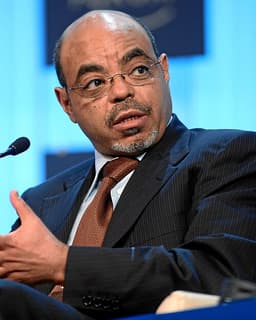
Meles Zenawi
Politician · Modern
57.6Total

Ruth Perry
Politician · Modern
50.4Total
Basic Information
Born
1955
1939
Died
—
—
Era
Modern
Modern
Nationality
Ethiopia
Liberia
Occupation
Politician
Politician
Civilization
Other
Other
Score Comparison
Military (10%)
36.6
33.6
Political (20%)
65.0
43.7
Influence (20%)
59.0
60.0
Legacy (20%)
48.3
50.0
Leadership (15%)
79.8
58.8
Strategy (15%)
53.5
41.7
TOTAL
57.6
50.4
Meles Zenawi — Complete Timeline
1991 AD
EPRDF capture of Addis AbabaWar◆ Major
Meles Zenawi, as leader of the Tigrayan People's Liberation Front (TPLF) and the Ethiopian People's Revolutionary Democratic Front (EPRDF) coalition, led rebel forces to overthrow the Derg regime. This ended the Ethiopian Civil War and installed Meles as president of the transitional government.
Civil WarRegime ChangeRebel Victory
Impact: national
1998 AD
Eritrean-Ethiopian WarWar◆ Major
Meles, as prime minister, led Ethiopia in a two-year border war with Eritrea. The conflict resulted in tens of thousands of deaths and ended with a stalemate, followed by the Algiers Agreement in 2000 and the establishment of the UN peacekeeping mission UNMEE.
Border WarEritreaPeacekeeping
Impact: regionaldestructive
2000 AD
Ethiopian economic reform programReform◆ Major
Meles implemented a series of economic reforms focused on agricultural development, infrastructure investment, and state-led industrialization. These policies contributed to sustained GDP growth averaging over 10% annually from 2004 to 2014, though critics noted limited political freedoms.
Economic DevelopmentAgricultureInfrastructure
Impact: nationalconstructive
2005 AD
2005 Ethiopian general electionPolitical Action◆ Major
Meles's government held multi-party elections that were initially seen as promising but ended in controversy. Opposition parties claimed fraud, leading to protests and a violent crackdown that killed at least 193 people. The event damaged Ethiopia's democratic reputation.
ElectionPolitical ViolenceDemocracy
Impact: nationaldestructive
2012 AD
Death in officeOther◆ Major
Meles Zenawi died on August 20, 2012, in a Brussels hospital from an undisclosed illness. His death ended 21 years of rule and triggered a peaceful transition of power to Deputy Prime Minister Hailemariam Desalegn, though the TPLF retained control.
DeathTransitionSuccession
Impact: national
Ruth Perry — Complete Timeline
1996 AD
Appointed Chairperson of the Council of StatePolitical Action◆ Major
Ruth Perry was appointed Chairperson of the Council of State of Liberia in September 1996, becoming the first female African head of state in the modern era. She led the transitional government during the final stages of the First Liberian Civil War.
First Female Head of StateTransitionLiberia
Impact: nationalconstructive
1997 AD
Oversaw Peace Process and ElectionsPolitical Action◆ Major
Perry's government supervised the disarmament of warring factions and organized the 1997 general elections, which brought Charles Taylor to power. Despite criticisms of the election's fairness, Perry's leadership helped end the civil war and restore civilian rule.
Peace ProcessElectionsLiberia
Impact: nationalconstructive
Post-Presidency AdvocacyPolitical Action
After leaving office in 1997, Perry remained active in peacebuilding and women's rights advocacy. She worked with organizations such as the Liberian Women's Initiative, promoting reconciliation and gender equality in post-conflict Liberia.
AdvocacyWomen's RightsLiberia
Impact: nationalconstructive
Expert Analysis
Origins
Meles Zenawi was born on May 8, 1955, in Adwa, northern Ethiopia, into a Tigrayan family. He studied medicine at Addis Ababa University but left to join the Tigrayan People's Liberation Front (TPLF) in the mid-1970s, fighting against the Marxist Derg regime. His early experiences in guerrilla warfare shaped his strategic thinking.
Ruth Perry was born on July 16, 1939, in Grand Cape Mount County, Liberia. She trained as a teacher and later worked in banking and public service. Her political career began in the 1980s, serving in the Senate and as a representative in the interim government. Her background in education and community work informed her approach to leadership.
Rise to Power
Meles rose through the ranks of the TPLF, becoming its leader in 1989. He formed the Ethiopian People's Revolutionary Democratic Front (EPRDF) coalition, which captured Addis Ababa in May 1991, ending the Derg regime. He served as president until 1995, then as prime minister until his death. His rise was marked by military victory and political consolidation.
Ruth Perry's ascent occurred during Liberia's civil wars. After the collapse of the first peace accord, she was appointed Chairperson of the Council of State in September 1996, a transitional role. She became the first female African head of state in modern history, tasked with overseeing the peace process and elections. Her rise was a compromise among warring factions.
Leadership & Governance
Meles governed with a strong hand, implementing a development strategy focused on agricultural transformation, infrastructure, and state-led industrialization. He maintained tight political control, using security forces to suppress dissent. His government's response to the 2005 election crisis showed his willingness to limit democracy for stability. He scored 79.8 in leadership, reflecting his decisive but authoritarian style.
Ruth Perry led a fragile transitional government. Her leadership emphasized reconciliation and inclusion. She successfully navigated the disarmament of factions and organized the 1997 elections, despite widespread irregularities. Her leadership score of 58.8 reflects the constraints of a weak state and her diplomatic approach.
Triumph & Tragedy
Meles's greatest success was transforming Ethiopia's economy: GDP grew at 10% annually from 2004 to 2012, poverty fell, and infrastructure expanded. However, his tragic failure was the 1998-2000 Eritrean-Ethiopian War, which killed tens of thousands and damaged regional relations. His political score of 65.0 reflects both his achievements and his repressive tactics.
Ruth Perry's triumph was overseeing a peaceful transition from civil war to elections, preventing further bloodshed. Her tragedy was the flawed election process that brought Charles Taylor to power, whose regime led to another war. Her influence score of 60.0 recognizes her symbolic role as a pioneer for women in African politics.
Character & Destiny
Meles was a strategic thinker, often described as a technocrat with a Marxist background. He was secretive and intolerant of opposition, which isolated him. His sudden death in office in 2012 left a power vacuum but allowed a peaceful transition. His character—disciplined and visionary—drove Ethiopia's development but also its authoritarian turn.
Ruth Perry was a consensus-builder, known for her calm demeanor and moral authority. She prioritized peace over personal power. Her destiny was to be a transitional figure, not a long-term leader. Her character suited the moment but limited her impact beyond 1997.
Legacy
Meles's legacy is mixed: he is celebrated for economic growth but criticized for human rights abuses. His policies remain influential in Ethiopia, though subsequent reforms have moved away from state control. His total score of 57.6 reflects a transformative yet controversial record.
Ruth Perry's legacy is primarily symbolic: as the first female African head of state, she inspired women leaders. However, her concrete achievements were limited by the context. Her legacy score of 50.0 indicates a modest but significant impact.
Conclusion
Meles Zenawi had a greater impact on his country and the region. His economic reforms reshaped Ethiopia, a nation of over 100 million, while Perry's influence was confined to a short transitional period. Meles's total score of 57.6 versus Perry's 50.4 reflects his broader and deeper influence, despite the trade-offs. The comparison underscores that long-term governance requires both vision and power, which Meles exercised more effectively.
Rankings
🥇
Meles ZenawiLeader
Mil: 36.6Pol: 65.0Inf: 59.0
57.6
🥈
Ruth Perry
Mil: 33.6Pol: 43.7Inf: 60.0
50.4
+7.2 behind
How This Comparison Works
Algorithm
Each figure is scored on 6 dimensions (0—100 scale) based on structured historical data: Military (10%), Political (20%), Influence (20%), Legacy (20%), Leadership (15%), Strategy (15%). The weighted total produces the final ranking.
Data Sources
Scores are computed from structured sub-indicators in the database. Scale factors adjust for era (Ancient ×0.85, Modern ×1.0) and civilization size (Eastern ×1.05, Other ×0.80) to account for differences in population and military scale.
Maximum 3 Figures
Comparisons are limited to 2—3 figures to ensure readability and statistical meaningfulness.
Error Margins
±5 points per dimension — Sub-scores are derived from historical records with inherent uncertainty. Two figures within 5 points on a dimension should be considered roughly equivalent in that area.
Total Score Accuracy
±3 points overall — The weighted combination of 6 dimensions produces a total score with approximately ±3 points of uncertainty. Differences of less than 3 points are not statistically significant— the figures are effectively tied.
Known Limitations
- Historical records are incomplete and uneven across civilizations
- Figures from oral-tradition societies may be underrepresented
- Occupation labels can misclassify multi-role figures
- Scores measure capability and impact, not moral character
- Quantitative scoring is a comparison tool, not absolute truth
Capability Radar
Military (10%) — Battles & Warfare
Battles
5
21
Win Rate
5
25
Expansion
5
25
Political (20%) — Governance & Reform
Reform
70
40
Diplomacy
65
35
Economy
70
30
Influence (20%) — Cultural & Global Reach
Cultural
40
45
Global
45
45
Legacy (20%) — Historical Impact
Historical
50
50
Longevity
30
40
Leadership (15%) — Power & Stability
Tenure
75
30
Stability
55
25
Strategy (15%) — Tactics & Innovation
Strategy
10
32
Tactics
5
32
Reform
15
39
Similar Comparisons
Comments & Discussion
No comments yet. Be the first to share your thoughts!