Loading...
Mayurasharma vs Napoleon Bonaparte
Napoleon Bonaparte leads by 24.0 pts · 2 figures compared
…
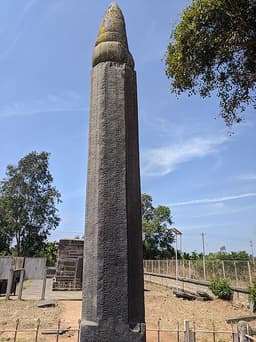
Mayurasharma
Emperor · Ancient
46.9Total

Napoleon Bonaparte
General · Modern
70.9Total
Basic Information
Born
325
1769
Died
365
1821
Era
Ancient
Modern
Nationality
India
France
Occupation
Emperor
General
Civilization
Indian
Western
Score Comparison
Military (10%)
46.7
94.0
Political (20%)
35.1
72.0
Influence (20%)
53.3
40.0
Legacy (20%)
45.8
80.0
Leadership (15%)
55.3
78.0
Strategy (15%)
38.6
90.0
TOTAL
46.9
70.9
Mayurasharma — Complete Timeline
345 AD
Foundation of the Kadamba dynastyPolitical Action◆ Major
Mayurasharma established the Kadamba dynasty, the first native kingdom in Karnataka. He broke away from the Pallava suzerainty and founded a kingdom that ruled from Banavasi, marking the beginning of Kannada political identity.
Dynasty FoundationKarnatakaKadamba
Impact: regionalconstructive
360 AD
Performance of the Ashvamedha sacrificeCultural◆ Major
Mayurasharma performed the Ashvamedha (horse sacrifice) to assert his imperial status. This Vedic ritual was a declaration of sovereignty and was recorded in the Talagunda inscription.
AshvamedhaImperial AuthorityVedic Ritual
Impact: regionalconstructive
Napoleon Bonaparte — Complete Timeline
1799 AD
Coup of 18 BrumaireOther◆ Major
Napoleon Bonaparte, with support from his brother Lucien and key political figures, overthrew the Directory in a bloodless coup. He established the Consulate with himself as First Consul, effectively becoming the ruler of France. This event ended the French Revolution's most unstable period.
French RevolutionCoupRise to Power
Impact: regional
1804 AD
Promulgation of the Napoleonic CodeOther◆ Major
Napoleon enacted the Civil Code of the French, known as the Napoleonic Code, a comprehensive set of laws that replaced the fragmented feudal legal systems. The code established legal equality, protected property rights, and secularized law. It became the basis for legal systems in many European and world countries.
Legal ReformNapoleonic CodeCivil Law
Impact: globalconstructive
1805 AD
Battle of AusterlitzWar◆ Major
Napoleon's Grande Arm
Napoleonic WarsBattleDecisive Victory
Impact: global
1812 AD
Invasion of RussiaWar◆ Major
Napoleon led the Grande Arm
Napoleonic WarsInvasionDisaster
Impact: globaldestructive
1815 AD
Battle of WaterlooWar◆ Major
Napoleon's French army was defeated by the combined forces of the Duke of Wellington's Anglo-Allied army and Gebhard Leberecht von Bl
Napoleonic WarsBattleFinal Defeat
Impact: globaldestructive
Expert Analysis
mayurasharma-vs-napoleon-bonaparte
# The Emperor and the Sage: Two Paths to Power
In the year 345, as Mayurasharma performed the ancient Ashvamedha sacrifice in the forests of Karnataka, a horse wandered freely across lands he claimed as his own, a ritual declaration of sovereignty that would echo through Indian history. Half a world away and fourteen centuries later, another young man—Napoleon Bonaparte—stood before the gates of Toulon in 1793, his cannons trained on British ships, about to ignite a career that would reshape Europe. Both men sought power, but their journeys could not have been more different. One founded a dynasty through ritual and rebellion; the other built an empire through war and law. What drove these two figures, separated by time and culture, to such divergent outcomes?
Origins
Napoleon Bonaparte was born in 1769 on the island of Corsica, a Mediterranean outcrop recently annexed by France. His family, minor Italian nobility, scraped by on modest means. The young Napoleon was sent to military school in mainland France, where he was mocked for his accent and small stature. This outsider status forged a relentless ambition. The French Revolution, erupting when he was twenty, shattered the old order and opened doors that would have remained closed under the monarchy. A world of chaos became his canvas.
Mayurasharma, by contrast, emerged around 325 from the Brahmin priestly class in what is now Karnataka, southern India. He was not born to rule. His people, the Kadambas, lived under the shadow of the Pallava dynasty, a powerful kingdom to the east. Mayurasharma’s path was spiritual and scholarly; he studied the Vedas and mastered ritual. But when a Pallava official insulted him during a journey to Kanchi, the young Brahmin’s pride ignited. He abandoned his priestly robes, took up the sword, and vowed to carve out a kingdom where his people could stand independent.
Rise to Power
Napoleon’s ascent was a whirlwind of military brilliance. In 1793, at just twenty-four, he recaptured Toulon from British forces, earning promotion to brigadier general. His Italian campaign of 1796-1797 was a masterpiece: he defeated larger Austrian armies through speed, deception, and audacity. By 1799, he had staged a coup and made himself First Consul of France. His rise was not slow or patient—it was explosive, fueled by the revolutionary fervor that had dissolved old hierarchies.
Mayurasharma’s rise was quieter, but no less determined. After the insult at Kanchi, he gathered a band of loyal followers and retreated into the forests of the Western Ghats. There, he waged a guerrilla war against Pallava outposts, slowly building a base of support. In 345, he performed the Ashvamedha sacrifice—a ritual where a horse was allowed to roam freely for a year, and any territory it entered was claimed as his. This was not just a military act; it was a cultural declaration. By reviving an ancient Vedic tradition, Mayurasharma asserted his legitimacy as a sovereign, not a rebel. The Pallavas, unable to crush him, eventually recognized his kingdom. His foundation of the Kadamba dynasty was a political action rooted in ritual, not revolution.
Leadership & Governance
Napoleon governed with the same energy he commanded armies. He centralized the French state, reorganized education, and, most famously, codified French law into the Napoleonic Code—a system that emphasized merit over birth and influenced legal systems across Europe. His military genius was undeniable: with a strategic score of 93 and a military score of 94, he won over sixty battles, from Austerlitz in 1805 to Jena in 1806. Yet his political score of 75 reflects a ruler who could not stop conquering. He placed his brothers on thrones across Europe, but his empire was a pyramid of cards.
Mayurasharma’s leadership was more modest. His military score of 48 and political score of 43 suggest a chieftain, not a conqueror. He did not seek to dominate India; he sought to create a homeland for the Kadamba people. His governance was rooted in local traditions: he patronized Brahmin scholars, performed Vedic rituals, and established a court that blended tribal custom with classical Hindu kingship. His Ashvamedha sacrifice was not just a power move—it was an act of cultural defiance, a statement that the Kannada-speaking people had their own destiny. Where Napoleon built an empire of laws, Mayurasharma built a kingdom of identity.
Triumph & Tragedy
Napoleon’s greatest moment was Austerlitz in 1805, where he crushed the combined armies of Russia and Austria. His tragedy was the invasion of Russia in 1812—a catastrophic campaign that cost half a million lives and destroyed his Grand Army. He was exiled to Elba in 1814, returned for a hundred days, and met final defeat at Waterloo in 1815. He died in exile on Saint Helena in 1821, a prisoner of the British. His ambition, which had lifted him so high, ultimately consumed him.
Mayurasharma’s triumph was the foundation of the Kadamba dynasty itself—a kingdom that would last for centuries. His tragedy was that he remains a footnote in world history. He did not conquer vast territories or leave behind a legal code. His legacy score of 62 reflects a figure remembered locally, not globally. But for the people of Karnataka, he is a founding father, the first native ruler to break Pallava dominance. His failure was not personal defeat, but the limited scale of his ambition.
Character & Destiny
Napoleon was a man of fire. His leadership score of 80 and strategy score of 93 reveal a mind that could see the battlefield as a chessboard. But he was also arrogant, impulsive, and unable to compromise. He once said, “Power is my mistress.” This hunger drove him to conquer Europe, but it also blinded him to the limits of power. He could win battles but not peace.
Mayurasharma was a man of stone. His leadership score of 38 suggests a quieter, more patient nature. He did not seek glory; he sought stability. He used ritual to build legitimacy, not war to impose will. His destiny was to found a dynasty that would outlast him, not to build an empire that would collapse. Where Napoleon’s character led to a dramatic fall, Mayurasharma’s led to a steady legacy.
Legacy
Napoleon’s influence is global. The Napoleonic Code shaped modern law; his military tactics are studied in academies; his image as the archetypal conqueror endures. His influence score of 82 and legacy score of 78 place him among history’s titans. But his empire was short-lived, and his name is tied to war and destruction.
Mayurasharma’s legacy is more subtle. He founded the Kadamba dynasty, which ruled for over two centuries and left behind temples, inscriptions, and a sense of Kannada identity. His influence score of 73 is surprisingly high for a local ruler—a testament to how a single act of cultural assertion can echo through centuries. He is remembered not as a conqueror, but as a liberator.
Conclusion
What separates Napoleon from Mayurasharma is not just time or geography, but the very nature of ambition. Napoleon sought to dominate the world; Mayurasharma sought to free his people. One built an empire of titles; the other built a kingdom of meaning. Napoleon’s story is a warning about the cost of unchecked power; Mayurasharma’s is a reminder that greatness can be found in small, enduring acts. In the end, both men shaped history—but in profoundly different ways. The question they leave us is not who was greater, but what kind of legacy we choose to build.
Rankings
🥇
Napoleon BonaparteLeader
Mil: 94.0Pol: 72.0Inf: 40.0
70.9
🥈
Mayurasharma
Mil: 46.7Pol: 35.1Inf: 53.3
46.9
+24.0 behind
How This Comparison Works
Algorithm
Each figure is scored on 6 dimensions (0—100 scale) based on structured historical data: Military (10%), Political (20%), Influence (20%), Legacy (20%), Leadership (15%), Strategy (15%). The weighted total produces the final ranking.
Data Sources
Scores are computed from structured sub-indicators in the database. Scale factors adjust for era (Ancient ×0.85, Modern ×1.0) and civilization size (Eastern ×1.05, Other ×0.80) to account for differences in population and military scale.
Maximum 3 Figures
Comparisons are limited to 2—3 figures to ensure readability and statistical meaningfulness.
Error Margins
±5 points per dimension — Sub-scores are derived from historical records with inherent uncertainty. Two figures within 5 points on a dimension should be considered roughly equivalent in that area.
Total Score Accuracy
±3 points overall — The weighted combination of 6 dimensions produces a total score with approximately ±3 points of uncertainty. Differences of less than 3 points are not statistically significant— the figures are effectively tied.
Known Limitations
- Historical records are incomplete and uneven across civilizations
- Figures from oral-tradition societies may be underrepresented
- Occupation labels can misclassify multi-role figures
- Scores measure capability and impact, not moral character
- Quantitative scoring is a comparison tool, not absolute truth
Capability Radar
Military (10%) — Battles & Warfare
Battles
25
95
Win Rate
30
90
Expansion
30
95
Political (20%) — Governance & Reform
Reform
35
95
Diplomacy
30
80
Economy
25
85
Influence (20%) — Cultural & Global Reach
Cultural
40
85
Global
20
90
Legacy (20%) — Historical Impact
Historical
45
95
Longevity
40
90
Leadership (15%) — Power & Stability
Tenure
40
85
Stability
30
70
Strategy (15%) — Tactics & Innovation
Strategy
25
95
Tactics
20
98
Reform
15
92
Similar Comparisons
Comments & Discussion
No comments yet. Be the first to share your thoughts!