Loading...
Maximinus Thrax vs Napoleon Bonaparte
Napoleon Bonaparte leads by 29.9 pts · 2 figures compared
…
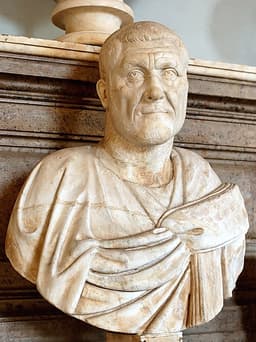
Maximinus Thrax
Emperor · Ancient
41.0Total

Napoleon Bonaparte
General · Modern
70.9Total
Basic Information
Born
173
1769
Died
238
1821
Era
Ancient
Modern
Nationality
Roman Empire
France
Occupation
Emperor
General
Civilization
Western
Western
Score Comparison
Military (10%)
45.0
94.0
Political (20%)
26.4
72.0
Influence (20%)
47.9
40.0
Legacy (20%)
38.3
80.0
Leadership (15%)
33.6
78.0
Strategy (15%)
60.0
90.0
TOTAL
41.0
70.9
Maximinus Thrax — Complete Timeline
235 AD
Campaign against the AlemanniWar◆ Major
Maximinus led a campaign against the Alemanni tribe in Germania. He defeated them in battle and drove them back across the Rhine. He then devastated their territory, earning the title 'Germanicus Maximus' from the Senate.
Germanic WarsRhine FrontierMilitary Victory
Impact: regional
Accession as EmperorPolitical Action
Maximinus was proclaimed emperor by the Pannonian legions after the assassination of Severus Alexander. He was the first emperor to rise from the ranks of the army without any senatorial background, marking a shift in imperial power dynamics.
Imperial AccessionBarracks EmperorMilitary Coup
Impact: global
238 AD
Siege of AquileiaWar◆ Major
Maximinus marched on Italy to suppress a rebellion led by the Senate and the Gordians. He besieged the city of Aquileia, which resisted his army. The siege dragged on, and Maximinus's troops grew discontented with the lack of supplies and progress.
Civil WarSiegeItaly
Impact: regionaldestructive
Assassination by His Own TroopsPolitical Action◆ Major
Maximinus was assassinated in his tent by soldiers of the Legio II Parthica during the siege of Aquileia. His death ended his three-year reign. The Praetorian Guard and the Senate then recognized the new emperors Pupienus and Balbinus.
AssassinationMilitary MutinyEnd of Reign
Impact: nationaltragic
Napoleon Bonaparte — Complete Timeline
1799 AD
Coup of 18 BrumaireOther◆ Major
Napoleon Bonaparte, with support from his brother Lucien and key political figures, overthrew the Directory in a bloodless coup. He established the Consulate with himself as First Consul, effectively becoming the ruler of France. This event ended the French Revolution's most unstable period.
French RevolutionCoupRise to Power
Impact: regional
1804 AD
Promulgation of the Napoleonic CodeOther◆ Major
Napoleon enacted the Civil Code of the French, known as the Napoleonic Code, a comprehensive set of laws that replaced the fragmented feudal legal systems. The code established legal equality, protected property rights, and secularized law. It became the basis for legal systems in many European and world countries.
Legal ReformNapoleonic CodeCivil Law
Impact: globalconstructive
1805 AD
Battle of AusterlitzWar◆ Major
Napoleon's Grande Arm
Napoleonic WarsBattleDecisive Victory
Impact: global
1812 AD
Invasion of RussiaWar◆ Major
Napoleon led the Grande Arm
Napoleonic WarsInvasionDisaster
Impact: globaldestructive
1815 AD
Battle of WaterlooWar◆ Major
Napoleon's French army was defeated by the combined forces of the Duke of Wellington's Anglo-Allied army and Gebhard Leberecht von Bl
Napoleonic WarsBattleFinal Defeat
Impact: globaldestructive
Expert Analysis
maximinus-thrax-vs-napoleon-bonaparte
# The Emperor and the Giant: Two Paths to Power, Two Destinies
On a June morning in 1815, a short man in a grey coat watched his dreams crumble in the muddy fields of Waterloo. Fourteen hundred miles away and sixteen centuries earlier, a giant of a man from Thrace lay dead in his tent, stabbed by his own soldiers outside the walls of Aquileia. Napoleon Bonaparte and Maximinus Thrax never met, never could have met, yet their stories intertwine like two threads of the same dark tapestry: the rise and fall of men who seized power through military might, only to discover that the sword that lifts a man to a throne can just as easily cut him down.
Origins
Napoleon was born in 1769 on the Mediterranean island of Corsica, a place that had only recently become French. His family was minor nobility, speaking Italian-accented French, perpetually outsiders in a nation that would one day worship him. The French Revolution, erupting when he was twenty, shattered the old order and created a world where talent mattered more than birth. A young artillery officer could become emperor—if he had the nerve, the genius, and the luck.
Maximinus Thrax came from an even more improbable place. Born around 173 in Thrace, a region considered barbaric by Rome’s elite, he was a man of immense physical stature—ancient sources claim he stood over eight feet tall, though such numbers are surely exaggerated. What is certain is that he was the first emperor to rise entirely from the ranks, a common soldier who had never even set foot in Rome before seizing power. In the Roman Empire of the third century, the old aristocratic families were losing their grip, and the legions had discovered they could make emperors as easily as they could break them.
Rise to Power
Napoleon’s ascent was a masterpiece of timing and brilliance. At twenty-four, he cleared the streets of Paris with a "whiff of grapeshot," saving the revolutionary government. At twenty-seven, he conquered Italy. By thirty, he was First Consul of France. The key turning point came in 1799 when he abandoned his army in Egypt and returned to France to stage a coup. He understood that power in revolutionary France flowed not from birth but from success, and he delivered victories like a magician pulling rabbits from a hat.
Maximinus took a cruder path. In 235, the Emperor Severus Alexander was murdered by his own troops during a campaign on the Rhine. The Pannonian legions, tired of a weak emperor who paid barbarians to go away rather than fighting them, proclaimed their commander, Maximinus, as emperor. He was the first "barracks emperor"—a man chosen by soldiers, not senators. His rise was not a matter of political maneuvering or strategic genius; it was a blunt assertion of military power over civilian authority.
Leadership & Governance
Napoleon governed with the same energy he brought to battle. He reformed French law through the Napoleonic Code, centralized the administration, built schools, and negotiated the Concordat with the Pope. His military genius is beyond dispute—his 94.0 military score and 93.0 strategy score reflect campaigns that are still studied in war colleges. He understood logistics, timing, and the psychology of his enemies. At Austerlitz in 1805, he destroyed the combined armies of Russia and Austria with a trap so elegant it seems almost fictional.
Maximinus, by contrast, was a soldier-emperor through and through. His military score of 30.6 and strategy score of 58.4 suggest a commander of modest ability, though his leadership score of 77.7 indicates he could inspire loyalty—at least for a time. He campaigned effectively against the Alemanni in 235, driving them back across the Rhine, and his physical presence on the battlefield was formidable. But he had no interest in governance. He never visited Rome, never courted the Senate, never tried to build the political consensus that might have sustained his rule. He taxed heavily to pay his soldiers and ignored everything else.
Triumph & Tragedy
Napoleon’s greatest moment was perhaps the Battle of Austerlitz, where the sun broke through the mist to reveal his trap sprung perfectly. His greatest failure was the invasion of Russia in 1812—a catastrophic miscalculation that cost him half a million men. He was exiled to Elba, returned, and then met his final defeat at Waterloo in 1815. His tragedy was that he could not stop; peace was impossible for a man who defined himself by conquest.
Maximinus’s triumph was brief. His campaign against the Alemanni succeeded, and for three years he held the empire together through sheer force. But in 238, the Senate in Rome rebelled, proclaiming Gordian I and II as emperors. Maximinus marched on Italy, besieging the city of Aquileia. The siege dragged on, supplies ran low, and the loyalty of his soldiers evaporated. In his tent, soldiers of the Legio II Parthica stabbed him to death. His tragedy was that he never understood that an emperor needs more than an army.
Character & Destiny
Napoleon was a man of immense ambition and intellect, capable of working eighteen-hour days and remembering every detail of his empire. But he was also arrogant, unable to delegate, and convinced of his own destiny. "I am not a man, but a thing," he once said. "I have no heart." This detachment allowed him to sacrifice millions for his ambitions.
Maximinus was a giant in an age of chaos, a man who believed that strength alone could rule. He was not stupid, but he was unsophisticated, a product of the camps rather than the courts. His physical size became a symbol of his approach: brute force without finesse. Where Napoleon saw the chessboard of Europe, Maximinus saw only the next battle.
Legacy
Napoleon’s legacy is enormous. The Napoleonic Code influences legal systems worldwide. His campaigns reshaped Europe, ending the Holy Roman Empire and spreading nationalism. His 82.0 influence score and 78.0 legacy score reflect a man whose shadow still falls across the modern world.
Maximinus Thrax is remembered, if at all, as a footnote—the first of the barracks emperors who plunged Rome into a fifty-year crisis. His 53.4 legacy score and 59.0 total score place him among history’s failures. He left no laws, no institutions, no lasting reforms. He proved only that an emperor made by soldiers can be unmade by them just as easily.
Conclusion
What separates Napoleon from Maximinus is not just genius but context. Napoleon rose in a revolutionary age that demanded new ideas; Maximinus rose in an age of collapse that demanded only strength. Napoleon built a system that outlasted him; Maximinus built nothing. Both men died abandoned—Napoleon on a remote island, Maximinus in a blood-soaked tent. The difference is that Napoleon’s story still teaches us something about power, ambition, and the human will to shape the world. Maximinus’s story teaches only that when the sword is the only law, the sword is always the final judge.
Rankings
🥇
Napoleon BonaparteLeader
Mil: 94.0Pol: 72.0Inf: 40.0
70.9
🥈
Maximinus Thrax
Mil: 45.0Pol: 26.4Inf: 47.9
41.0
+29.9 behind
How This Comparison Works
Algorithm
Each figure is scored on 6 dimensions (0—100 scale) based on structured historical data: Military (10%), Political (20%), Influence (20%), Legacy (20%), Leadership (15%), Strategy (15%). The weighted total produces the final ranking.
Data Sources
Scores are computed from structured sub-indicators in the database. Scale factors adjust for era (Ancient ×0.85, Modern ×1.0) and civilization size (Eastern ×1.05, Other ×0.80) to account for differences in population and military scale.
Maximum 3 Figures
Comparisons are limited to 2—3 figures to ensure readability and statistical meaningfulness.
Error Margins
±5 points per dimension — Sub-scores are derived from historical records with inherent uncertainty. Two figures within 5 points on a dimension should be considered roughly equivalent in that area.
Total Score Accuracy
±3 points overall — The weighted combination of 6 dimensions produces a total score with approximately ±3 points of uncertainty. Differences of less than 3 points are not statistically significant— the figures are effectively tied.
Known Limitations
- Historical records are incomplete and uneven across civilizations
- Figures from oral-tradition societies may be underrepresented
- Occupation labels can misclassify multi-role figures
- Scores measure capability and impact, not moral character
- Quantitative scoring is a comparison tool, not absolute truth
Capability Radar
Military (10%) — Battles & Warfare
Battles
55
95
Win Rate
50
90
Expansion
35
95
Political (20%) — Governance & Reform
Reform
15
95
Diplomacy
20
80
Economy
15
85
Influence (20%) — Cultural & Global Reach
Cultural
20
85
Global
25
90
Legacy (20%) — Historical Impact
Historical
30
95
Longevity
20
90
Leadership (15%) — Power & Stability
Tenure
20
85
Stability
10
70
Strategy (15%) — Tactics & Innovation
Strategy
40
95
Tactics
45
98
Reform
30
92
Similar Comparisons
Comments & Discussion
No comments yet. Be the first to share your thoughts!