Loading...
Maxentius vs Napoleon Bonaparte
Napoleon Bonaparte leads by 30.5 pts · 2 figures compared
…
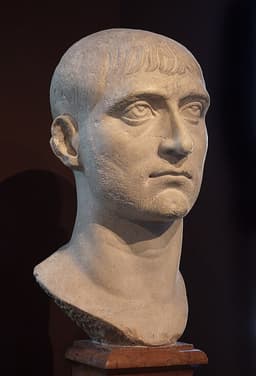
Maxentius
Emperor · Ancient
40.4Total

Napoleon Bonaparte
General · Modern
70.9Total
Basic Information
Born
278
1769
Died
312
1821
Era
Ancient
Modern
Nationality
Roman Empire
France
Occupation
Emperor
General
Civilization
Western
Western
Score Comparison
Military (10%)
45.0
94.0
Political (20%)
30.8
72.0
Influence (20%)
44.8
40.0
Legacy (20%)
35.8
80.0
Leadership (15%)
48.4
78.0
Strategy (15%)
38.6
90.0
TOTAL
40.4
70.9
Maxentius — Complete Timeline
306 AD
Proclamation as EmperorPolitical Action◆ Major
Maxentius was proclaimed emperor in Rome by the Praetorian Guard and the Roman populace, who resented the tax policies of Galerius. He initially ruled as a usurper but later claimed the title Augustus. His reign was centered in Italy and Africa, challenging the Tetrarchic system.
UsurpationTetrarchyImperial Proclamation
Impact: regional
307 AD
Alliance with MaximianPolitical Action
Maxentius allied with his father Maximian, who had come out of retirement to support him. Maximian married his daughter Fausta to Constantine to secure an alliance, but the alliance was short-lived. Maximian later betrayed Maxentius by attempting to usurp his throne.
AllianceTetrarchyFamily Politics
Impact: regional
308 AD
Construction of the Basilica of MaxentiusCultural◆ Major
Maxentius began construction of the Basilica Nova in the Roman Forum, a massive civic building with a vaulted ceiling. The basilica was completed by Constantine after Maxentius's death. It remains one of the largest ancient Roman structures and a symbol of Maxentius's building program.
ArchitectureBuilding ProgramRoman Forum
constructive
312 AD
Battle of the Milvian BridgeWar
Maxentius led his forces against Constantine at the Milvian Bridge near Rome. His army was defeated, and Maxentius drowned in the Tiber while attempting to retreat. The battle marked Constantine's rise as sole ruler of the West and was later associated with Constantine's conversion to Christianity.
Civil WarBattleConstantine
Impact: regionaltragic
Napoleon Bonaparte — Complete Timeline
1799 AD
Coup of 18 BrumaireOther◆ Major
Napoleon Bonaparte, with support from his brother Lucien and key political figures, overthrew the Directory in a bloodless coup. He established the Consulate with himself as First Consul, effectively becoming the ruler of France. This event ended the French Revolution's most unstable period.
French RevolutionCoupRise to Power
Impact: regional
1804 AD
Promulgation of the Napoleonic CodeOther◆ Major
Napoleon enacted the Civil Code of the French, known as the Napoleonic Code, a comprehensive set of laws that replaced the fragmented feudal legal systems. The code established legal equality, protected property rights, and secularized law. It became the basis for legal systems in many European and world countries.
Legal ReformNapoleonic CodeCivil Law
Impact: globalconstructive
1805 AD
Battle of AusterlitzWar◆ Major
Napoleon's Grande Arm
Napoleonic WarsBattleDecisive Victory
Impact: global
1812 AD
Invasion of RussiaWar◆ Major
Napoleon led the Grande Arm
Napoleonic WarsInvasionDisaster
Impact: globaldestructive
1815 AD
Battle of WaterlooWar◆ Major
Napoleon's French army was defeated by the combined forces of the Duke of Wellington's Anglo-Allied army and Gebhard Leberecht von Bl
Napoleonic WarsBattleFinal Defeat
Impact: globaldestructive
Expert Analysis
maxentius-vs-napoleon-bonaparte
# The Emperor Who Drowned and the Emperor Who Conquered the World
Two men, each crowned emperor in a time of chaos, yet their names echo across history with vastly different resonance. One is remembered as a world-shaking genius who redrew the map of Europe and rewrote its laws; the other is recalled, if at all, as a footnote—a man who built a magnificent basilica but lost an empire in a river. Why did Napoleon Bonaparte, born on a Mediterranean island in 1769, rise to dominate a continent, while Maxentius, born into the purple of imperial Rome in 278, sank into the Tiber and oblivion? The answer lies not in the stars, but in the marrow of their character and the currents of their age.
Origins
Maxentius was born into privilege as the son of Emperor Maximian, a man who had clawed his way to power through military might. The young Maxentius grew up in the shadow of the Tetrarchy—a system designed by Diocletian to prevent civil war by dividing power among four rulers. He was educated in the palaces of Rome and Nicomedia, taught to expect power as his birthright. But the Tetrarchy was a brittle machine, and when his father abdicated in 305, Maxentius found himself passed over for the succession. The insult festered.
Napoleon, by contrast, was born on Corsica—a rugged island that had only become French the year before his birth. His family were minor nobles, poor and resentful of French rule. Young Napoleon spoke Italian-accented French, was bullied at military school, and carried the chip of an outsider on his shoulder. Where Maxentius inherited a world, Napoleon had to conquer one. The Corsican boy devoured histories of Alexander and Caesar, dreaming not of preserving a throne but of forging one.
Rise to Power
Maxentius seized his chance in 306, when the death of Emperor Constantius I sparked a succession crisis. The Praetorian Guard, the Roman populace, and the city of Rome itself—resentful of tax policies imposed by the distant emperor Galerius—proclaimed Maxentius emperor. He did not win this throne through battle; he was handed it by a mob. He never left Italy, never campaigned beyond the Alps, and allowed his father Maximian to return from retirement in 307 to lend legitimacy. This was a ruler who relied on the city of Rome as his fortress, not his springboard.
Napoleon’s rise was a ladder of fire. In 1795, he saved the revolutionary government from a royalist mob with a "whiff of grapeshot." In 1796, at just twenty-six, he took command of a starving, ragged army in Italy and turned it into a lightning force that shattered the Austrian Empire. He did not inherit a throne; he conquered one. By 1799, he had staged a coup and made himself First Consul. By 1804, he crowned himself Emperor in Notre Dame, taking the crown from the Pope’s hands and placing it on his own head. Where Maxentius was chosen by the crowd, Napoleon chose himself.
Leadership & Governance
Maxentius ruled Italy and Africa for six years, and his governance was defensive and architectural. He built the magnificent Basilica Nova in the Roman Forum—a vaulted hall of brick and concrete that still awes visitors—but his military strategy was passive. He fortified Rome, stockpiled grain, and waited for his enemies to come to him. When Constantine marched on Italy in 312, Maxentius made a fatal error: he left his walls. His generals advised him to let Constantine besiege Rome, but Maxentius, perhaps pressured by the Roman populace or his own superstitions, marched out to meet him at the Milvian Bridge. His army was larger, but his leadership was hollow. His soldiers drowned in the Tiber; Maxentius, weighted by his armor, drowned with them.
Napoleon’s leadership was the opposite: kinetic, visionary, and ruthless. He reorganized France into departments, centralized the state, and created the Napoleonic Code—a legal system that enshrined equality before the law, property rights, and secular administration. His military genius was unmatched: he defeated the Austrians at Austerlitz in 1805, the Prussians at Jena in 1806, and the Russians at Friedland in 1807. He appointed marshals based on merit, not birth, and inspired loyalty through glory. But his political wisdom had limits. He overreached—invading Spain in 1808, Russia in 1812, and finally falling at Waterloo in 1815. His governance was brilliant, but his ambition was a fire that consumed everything, including itself.
Triumph & Tragedy
Maxentius’s greatest moment was also his last: the Battle of the Milvian Bridge. He had built a pontoon bridge across the Tiber, perhaps to trap Constantine, perhaps to allow his own retreat. When his army broke, he tried to flee across it, and the bridge collapsed. He drowned in the river, his body dragged out and paraded through Rome. His tragedy was not that he fought poorly, but that he never truly fought at all. He was a caretaker emperor in an age of conquerors.
Napoleon’s triumph was Austerlitz, where he lured the combined Russian and Austrian armies into a trap and destroyed them. His tragedy was the retreat from Moscow in 1812—400,000 men marched into Russia; fewer than 30,000 came back. He was exiled to Elba, escaped, ruled for a Hundred Days, and was finally defeated at Waterloo. His second exile on Saint Helena, a remote Atlantic island, was a slow death from stomach cancer in 1821. He died at fifty-one, alone and bitter, but still dreaming of glory.
Character & Destiny
Maxentius was cautious, superstitious, and dependent on the city of Rome. He consulted oracles and omens; he trusted the walls of the Eternal City to protect him. His character was that of a man who had never had to fight for anything, and when the moment came to fight for everything, he failed. His destiny was to be erased—his name damned by Constantine’s propaganda, his basilica finished by his conqueror, his memory reduced to a cautionary tale.
Napoleon was restless, brilliant, and insatiable. He worked eighteen-hour days, dictated letters to multiple secretaries simultaneously, and slept four hours a night. He was a man of boundless energy and boundless ego. "Impossible is a word to be found only in the dictionary of fools," he once said. His character drove him to conquer Europe, but it also drove him to invade Russia, to refuse compromise, and to fall. His destiny was to be remembered—as a titan, a tyrant, and a transformation.
Legacy
Maxentius left behind a basilica, a bridge, and a defeat. His name is known only to historians and students of the late Roman Empire. He is a warning: that birth and position cannot substitute for skill and will. His total score of 49.0, with a military score of 41.5, reflects a ruler who was neither great nor terrible—just inadequate.
Napoleon left behind the Napoleonic Code, the modern French state, the metric system, and a legend that still shapes Europe. His scores—Military 94.0, Strategy 93.0, Leadership 80.0—reflect a man who was among the greatest commanders in history. But his legacy is ambiguous: he spread revolutionary ideals of liberty and equality, but also conquest and war. He is remembered as both a liberator and a tyrant, a genius and a caution.
Conclusion
Standing at the Milvian Bridge in 312, Maxentius saw a river that would swallow him. Standing at Waterloo in 1815, Napoleon saw a battlefield that would exile him. Both men lost everything, but one lost only his life; the other lost an empire that had changed the world. The difference was not in their eras, their resources, or their opportunities. It was in their will. Maxentius waited for history to happen to him; Napoleon made history happen. And that, in the end, is the difference between a footnote and a legend.
Rankings
🥇
Napoleon BonaparteLeader
Mil: 94.0Pol: 72.0Inf: 40.0
70.9
🥈
Maxentius
Mil: 45.0Pol: 30.8Inf: 44.8
40.4
+30.5 behind
How This Comparison Works
Algorithm
Each figure is scored on 6 dimensions (0—100 scale) based on structured historical data: Military (10%), Political (20%), Influence (20%), Legacy (20%), Leadership (15%), Strategy (15%). The weighted total produces the final ranking.
Data Sources
Scores are computed from structured sub-indicators in the database. Scale factors adjust for era (Ancient ×0.85, Modern ×1.0) and civilization size (Eastern ×1.05, Other ×0.80) to account for differences in population and military scale.
Maximum 3 Figures
Comparisons are limited to 2—3 figures to ensure readability and statistical meaningfulness.
Error Margins
±5 points per dimension — Sub-scores are derived from historical records with inherent uncertainty. Two figures within 5 points on a dimension should be considered roughly equivalent in that area.
Total Score Accuracy
±3 points overall — The weighted combination of 6 dimensions produces a total score with approximately ±3 points of uncertainty. Differences of less than 3 points are not statistically significant— the figures are effectively tied.
Known Limitations
- Historical records are incomplete and uneven across civilizations
- Figures from oral-tradition societies may be underrepresented
- Occupation labels can misclassify multi-role figures
- Scores measure capability and impact, not moral character
- Quantitative scoring is a comparison tool, not absolute truth
Capability Radar
Military (10%) — Battles & Warfare
Battles
35
95
Win Rate
20
90
Expansion
10
95
Political (20%) — Governance & Reform
Reform
25
95
Diplomacy
20
80
Economy
30
85
Influence (20%) — Cultural & Global Reach
Cultural
15
85
Global
10
90
Legacy (20%) — Historical Impact
Historical
25
95
Longevity
10
90
Leadership (15%) — Power & Stability
Tenure
40
85
Stability
20
70
Strategy (15%) — Tactics & Innovation
Strategy
20
95
Tactics
25
98
Reform
15
92
Similar Comparisons
Comments & Discussion
BASILICA BUILDER6/17/2026
Calling Maxentius a footnote is lazy history. He built the Basilica Nova — that massive vaulted hall that inspired every Renaissance dome from Florence to St. Peter's. Napoleon conquered Europe with armies, sure, but Maxentius shaped architecture for a millennium. The Pantheon's shadow is long, but Maxentius' engineering was audacious: brick-faced concrete daring gravity itself. He lost the Milvian Bridge, yes, but Constantine stole his city, his basilica, his legacy. That's not failure — that's
河川之渊6/17/2026
拿破仑是陆战的巨匠,马克森提乌斯却是水战的蠢材。密尔维安桥战役那天,他本可以守住台伯河,却偏要打传统会战。结果呢?他的禁卫军被推下河,自己也淹死在铠甲里。拿破仑在奥斯特里茨知道何时会战,何时背水——但这位罗马皇帝连退路都没留。历史不嘲笑失败者,它只嘲笑那些明明有河却不会利用的蠢货。
CLASSICS CURMUDGEON6/17/2026
The real contrast isn't genius vs. mediocrity — it's legitimacy. Napoleon forged his crown at Notre-Dame, seizing it from the Pope's hands. Maxentius inherited purple, yes, but he also claimed to be restitutor urbis Romae, restoring Rome's ancient dignity. That's not nothing. Napoleon's campaigns destabilized Europe for twenty years; Maxentius' reign brought back building projects, grain distributions, even gladiatorial games. Before Constantine demonized him, Maxentius was legitimately popular
数据铁粉6/17/2026
你说拿破仑‘改写法律’?《拿破仑法典》是抄袭查士丁尼的《民法大全》,而查士丁尼法典的基础恰恰是罗马法——马克森提乌斯时代的司法体系。数据摆在这里:拿破仑打了17年仗,每次战役消耗法国国库数以亿计,最后帝国垮了。马克森提乌斯统治6年,没有大规模对外战争,经济相对稳定。谁更‘伟大’?一个把国家打破产的军事天才,不如一个维护社会福利的平庸皇帝。
REVISIONIST SCOURGE6/17/2026
Everyone repeats 'Constantine the Great' v. 'Maxentius the Tyrant' — but read Zosimus. The pagan historian says Constantine was the aggressor, invading Italy in 312 without provocation. Maxentius defended Rome peacefully until forced to fight. And Constantine? He kept Maxentius' administrative reforms, his taxation system, even his Praetorian Prefect's policy. The 'Tiber loser' becomes history's trash can: all Constantine's sins get dumped on him. Napoleon at least died on