Loading...
Maumoon Abdul Gayoom vs Ryutaro Hashimoto
Maumoon Abdul Gayoom leads by 4.6 pts · 2 figures compared
…
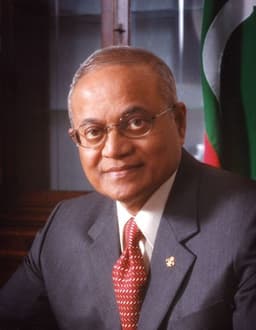
Maumoon Abdul Gayoom
Politician · Modern
55.6Total

Ryutaro Hashimoto
Politician · Modern
51.0Total
Basic Information
Born
1937
1937
Died
—
—
Era
Modern
Modern
Nationality
Maldives
Japan
Occupation
Politician
Politician
Civilization
Indian
Eastern
Score Comparison
Military (10%)
40.3
13.8
Political (20%)
68.0
62.7
Influence (20%)
53.3
57.2
Legacy (20%)
45.0
49.2
Leadership (15%)
72.0
66.0
Strategy (15%)
60.0
37.6
TOTAL
55.6
51.0
Maumoon Abdul Gayoom — Complete Timeline
1978 AD
Became President of the MaldivesPolitical Action◆ Major
Maumoon Abdul Gayoom was elected President of the Maldives, succeeding Ibrahim Nasir. He would go on to rule for 30 years, the longest tenure in the country's history, initially with popular support but later facing increasing authoritarianism.
PresidencyLongest-servingMaldives
Impact: national
1979 AD
Introduced the tourism-based economic modelReform◆ Major
Gayoom's government expanded the Maldives' tourism industry, opening numerous resorts and promoting the country as a luxury destination. This policy transformed the economy, making tourism the dominant sector and driving significant economic growth, but also creating environmental pressures.
TourismEconomic developmentMaldives
Impact: nationalconstructive
1988 AD
Survived a coup attemptPolitical Action◆ Major
A coup attempt by Sri Lankan Tamil mercenaries and Maldivian dissidents was thwarted with military assistance from India. The failed coup led to increased security measures and closer ties between the Maldives and India, while Gayoom's grip on power tightened.
Coup attemptIndia-Maldives relationsSecurity
Impact: national
2004 AD
Declared a state of emergencyPolitical Action◆ Major
Following the 2004 Indian Ocean tsunami, Gayoom declared a state of emergency. The disaster devastated the Maldives, killing over 100 people and causing massive economic damage. The government's response was criticized for being slow and inadequate.
TsunamiDisaster responseEmergency
Impact: nationaltragic
2008 AD
Lost the first multi-party presidential electionPolitical Action
After 30 years in power, Gayoom was defeated in the Maldives' first multi-party presidential election by Mohamed Nasheed. The peaceful transfer of power was a landmark for Maldivian democracy, ending Gayoom's authoritarian rule.
ElectionDemocracyTransition
Impact: national
Ryutaro Hashimoto — Complete Timeline
1978 AD
Appointed Minister of Health and WelfarePolitical Action
Ryutaro Hashimoto was appointed Minister of Health and Welfare. He gained prominence for his role in tobacco policy and later became a key figure in administrative reform.
MinisterJapanHealth Policy
Impact: national
1996 AD
Appointed Prime MinisterPolitical Action◆ Major
Ryutaro Hashimoto became Prime Minister of Japan. His tenure focused on administrative reform, economic deregulation, and fiscal consolidation to address Japan's economic stagnation.
Prime MinisterJapan1990s
Impact: national
1997 AD
Implemented Administrative ReformReform◆ Major
Hashimoto's government enacted a major administrative reform that restructured central government ministries, reducing their number from 22 to 12. This aimed to increase efficiency and reduce bureaucratic power.
Administrative ReformJapanGovernment
Impact: nationalconstructive
1998 AD
Lost Upper House ElectionPolitical Action◆ Major
Hashimoto's Liberal Democratic Party suffered a major defeat in the House of Councillors election, leading to his resignation as Prime Minister. The loss was attributed to public dissatisfaction with economic policies.
ElectionResignationJapan
Impact: nationaldestructive
Expert Analysis
Origins
Maumoon Abdul Gayoom was born on December 29, 1937, in Malé, Maldives, into a well-connected family. He studied at Al-Azhar University in Cairo and later at the American University of Beirut, returning to become a civil servant. His early career included teaching and diplomatic service, notably as a permanent representative to the UN. In contrast, Ryutaro Hashimoto was born on July 29, 1937, in Tokyo, Japan, into a political family; his father was a cabinet minister. He studied at Keio University and entered politics after a brief stint in the private sector. Hashimoto's early career was shaped by his father's legacy and his own election to the House of Representatives in 1963.
Rise to Power
Gayoom rose to power in 1978, succeeding Ibrahim Nasir as President. He was initially seen as a reformer, but quickly consolidated authority. His long tenure was marked by a series of controlled elections with no opposition, until the 2004 tsunami forced political changes. His key turning point was surviving a 1988 coup attempt by Tamil mercenaries, which strengthened his reliance on security forces. Hashimoto rose through the Liberal Democratic Party (LDP) ranks, becoming Minister of Health and Welfare in 1978, where he gained fame for tobacco policy. He later served as Minister of Transport and Minister of Finance. His major turning point was becoming Prime Minister in 1996 after the LDP's coalition victory. He was known as a reformist, aiming to streamline government.
Leadership & Governance
Gayoom's leadership was autocratic; he ruled by decree, suppressed dissent, and maintained power through patronage. His governance focused on economic development via tourism, which transformed the Maldives from a poor fishing economy to a middle-income country. However, political freedoms were limited, and human rights abuses were documented. Hashimoto's leadership was technocratic and reformist. As Prime Minister from 1996 to 1998, he implemented administrative reforms, merging 22 ministries into 12, and pursued fiscal consolidation. His style was top-down but within a democratic framework. Hashimoto's political score of 62.7 reflects his effectiveness within Japan's parliamentary system, while Gayoom's 68.0 reflects his dominance in a controlled environment.
Triumph & Tragedy
Gayoom's greatest success was the tourism-led economic transformation; tourist arrivals grew from 20,000 in 1978 to over 600,000 by 2008. His greatest failure was his authoritarian rule, which culminated in the 2004 tsunami aftermath and the 2005 pro-democracy protests. He lost the first multi-party election in 2008 to Mohamed Nasheed. Hashimoto's triumph was the administrative reform, which modernized Japan's bureaucracy. His tragedy was his inability to manage the economy; his fiscal tightening worsened a recession, leading to the LDP's 1998 Upper House loss and his resignation. Hashimoto's legacy score of 49.2 reflects mixed outcomes.
Character & Destiny
Gayoom was pragmatic and resilient, surviving multiple assassination attempts and a coup. His character was shaped by a desire for control, which ultimately led to his downfall as democratic pressures grew. Hashimoto was principled and determined, but his inflexible reform agenda cost him political support. Historical assessments note Gayoom's economic success but criticize his authoritarianism; Hashimoto is remembered as a reformer who took on entrenched interests but failed to sustain his vision.
Legacy
Gayoom's legacy is the transformation of the Maldives into a tourist paradise, but also a political system that struggled with democracy. His influence endures in the country's economic model. Hashimoto's legacy is the administrative reform that reshaped Japan's central government, though his economic policies were reversed. His political influence waned after his resignation. Gayoom's total score of 55.6 surpasses Hashimoto's 51.0, indicating broader impact.
Conclusion
Maumoon Abdul Gayoom had a greater impact due to his longer tenure and transformative economic policies that lifted the Maldives from poverty. While Hashimoto's reforms were significant, they were less transformative and his tenure shorter. Gayoom's influence on a small nation's trajectory is more profound than Hashimoto's on a larger, already developed Japan. Thus, Gayoom scores higher overall.
Rankings
🥇
Maumoon Abdul GayoomLeader
Mil: 40.3Pol: 68.0Inf: 53.3
55.6
🥈
Ryutaro Hashimoto
Mil: 13.8Pol: 62.7Inf: 57.2
51.0
+4.6 behind
How This Comparison Works
Algorithm
Each figure is scored on 6 dimensions (0—100 scale) based on structured historical data: Military (10%), Political (20%), Influence (20%), Legacy (20%), Leadership (15%), Strategy (15%). The weighted total produces the final ranking.
Data Sources
Scores are computed from structured sub-indicators in the database. Scale factors adjust for era (Ancient ×0.85, Modern ×1.0) and civilization size (Eastern ×1.05, Other ×0.80) to account for differences in population and military scale.
Maximum 3 Figures
Comparisons are limited to 2—3 figures to ensure readability and statistical meaningfulness.
Error Margins
±5 points per dimension — Sub-scores are derived from historical records with inherent uncertainty. Two figures within 5 points on a dimension should be considered roughly equivalent in that area.
Total Score Accuracy
±3 points overall — The weighted combination of 6 dimensions produces a total score with approximately ±3 points of uncertainty. Differences of less than 3 points are not statistically significant— the figures are effectively tied.
Known Limitations
- Historical records are incomplete and uneven across civilizations
- Figures from oral-tradition societies may be underrepresented
- Occupation labels can misclassify multi-role figures
- Scores measure capability and impact, not moral character
- Quantitative scoring is a comparison tool, not absolute truth
Capability Radar
Military (10%) — Battles & Warfare
Battles
42
15
Win Rate
46
19
Expansion
52
17
Political (20%) — Governance & Reform
Reform
60
85
Diplomacy
55
65
Economy
50
70
Influence (20%) — Cultural & Global Reach
Cultural
30
30
Global
30
45
Legacy (20%) — Historical Impact
Historical
40
55
Longevity
30
40
Leadership (15%) — Power & Stability
Tenure
85
60
Stability
40
55
Strategy (15%) — Tactics & Innovation
Strategy
54
23
Tactics
54
23
Reform
60
27
Similar Comparisons
Comments & Discussion
No comments yet. Be the first to share your thoughts!