Loading...
Marthanda Varma vs Napoleon Bonaparte
Napoleon Bonaparte leads by 11.7 pts · 2 figures compared
…
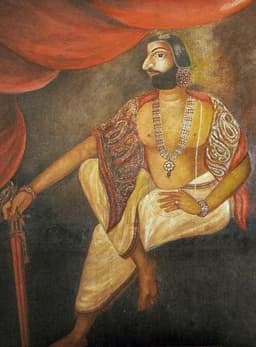
Marthanda Varma
Emperor · Modern
59.2Total

Napoleon Bonaparte
General · Modern
70.9Total
Basic Information
Born
1706
1769
Died
1758
1821
Era
Modern
Modern
Nationality
India
France
Occupation
Emperor
General
Civilization
Indian
Western
Score Comparison
Military (10%)
72.5
94.0
Political (20%)
60.0
72.0
Influence (20%)
56.4
40.0
Legacy (20%)
49.2
80.0
Leadership (15%)
66.0
78.0
Strategy (15%)
66.3
90.0
TOTAL
59.2
70.9
Marthanda Varma — Complete Timeline
1729 AD
Annexation of the Venad kingdomWar◆ Major
Marthanda Varma ascended the throne of Venad (later Travancore) and began a campaign to unify the fragmented principalities of southern Kerala. He defeated rival chieftains and annexed territories, including the powerful Ettuveetil Pillamar, consolidating his rule and laying the foundation for the Travancore kingdom.
UnificationVenadKerala
Impact: regionalconstructive
1733 AD
Construction of the Padmanabhaswamy Temple gopuramCultural
Marthanda Varma commissioned the construction of the seven-tiered gopuram (tower) of the Padmanabhaswamy Temple in Thiruvananthapuram. This architectural project symbolized his devotion and the wealth of Travancore. The temple became the state's spiritual center and a major pilgrimage site.
Temple ArchitecturePadmanabhaswamyThiruvananthapuram
Impact: regionalconstructive
1741 AD
Battle of ColachelWar◆ Major
Marthanda Varma's forces defeated the Dutch East India Company at the Battle of Colachel, a rare Asian victory over a European colonial power. The Dutch commander Eustachius De Lannoy was captured and later served as a general in the Travancore army. This victory established Travancore as a major power in southern India.
Dutch East India CompanyTravancoreColonial Conflict
Impact: regionalconstructive
1753 AD
Treaty with the British East India CompanyPolitical Action◆ Major
Marthanda Varma signed a treaty with the British East India Company, agreeing to provide military support in exchange for protection against the Dutch and other rivals. This alliance ensured Travancore's security and allowed the kingdom to focus on internal development, though it also began a dependency on the British.
British AllianceTravancoreColonial Diplomacy
Impact: regional
Napoleon Bonaparte — Complete Timeline
1799 AD
Coup of 18 BrumaireOther◆ Major
Napoleon Bonaparte, with support from his brother Lucien and key political figures, overthrew the Directory in a bloodless coup. He established the Consulate with himself as First Consul, effectively becoming the ruler of France. This event ended the French Revolution's most unstable period.
French RevolutionCoupRise to Power
Impact: regional
1804 AD
Promulgation of the Napoleonic CodeOther◆ Major
Napoleon enacted the Civil Code of the French, known as the Napoleonic Code, a comprehensive set of laws that replaced the fragmented feudal legal systems. The code established legal equality, protected property rights, and secularized law. It became the basis for legal systems in many European and world countries.
Legal ReformNapoleonic CodeCivil Law
Impact: globalconstructive
1805 AD
Battle of AusterlitzWar◆ Major
Napoleon's Grande Arm
Napoleonic WarsBattleDecisive Victory
Impact: global
1812 AD
Invasion of RussiaWar◆ Major
Napoleon led the Grande Arm
Napoleonic WarsInvasionDisaster
Impact: globaldestructive
1815 AD
Battle of WaterlooWar◆ Major
Napoleon's French army was defeated by the combined forces of the Duke of Wellington's Anglo-Allied army and Gebhard Leberecht von Bl
Napoleonic WarsBattleFinal Defeat
Impact: globaldestructive
Expert Analysis
marthanda-varma-vs-napoleon-bonaparte
# The Emperor and the Maharaja: Two Paths to Power in an Age of Empire
On a June morning in 1815, Napoleon Bonaparte stood on a muddy field near Waterloo, watching his Imperial Guard march into their final catastrophe. Across the globe, in the lush palm groves of southern India, another ruler had faced his own moment of reckoning seventy-four years earlier—but with a very different outcome. Where Napoleon met his end at the hands of a European coalition, Marthanda Varma of Travancore had crushed a European power on his own soil, forcing the Dutch East India Company to sue for peace. Both men built kingdoms from chaos; both faced the rising tide of European colonialism. One became a cautionary tale, the other a forgotten triumph. What made the difference?
Origins
Napoleon was born in 1769 on the island of Corsica, a Mediterranean backwater recently annexed by France. His family belonged to the minor nobility—poor, proud, and resentful of French rule. He spoke Italian before French, and his childhood was shaped by the humiliations of conquest. The French Revolution, which erupted when he was twenty, shattered the old order and created opportunities unimaginable under the Bourbon monarchy. For a brilliant, ambitious young man of modest birth, the revolution was a ladder.
Marthanda Varma, born in 1706, inherited a different kind of fragility. The Venad kingdom, which he would transform into Travancore, was a patchwork of warring chieftains and feuding nobles, squeezed between the powerful Zamorin of Calicut to the north and the Dutch East India Company along the coast. The young prince grew up in a world of palace intrigues, where uncles and cousins schemed for power and European traders manipulated local rivalries for profit. His education was in statecraft, temple ritual, and the martial traditions of the Nair warrior caste. Where Napoleon learned to read the battlefield, Marthanda Varma learned to read the court.
Rise to Power
Napoleon’s ascent was meteoric and public. At twenty-four, he crushed a royalist uprising in Paris with a "whiff of grapeshot." At twenty-six, he commanded the Army of Italy and conquered the peninsula in a series of dazzling campaigns. At thirty, he was First Consul of France; at thirty-five, Emperor. His rise was a product of revolutionary chaos—a system that rewarded talent over birth, and where a young artillery officer could become a master of Europe in a decade.
Marthanda Varma’s path was slower, more treacherous, and far less glamorous. He ascended the throne of Venad in 1729, at the age of twenty-three, inheriting a kingdom in name only. The real power lay with the Ettuveetil Pillamar—the "Lords of the Eight Houses"—a network of noble families who controlled the land, the trade, and the army. For the first years of his reign, Marthanda Varma fought a shadow war of assassination, bribery, and political maneuvering. He eliminated his enemies one by one, often with ruthless efficiency. By 1734, he had broken the power of the nobles and consolidated his rule. It was a quiet, bloody revolution, fought not on battlefields but in the corridors of power.
Leadership & Governance
As a military commander, Napoleon was a genius of movement and concentration. His campaigns—Austerlitz in 1805, Jena in 1806, Friedland in 1807—are still studied in war colleges. He understood that speed, surprise, and the decisive blow could defeat larger armies. But his genius was also his flaw: he could not stop. Victory demanded more victory, and each conquest created new enemies. His political reforms were more enduring: the Napoleonic Code standardized French law, the Concordat with the Pope stabilized religious relations, and the centralized state he built survived his fall.
Marthanda Varma was a different kind of strategist. His military record includes only one major battle—the Battle of Colachel in 1741—but it was a masterpiece of preparation and deception. When the Dutch East India Company landed a force of European and Indonesian troops on the Travancore coast, Marthanda Varma did not meet them in open battle. Instead, he drew them inland, cut their supply lines, and attacked when they were exhausted and isolated. The Dutch commander, Captain Eustachius De Lannoy, was captured and—in a stroke of astonishing pragmatism—was offered a choice: join the Travancore army or die. De Lannoy chose to join, and went on to train the Travancore forces in European military techniques, creating a hybrid army that would defend the kingdom for decades.
Politically, Marthanda Varma was a builder. He constructed the seven-tiered gopuram of the Padmanabhaswamy Temple in 1733, a statement of both piety and power. He reformed the administration, centralized the tax system, and created a standing army. In 1753, he signed a treaty with the British East India Company—not as a subordinate, but as an equal, agreeing to provide military support in exchange for recognition of his sovereignty. It was a diplomatic masterstroke: by aligning with the British, he neutralized the Dutch and secured his kingdom’s independence.
Triumph & Tragedy
Napoleon’s greatest triumph was Austerlitz, where he destroyed the combined armies of Austria and Russia. His greatest tragedy was the invasion of Russia in 1812, a catastrophic miscalculation that cost him half a million men. He never recovered. Waterloo was the final act, a battle he might have won if his subordinates had arrived on time, if the rain had stopped earlier, if—but history does not deal in ifs.
Marthanda Varma’s greatest triumph was Colachel, a victory that echoed across Asia. It proved that a well-led native army could defeat a European power. His tragedy was more subtle: he died in 1758, leaving no heir. He had dedicated his kingdom to the deity Padmanabhaswamy, ruling as the god’s servant, but this spiritual devotion could not solve the problem of succession. After his death, Travancore slowly declined, eventually becoming a princely state under British suzerainty.
Character & Destiny
Napoleon was driven by an insatiable hunger for glory. "I live only for posterity," he once said, and he meant it. His ambition was boundless, his energy inexhaustible, his confidence absolute. But that same ambition blinded him to the limits of power. He could conquer, but he could not consolidate. He could defeat armies, but he could not pacify nations.
Marthanda Varma was driven by a different impulse: survival. He had seen what happened to kingdoms that could not defend themselves. The Dutch had already established footholds along the Malabar coast; the British were rising; the Mughal Empire was crumbling. He understood that the only way to preserve his people’s independence was to become strong enough to be useful to the strongest power. His vision was not of conquest but of consolidation. He built a state that could endure.
Legacy
Napoleon’s legacy is written across Europe: the legal codes, the administrative systems, the national boundaries, the very idea of modern warfare. He is remembered as both liberator and tyrant, genius and fool. His name is synonymous with ambition, and his fall is a warning.
Marthanda Varma’s legacy is more contained but no less remarkable. In Kerala, he is remembered as the "Maker of Travancore," the king who defeated the Dutch and built a temple that would later yield the world’s most valuable treasure. His kingdom survived for another two centuries, a testament to his foresight. But outside India, he is almost unknown.
Conclusion
Two rulers, two worlds, two fates. Napoleon tried to conquer the world and lost everything. Marthanda Varma tried to save his kingdom and succeeded. One burned like a comet, the other burned like a lamp. In the end, perhaps the question is not who was greater, but who was wiser. Napoleon taught us how to win battles; Marthanda Varma taught us how to survive the peace. In an age of empires, that may be the more valuable lesson.
Rankings
🥇
Napoleon BonaparteLeader
Mil: 94.0Pol: 72.0Inf: 40.0
70.9
🥈
Marthanda Varma
Mil: 72.5Pol: 60.0Inf: 56.4
59.2
+11.7 behind
How This Comparison Works
Algorithm
Each figure is scored on 6 dimensions (0—100 scale) based on structured historical data: Military (10%), Political (20%), Influence (20%), Legacy (20%), Leadership (15%), Strategy (15%). The weighted total produces the final ranking.
Data Sources
Scores are computed from structured sub-indicators in the database. Scale factors adjust for era (Ancient ×0.85, Modern ×1.0) and civilization size (Eastern ×1.05, Other ×0.80) to account for differences in population and military scale.
Maximum 3 Figures
Comparisons are limited to 2—3 figures to ensure readability and statistical meaningfulness.
Error Margins
±5 points per dimension — Sub-scores are derived from historical records with inherent uncertainty. Two figures within 5 points on a dimension should be considered roughly equivalent in that area.
Total Score Accuracy
±3 points overall — The weighted combination of 6 dimensions produces a total score with approximately ±3 points of uncertainty. Differences of less than 3 points are not statistically significant— the figures are effectively tied.
Known Limitations
- Historical records are incomplete and uneven across civilizations
- Figures from oral-tradition societies may be underrepresented
- Occupation labels can misclassify multi-role figures
- Scores measure capability and impact, not moral character
- Quantitative scoring is a comparison tool, not absolute truth
Capability Radar
Military (10%) — Battles & Warfare
Battles
55
95
Win Rate
70
90
Expansion
55
95
Political (20%) — Governance & Reform
Reform
65
95
Diplomacy
55
80
Economy
60
85
Influence (20%) — Cultural & Global Reach
Cultural
45
85
Global
35
90
Legacy (20%) — Historical Impact
Historical
50
95
Longevity
45
90
Leadership (15%) — Power & Stability
Tenure
60
85
Stability
55
70
Strategy (15%) — Tactics & Innovation
Strategy
60
95
Tactics
65
98
Reform
50
92
Similar Comparisons
Comments & Discussion
No comments yet. Be the first to share your thoughts!