Loading...
Luong Cuong vs Than Shwe
Than Shwe leads by 8.9 pts · 2 figures compared
…
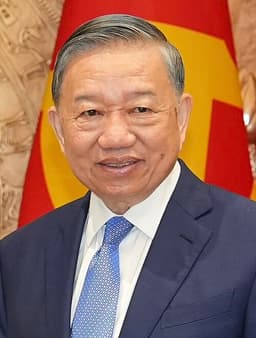
Luong Cuong
General · Modern
36.7Total

Than Shwe
General · Modern
45.6Total
Basic Information
Born
1957
1933
Died
—
—
Era
Modern
Modern
Nationality
Vietnam
Myanmar
Occupation
General
General
Civilization
Eastern
Eastern
Score Comparison
Military (10%)
25.9
50.0
Political (20%)
26.4
25.0
Influence (20%)
48.6
48.6
Legacy (20%)
36.7
40.8
Leadership (15%)
34.6
71.0
Strategy (15%)
36.8
38.6
TOTAL
36.7
45.6
Luong Cuong — Complete Timeline
2024 AD
Appointed President of VietnamPolitical Action◆ Major
Luong Cuong was appointed as President of Vietnam following the resignation of Vo Van Thuong. He was a former general and head of the General Political Department of the Vietnam People's Army.
PresidencyMilitaryVietnam
Impact: national
Role in Anti-Corruption CampaignPolitical Action
As president, Cuong continued the anti-corruption campaign known as the 'Blazing Furnace,' targeting high-ranking officials. His military background was seen as strengthening enforcement.
CorruptionCampaignMilitary
Impact: national
Than Shwe — Complete Timeline
1989 AD
Placed Aung San Suu Kyi under house arrestPolitical Action◆ Major
Than Shwe ordered the house arrest of Aung San Suu Kyi, the leader of the National League for Democracy. She remained under detention for most of the next two decades, becoming a symbol of resistance.
RepressionHouse ArrestAung San Suu Kyi
Impact: nationaldestructive
1992 AD
Seized power in a coupPolitical Action◆ Major
Than Shwe became the head of the State Law and Order Restoration Council (SLORC) after a coup that ousted the previous junta leader. He consolidated power and ruled Myanmar with an iron fist.
CoupMilitary JuntaDictatorship
Impact: nationaldestructive
2003 AD
Announced the 'Roadmap to Democracy'Political Action◆ Major
Than Shwe announced a seven-step 'Roadmap to Democracy' that included a new constitution and elections. Critics viewed it as a ploy to legitimize military rule, as the constitution reserved 25% of parliamentary seats for the military.
RoadmapConstitutionPolitical Reform
Impact: national
2007 AD
Suppressed the Saffron RevolutionPolitical Action◆ Major
Than Shwe ordered a violent crackdown on the Saffron Revolution, a series of protests led by Buddhist monks. Security forces killed dozens and arrested thousands, drawing international condemnation.
RepressionSaffron RevolutionHuman Rights
Impact: nationaldestructive
2011 AD
Stepped down from powerPolitical Action◆ Major
Than Shwe formally stepped down as head of the junta, handing power to a nominally civilian government led by Thein Sein. He remained influential behind the scenes, but his departure marked the end of direct military rule.
TransitionEnd of JuntaPolitical Change
Impact: national
Expert Analysis
Origins
Luong Cuong was born in 1957 in Phu Tho province, northern Vietnam. He joined the People's Army of Vietnam in 1975, shortly after the end of the Vietnam War. Cuong rose through the ranks of the military's political apparatus, serving in various political commissar roles. He studied at the National Defense Academy and later at the Ho Chi Minh National Academy of Politics, building a career in military-political affairs. His background was shaped by the communist party's structure, where military and political careers intertwined.
Than Shwe was born in 1933 in Kyaukse, British Burma. He joined the Burmese army in 1953 and trained at the Officers Training School in Bahtoo. Shwe served in the 4th Infantry Battalion and later commanded the 99th Light Infantry Division. He was involved in the 1962 coup that brought Ne Win to power and subsequently held various military commands. His early career was defined by ethnic insurgencies and internal conflicts, where he gained a reputation for ruthless efficiency.
Rise to Power
Luong Cuong's rise was gradual within the military-political hierarchy. He became a member of the Central Committee of the Communist Party of Vietnam in 2011 and was appointed head of the General Political Department of the Vietnam People's Army in 2016. This role made him the top political officer in the military. In 2021, he was elected to the Politburo. His ascent culminated in March 2024 when he was appointed President of Vietnam following the resignation of Vo Van Thuong, who stepped down amid the ongoing anti-corruption campaign. Cuong's military background and party loyalty positioned him as a compromise candidate.
Than Shwe seized power more directly. In 1992, he became chairman of the State Law and Order Restoration Council (SLORC) after ousting General Saw Maung, who was deemed unfit. Shwe consolidated control by purging rivals and expanding the military's role in the economy. He oversaw the transition to the State Peace and Development Council (SPDC) in 1997, maintaining absolute control. His rise was marked by the suppression of the 1988 pro-democracy uprising and the subsequent house arrest of Aung San Suu Kyi in 1989.
Leadership & Governance
Luong Cuong's leadership style is institutional and procedural. As president, his powers are largely ceremonial, with real authority resting with the Communist Party General Secretary. Cuong continued the 'Blazing Furnace' anti-corruption campaign, which targeted high-ranking officials including former President Vo Van Thuong and National Assembly Chairwoman Nguyen Thi Kim Ngan. His governance focuses on party discipline and maintaining stability. Cuong scored 34.6 in leadership, reflecting his constrained role within Vietnam's collective leadership system.
Than Shwe ruled as an autocrat. He centralized power, controlled the judiciary, and suppressed dissent. His governance was characterized by the 'Roadmap to Democracy' announced in 2003, a seven-step plan that critics argued was designed to entrench military power. Under his rule, Myanmar remained isolated, with economic sanctions imposed by Western nations. He personally ordered the violent crackdown on the Saffron Revolution in 2007, where security forces killed dozens of protesters, mostly Buddhist monks. Shwe's leadership score of 71.0 reflects his direct control over the state apparatus.
Triumph & Tragedy
Luong Cuong's greatest success is maintaining stability in Vietnam's complex political environment. His continuation of the anti-corruption campaign has removed many corrupt officials, though it has also been used to sideline political rivals. His tragedy is the limited impact he can have due to the ceremonial nature of his office. His military score of 25.9 and political score of 26.4 indicate his relative lack of independent power.
Than Shwe's triumph was maintaining military rule for nearly two decades despite internal and external pressure. He successfully managed the transition to a nominally civilian government in 2011, ensuring the military's continued influence through reserved parliamentary seats and control of key ministries. His tragedy is the legacy of repression: the suppression of democracy, the house arrest of Aung San Suu Kyi, and the economic stagnation of Myanmar. His military score of 50.0 and strategy score of 38.6 reflect his tactical but ultimately flawed approach.
Character & Destiny
Luong Cuong is characterized as a loyal party soldier, cautious and methodical. His career in political commissar roles suggests a focus on ideological conformity rather than personal ambition. His destiny is to serve as a figurehead within Vietnam's collective leadership.
Than Shwe is described as reclusive, secretive, and ruthless. He avoided public appearances and ruled through a small circle of generals. His character, shaped by decades of civil war, led him to prioritize control over development. His destiny was to be the last strongman of Myanmar's junta era, stepping down in 2011 but remaining influential behind the scenes until his death in 2025.
Legacy
Luong Cuong's legacy is tied to Vietnam's anti-corruption campaign. He is likely to be remembered as a transitional figure who upheld party discipline. His influence score of 48.6 and legacy score of 36.7 suggest limited long-term impact beyond Vietnam's borders.
Than Shwe's legacy is more profound. He left Myanmar with a deeply entrenched military-political class, a constitution that guarantees military power, and a shattered civil society. His decision to step down and allow a managed transition has been cited as a rare example of a junta leader voluntarily ceding power, though the transition was a facade. His legacy score of 40.8 and influence score of 48.6 reflect his significant but negative impact on Myanmar's development.
Conclusion
Than Shwe had greater impact than Luong Cuong, both in scope and duration. While Cuong operates within a stable, one-party state where individual leaders have limited influence, Shwe personally shaped Myanmar's trajectory for decades. Shwe's decisions—the house arrest of Suu Kyi, the suppression of the Saffron Revolution, the 2008 constitution—continue to affect Myanmar's politics today. Cuong's role, by contrast, is largely procedural. The score gap of 8.9 points (Than Shwe 45.6 vs Cuong 36.7) reflects this disparity in power and impact. Than Shwe's leadership score of 71.0 dwarfs Cuong's 34.6, underscoring his direct control. In the contest between a transitional figurehead and a dominating autocrat, the latter's mark on history is unmistakably larger.
Rankings
🥇
Than ShweLeader
Mil: 50.0Pol: 25.0Inf: 48.6
45.6
🥈
Luong Cuong
Mil: 25.9Pol: 26.4Inf: 48.6
36.7
+8.9 behind
How This Comparison Works
Algorithm
Each figure is scored on 6 dimensions (0—100 scale) based on structured historical data: Military (10%), Political (20%), Influence (20%), Legacy (20%), Leadership (15%), Strategy (15%). The weighted total produces the final ranking.
Data Sources
Scores are computed from structured sub-indicators in the database. Scale factors adjust for era (Ancient ×0.85, Modern ×1.0) and civilization size (Eastern ×1.05, Other ×0.80) to account for differences in population and military scale.
Maximum 3 Figures
Comparisons are limited to 2—3 figures to ensure readability and statistical meaningfulness.
Error Margins
±5 points per dimension — Sub-scores are derived from historical records with inherent uncertainty. Two figures within 5 points on a dimension should be considered roughly equivalent in that area.
Total Score Accuracy
±3 points overall — The weighted combination of 6 dimensions produces a total score with approximately ±3 points of uncertainty. Differences of less than 3 points are not statistically significant— the figures are effectively tied.
Known Limitations
- Historical records are incomplete and uneven across civilizations
- Figures from oral-tradition societies may be underrepresented
- Occupation labels can misclassify multi-role figures
- Scores measure capability and impact, not moral character
- Quantitative scoring is a comparison tool, not absolute truth
Capability Radar
Military (10%) — Battles & Warfare
Battles
10
10
Win Rate
10
15
Expansion
10
10
Political (20%) — Governance & Reform
Reform
10
5
Diplomacy
10
10
Economy
10
10
Influence (20%) — Cultural & Global Reach
Cultural
10
10
Global
10
10
Legacy (20%) — Historical Impact
Historical
10
20
Longevity
10
15
Leadership (15%) — Power & Stability
Tenure
10
70
Stability
10
20
Strategy (15%) — Tactics & Innovation
Strategy
10
25
Tactics
10
20
Reform
10
15
Similar Comparisons
Comments & Discussion
No comments yet. Be the first to share your thoughts!