Loading...
This comparison has not been analyzed yet.
One-time AI generation (~1 minute). Scores and timeline are already available below.
Louis Faidherbe vs Rodion Malinovsky
Louis Faidherbe leads by 6.7 pts · 2 figures compared
…

Louis Faidherbe
General · Modern
66.7Total
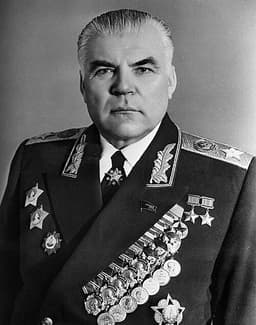
Rodion Malinovsky
General · Modern
60.0Total
Basic Information
Born
1818
1898
Died
1889
1967
Era
Modern
Modern
Nationality
France
USSR
Occupation
General
General
Civilization
Western
Western
Score Comparison
Military (10%)
78.0
72.0
Political (20%)
70.3
45.0
Influence (20%)
65.0
55.0
Legacy (20%)
55.0
58.0
Leadership (15%)
77.2
72.0
Strategy (15%)
68.0
69.6
TOTAL
66.7
60.0
Louis Faidherbe — Complete Timeline
1854 AD
Governor of SenegalPolitical Action
Louis Faidherbe was appointed Governor of Senegal in 1854. He transformed the colony from a small trading post into a modern colonial state. He expanded French control inland, built infrastructure, and established the city of Dakar as a major port.
SenegalColonialismAdministration
Impact: regionalconstructive
1855 AD
Construction of the Dakar-Niger RailwayInvention◆ Major
Faidherbe initiated the construction of the Dakar-Niger Railway, which connected the port of Dakar to the interior of French West Africa. The railway facilitated the export of peanuts and other goods, transforming Senegal's economy and solidifying French control over the region.
SenegalInfrastructureEconomic Development
Impact: regionalconstructive
1856 AD
Founding of the École des OtagesCultural
Faidherbe founded the
SenegalEducationAssimilation
constructive
1857 AD
Military Campaigns against the Toucouleur EmpireWar◆ Major
Faidherbe led military campaigns against the Toucouleur Empire under El Hajj Umar Tall, who resisted French expansion. Faidherbe's forces defeated the Toucouleur at the Battle of M
SenegalWarColonial Expansion
Impact: regionaldestructive
1870 AD
Franco-Prussian War ServiceWar◆ Major
During the Franco-Prussian War, Faidherbe was recalled to France and given command of the Army of the North. He fought several battles against the Prussian forces, including the Battle of St. Quentin in 1871, where his army was defeated. He was later criticized for his performance.
FranceFranco-Prussian WarMilitary Command
Impact: nationaltragic
Rodion Malinovsky — Complete Timeline
1939 AD
Battle of Khalkhin GolWar
Malinovsky served as a division commander during the Battle of Khalkhin Gol against Japan. The Soviet victory secured the eastern border and influenced Japan's decision not to attack the USSR in 1941.
Soviet-Japanese Border WarMongoliaVictory
Impact: regional
1942 AD
Battle of StalingradWar◆ Major
Malinovsky commanded the 2nd Guards Army during the Battle of Stalingrad. His forces played a key role in repelling the German relief attempt by Army Group Don, securing the encirclement of the 6th Army.
World War IIStalingradCounteroffensive
Impact: global
1944 AD
Jassy–Kishinev OffensiveWar◆ Major
Malinovsky commanded the 2nd Ukrainian Front in the Jassy
World War IIRomaniaOffensive
Impact: regional
1957 AD
Appointment as Minister of Defense of the USSRPolitical Action◆ Major
Malinovsky was appointed Minister of Defense of the USSR by Khrushchev. He oversaw the Soviet military during the Cold War, including the Cuban Missile Crisis and the buildup of nuclear forces.
Cold WarDefense MinisterNuclear
Impact: global
This comparison has not been analyzed yet.
One-time AI generation (~1 minute). Scores and timeline are already available below.
Rankings
🥇
Louis FaidherbeLeader
Mil: 78.0Pol: 70.3Inf: 65.0
66.7
🥈
Rodion Malinovsky
Mil: 72.0Pol: 45.0Inf: 55.0
60.0
+6.7 behind
How This Comparison Works
Algorithm
Each figure is scored on 6 dimensions (0—100 scale) based on structured historical data: Military (10%), Political (20%), Influence (20%), Legacy (20%), Leadership (15%), Strategy (15%). The weighted total produces the final ranking.
Data Sources
Scores are computed from structured sub-indicators in the database. Scale factors adjust for era (Ancient ×0.85, Modern ×1.0) and civilization size (Eastern ×1.05, Other ×0.80) to account for differences in population and military scale.
Maximum 3 Figures
Comparisons are limited to 2—3 figures to ensure readability and statistical meaningfulness.
Error Margins
±5 points per dimension — Sub-scores are derived from historical records with inherent uncertainty. Two figures within 5 points on a dimension should be considered roughly equivalent in that area.
Total Score Accuracy
±3 points overall — The weighted combination of 6 dimensions produces a total score with approximately ±3 points of uncertainty. Differences of less than 3 points are not statistically significant— the figures are effectively tied.
Known Limitations
- Historical records are incomplete and uneven across civilizations
- Figures from oral-tradition societies may be underrepresented
- Occupation labels can misclassify multi-role figures
- Scores measure capability and impact, not moral character
- Quantitative scoring is a comparison tool, not absolute truth
Capability Radar
Military (10%) — Battles & Warfare
Battles
65
85
Win Rate
70
80
Expansion
90
75
Political (20%) — Governance & Reform
Reform
80
55
Diplomacy
75
60
Economy
70
50
Influence (20%) — Cultural & Global Reach
Cultural
55
45
Global
65
60
Legacy (20%) — Historical Impact
Historical
70
65
Longevity
60
50
Leadership (15%) — Power & Stability
Tenure
70
65
Stability
65
60
Strategy (15%) — Tactics & Innovation
Strategy
80
85
Tactics
75
78
Reform
85
70
Similar Comparisons
Comments & Discussion
No comments yet. Be the first to share your thoughts!