Loading...
Lloyd Fredendall vs Napoleon Bonaparte
Napoleon Bonaparte leads by 31.3 pts · 2 figures compared
…
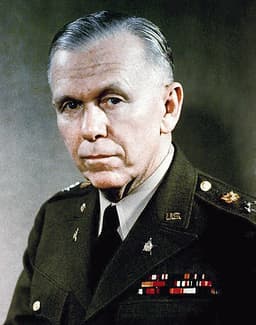
Lloyd Fredendall
General · Modern
39.6Total

Napoleon Bonaparte
General · Modern
70.9Total
Basic Information
Born
1883
1769
Died
1963
1821
Era
Modern
Modern
Nationality
United States
France
Occupation
General
General
Civilization
Western
Western
Score Comparison
Military (10%)
45.0
94.0
Political (20%)
26.4
72.0
Influence (20%)
47.1
40.0
Legacy (20%)
39.2
80.0
Leadership (15%)
33.5
78.0
Strategy (15%)
45.0
90.0
TOTAL
39.6
70.9
Lloyd Fredendall — Complete Timeline
1943 AD
Command at the Battle of Kasserine PassWar◆ Major
Fredendall commanded II Corps during the Battle of Kasserine Pass in Tunisia. His forces were defeated by German forces under Erwin Rommel, suffering heavy casualties and a significant territorial loss. This defeat led to his relief from command.
World War IINorth African CampaignDefeat
Impact: regionaldestructive
Relief from Command of II CorpsPolitical Action◆ Major
Following the defeat at Kasserine Pass, General Dwight D. Eisenhower relieved Fredendall of his command of II Corps. Fredendall was reassigned to training commands in the United States for the remainder of the war.
World War IICommand ChangeCareer End
Impact: nationaltragic
Napoleon Bonaparte — Complete Timeline
1799 AD
Coup of 18 BrumaireOther◆ Major
Napoleon Bonaparte, with support from his brother Lucien and key political figures, overthrew the Directory in a bloodless coup. He established the Consulate with himself as First Consul, effectively becoming the ruler of France. This event ended the French Revolution's most unstable period.
French RevolutionCoupRise to Power
Impact: regional
1804 AD
Promulgation of the Napoleonic CodeOther◆ Major
Napoleon enacted the Civil Code of the French, known as the Napoleonic Code, a comprehensive set of laws that replaced the fragmented feudal legal systems. The code established legal equality, protected property rights, and secularized law. It became the basis for legal systems in many European and world countries.
Legal ReformNapoleonic CodeCivil Law
Impact: globalconstructive
1805 AD
Battle of AusterlitzWar◆ Major
Napoleon's Grande Arm
Napoleonic WarsBattleDecisive Victory
Impact: global
1812 AD
Invasion of RussiaWar◆ Major
Napoleon led the Grande Arm
Napoleonic WarsInvasionDisaster
Impact: globaldestructive
1815 AD
Battle of WaterlooWar◆ Major
Napoleon's French army was defeated by the combined forces of the Duke of Wellington's Anglo-Allied army and Gebhard Leberecht von Bl
Napoleonic WarsBattleFinal Defeat
Impact: globaldestructive
Expert Analysis
lloyd-fredendall-vs-napoleon-bonaparte
# The General and the Emperor: Two Paths of Command
On a cold February morning in 1943, somewhere in the dusty hills of Tunisia, General Lloyd Fredendall sat in a command post carved deep into a ravine—so far from the front lines that his own officers could barely find him. He was issuing orders by radio to units he had never visited, deploying battalions on maps he had not personally surveyed. A hundred and thirty years earlier, another general stood on a ridge in Italy, staring through a telescope at enemy positions he had reconnoitered himself the night before, his coat mud-spattered, his voice hoarse from shouting commands. One man would be remembered as a titan of history; the other, as a footnote. What made the difference? Not merely talent, but something deeper: the marriage of ambition to preparation, of vision to execution.
Origins
Napoleon Bonaparte was born in 1769 on the island of Corsica, a place of fierce independence and ancient vendettas. His family was minor nobility, but poor. He spoke French with a thick Italian accent and was mocked at military school for his small stature and provincial manners. Yet he devoured books on military history, artillery mathematics, and the campaigns of Alexander and Caesar. The French Revolution, which shattered the old order, was his great opportunity: a young man of talent could rise faster than any nobleman.
Lloyd Fredendall was born in 1883 in Wyoming, the son of a Union Army veteran who became a lawyer. He attended West Point, graduating in 1907 near the bottom of his class—113th out of 115. He served in the Philippine Insurrection and on the Mexican border, but never commanded troops in combat before World War II. His rise came through administrative assignments and the patronage of senior officers who valued loyalty over brilliance. By 1942, he was a major general, but he had never led men under fire.
Rise to Power
Napoleon’s ascent was meteoric. At 24, he drove the British out of Toulon with a daring artillery plan. At 26, he crushed a royalist uprising in Paris with a "whiff of grapeshot." At 27, he took command of the starving, mutinous Army of Italy and turned it into a weapon of conquest. He did not wait for opportunity—he seized it. When the Directory offered him command of an invasion of Egypt, he accepted, not because it was wise, but because it fed his ambition.
Fredendall’s rise was slower, more bureaucratic. He commanded the 4th Infantry Division during training exercises in Louisiana, where his performance was competent but unremarkable. In 1942, General Dwight Eisenhower selected him to lead II Corps in the invasion of North Africa—Operation Torch. The choice was political: Fredendall had friends in Washington, and Eisenhower needed experienced commanders quickly. But experience in paperwork is not the same as experience in war.
Leadership & Governance
Napoleon governed through presence. He rode among his troops, ate their rations, and knew their names. At Austerlitz in 1805, he personally directed the artillery placement that lured the Austro-Russian army into a trap. His Napoleonic Code reformed French law, establishing equality before the law and merit-based advancement. He created a system of prefects and central administration that survives in France today. His leadership was a blend of genius and tyranny: he demanded total loyalty and crushed dissent, but he also rewarded talent without regard to birth.
Fredendall governed through distance. He established his command post 70 miles behind the front, in a cave carved by engineers at enormous effort. He issued orders without visiting the terrain, and his subordinates complained he was invisible. At Kasserine Pass in February 1943, he placed units in exposed positions, failed to coordinate artillery support, and ignored intelligence warnings. When German General Erwin Rommel struck, the American forces collapsed in chaos. Fredendall’s men fought bravely, but their commander had failed them.
Triumph & Tragedy
Napoleon’s greatest triumph was Austerlitz, where he destroyed a larger coalition army and forced the Holy Roman Empire to dissolve. His greatest tragedy was the invasion of Russia in 1812: 600,000 men marched east; fewer than 40,000 returned. He never recovered from that hubris. Exiled to Elba, he escaped and ruled for 100 days—only to meet final defeat at Waterloo in 1815, where his old genius flickered but failed.
Fredendall’s triumph was never his own. After Kasserine, Eisenhower replaced him with General George Patton, who immediately visited the front lines, tightened discipline, and restored morale. Within weeks, Patton’s II Corps won a decisive victory at El Guettar. Fredendall was sent back to the United States, given training commands, and never saw combat again. His tragedy was not defeat—it was irrelevance. He was a man promoted beyond his capacity, and history recorded his failure with clinical precision.
Character & Destiny
Napoleon was driven by an insatiable hunger for glory. "Impossible is a word to be found only in the dictionary of fools," he said. His confidence was absolute, his energy inexhaustible. But that same hunger led him to overreach—to invade Spain, to march on Moscow, to refuse peace when it was offered. His character was his fate: he could not stop because he could not imagine a world without him at its center.
Fredendall was cautious, deferential, and risk-averse. He feared making mistakes more than he feared losing. In his memoir, Eisenhower wrote that Fredendall "simply was not tough enough for the job." His character was also his fate: he lacked the fire to inspire men, the curiosity to learn the ground, and the courage to lead from the front. He was a peacetime general in a war that demanded warriors.
Legacy
Napoleon’s legacy is vast. The Napoleonic Code influenced legal systems across Europe and the Americas. His military innovations—the corps system, mass conscription, rapid maneuver—shaped warfare for a century. He is remembered as both a liberator and a tyrant, a genius and a cautionary tale. His name is synonymous with ambition.
Fredendall’s legacy is a single word: Kasserine. Military historians study his failure as a case study in poor command. His name appears in books on leadership as an example of what not to do. He was not evil, nor incompetent in every respect—but he was the wrong man at the wrong moment, and the price was paid in American lives.
Conclusion
Standing on the ridge at Austerlitz, Napoleon could see the battlefield whole—every unit, every hill, every retreating enemy. He understood that war is not a diagram on a map but a human drama of fear and courage, hunger and exhaustion. Fredendall, in his cave, saw only radio signals and reports. He forgot that soldiers bleed. In the end, the difference between the emperor and the forgotten general was not intelligence or luck. It was the willingness to stand where the bullets fly, to feel the mud on your boots, and to know that your men are watching. History forgives many failures. It never forgives absence.
Rankings
🥇
Napoleon BonaparteLeader
Mil: 94.0Pol: 72.0Inf: 40.0
70.9
🥈
Lloyd Fredendall
Mil: 45.0Pol: 26.4Inf: 47.1
39.6
+31.3 behind
How This Comparison Works
Algorithm
Each figure is scored on 6 dimensions (0—100 scale) based on structured historical data: Military (10%), Political (20%), Influence (20%), Legacy (20%), Leadership (15%), Strategy (15%). The weighted total produces the final ranking.
Data Sources
Scores are computed from structured sub-indicators in the database. Scale factors adjust for era (Ancient ×0.85, Modern ×1.0) and civilization size (Eastern ×1.05, Other ×0.80) to account for differences in population and military scale.
Maximum 3 Figures
Comparisons are limited to 2—3 figures to ensure readability and statistical meaningfulness.
Error Margins
±5 points per dimension — Sub-scores are derived from historical records with inherent uncertainty. Two figures within 5 points on a dimension should be considered roughly equivalent in that area.
Total Score Accuracy
±3 points overall — The weighted combination of 6 dimensions produces a total score with approximately ±3 points of uncertainty. Differences of less than 3 points are not statistically significant— the figures are effectively tied.
Known Limitations
- Historical records are incomplete and uneven across civilizations
- Figures from oral-tradition societies may be underrepresented
- Occupation labels can misclassify multi-role figures
- Scores measure capability and impact, not moral character
- Quantitative scoring is a comparison tool, not absolute truth
Capability Radar
Military (10%) — Battles & Warfare
Battles
10
95
Win Rate
5
90
Expansion
0
95
Political (20%) — Governance & Reform
Reform
5
95
Diplomacy
10
80
Economy
5
85
Influence (20%) — Cultural & Global Reach
Cultural
5
85
Global
5
90
Legacy (20%) — Historical Impact
Historical
15
95
Longevity
10
90
Leadership (15%) — Power & Stability
Tenure
20
85
Stability
5
70
Strategy (15%) — Tactics & Innovation
Strategy
5
95
Tactics
5
98
Reform
5
92
Similar Comparisons
Comments & Discussion
No comments yet. Be the first to share your thoughts!