Loading...
Liu Zhang vs Zhang Qian
Zhang Qian leads by 0.6 pts · 2 figures compared
…

Liu Zhang
Politician · Ancient
45.8Total
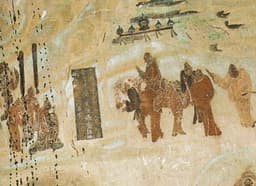
Zhang Qian
Explorer · Ancient
46.4Total
Basic Information
Born
162
-164
Died
219
-114
Era
Ancient
Ancient
Nationality
China
China
Occupation
Politician
Explorer
Civilization
Eastern
Eastern
Score Comparison
Military (10%)
38.3
40.3
Political (20%)
35.1
26.4
Influence (20%)
48.6
58.3
Legacy (20%)
39.2
55.0
Leadership (15%)
62.2
40.9
Strategy (15%)
54.3
39.5
TOTAL
45.8
46.4
Liu Zhang — Complete Timeline
211 AD
Invitation to Liu BeiPolitical Action◆ Major
Liu Zhang invited Liu Bei into Yi Province to help defend against the threat from Zhang Lu in Hanzhong. This decision allowed Liu Bei to establish a foothold in the province, ultimately leading to Liu Zhang's downfall.
Three KingdomsMiscalculationInvasion
Impact: regionaldestructive
214 AD
Surrender of Yi Province to Liu BeiPolitical Action◆ Major
Liu Zhang, Governor of Yi Province, surrendered to Liu Bei after a prolonged siege of Chengdu. Liu Bei had been invited to help defend against Zhang Lu but instead turned on Liu Zhang, taking control of the province.
Three KingdomsSurrenderLoss of Power
Impact: regionaldestructive
Zhang Qian — Complete Timeline
138 BC
First Mission to the Western RegionsPolitical Action◆ Major
Emperor Wu of Han dispatched Zhang Qian as an envoy to seek an alliance with the Yuezhi against the Xiongnu. Zhang Qian was captured by the Xiongnu and held for ten years, but eventually escaped and continued his journey.
Han DynastyDiplomacyExploration
Impact: regional
128 BC
Reached the Yuezhi and BactriaPolitical Action◆ Major
After escaping Xiongnu captivity, Zhang Qian traveled through Ferghana and Sogdiana to reach the Yuezhi in Bactria. The Yuezhi declined an alliance against the Xiongnu, but Zhang Qian gathered detailed intelligence on Central Asian states.
Han DynastyExplorationCentral Asia
Impact: regional
126 BC
Return to Chang'an and Report to Emperor WuPolitical Action◆ Major
Zhang Qian returned to the Han capital after 13 years, bringing detailed accounts of the Western Regions, including the kingdoms of Dayuan, Kangju, and Daxia. His report provided the first reliable Chinese knowledge of Central Asia and spurred Han expansion.
Han DynastyExplorationDiplomacy
Impact: regionalconstructive
115 BC
Second Mission to the WusunPolitical Action◆ Major
Emperor Wu sent Zhang Qian on a second mission to the Wusun in the Ili Valley to secure an alliance against the Xiongnu. Zhang Qian established diplomatic relations and opened the Silk Road trade routes between China and Central Asia.
Han DynastySilk RoadDiplomacy
Impact: regionalconstructive
Expert Analysis
Origins
Liu Zhang was born in 162 CE into the Han imperial family, the son of Liu Yan, who served as the governor of Yi Province. His early life was steeped in the politics of the declining Eastern Han dynasty. He inherited the governorship of Yi Province after his father's death in 194 CE, but lacked the military and political acumen to maintain control, relying heavily on advisors and local warlords.
Zhang Qian was born around 164 BCE in Hanzhong, central China, during the early Western Han dynasty. His family was of modest means, but he secured a position as a court attendant, which provided him with the education and connections to be selected by Emperor Wu for a diplomatic mission. His formative years were shaped by the constant threat of the Xiongnu confederation, which dominated the northern frontier.
Rise to Power
Liu Zhang's rise was largely hereditary. He became governor of Yi Province at age 32, controlling one of the wealthiest and most strategically secure regions of Han China. However, his rule was immediately challenged by internal dissent and external threats from Zhang Lu in Hanzhong. In 211 CE, he made the fateful decision to invite Liu Bei, a powerful warlord, into Yi to help defend against Zhang Lu. This invitation, intended to bolster his position, instead led to his downfall as Liu Bei turned against him.
Zhang Qian's rise was based on merit and imperial favor. In 138 BCE, Emperor Wu dispatched him as an envoy to the Yuezhi tribe in the west to form an alliance against the Xiongnu. Zhang Qian was captured by the Xiongnu and held for over a decade, but he escaped and continued his mission. He reached the Yuezhi in Bactria, though they declined an alliance. After a perilous journey, he returned to Chang'an in 125 BCE with invaluable intelligence about the Western Regions, earning Emperor Wu's admiration and further commissions.
Leadership & Governance
Liu Zhang's leadership was characterized by indecision and reliance on subordinates. He scored 62.2 in leadership, reflecting his ability to maintain a stable province initially, but his governance lacked strategic vision. He failed to suppress local rebellions effectively and allowed factionalism among his advisors. His decision to invite Liu Bei, despite warnings from his generals, demonstrated poor judgment. In contrast, Zhang Qian's leadership score of 40.9 is lower, but his governance was not about ruling a region; rather, he led expeditions through hostile territory. His diplomatic approach—offering gifts, learning local languages, and respecting customs—enabled him to establish relations with multiple kingdoms, a form of governance through influence.
Triumph & Tragedy
Liu Zhang's greatest success was maintaining control of Yi Province for over a decade, a region that remained prosperous under his nominal rule. His surrender to Liu Bei in 214 CE after a siege of Chengdu was a tragic failure, as he lost his domain and was reduced to a pensioner. He died in 219 CE, overshadowed by Liu Bei's rise. Zhang Qian's triumph was his first mission, which opened the Silk Road and brought back detailed reports of Central Asia, including the existence of the Roman Empire indirectly. His tragedy was the failure to secure alliances against the Xiongnu; both the Yuezhi and later the Wusun declined. Additionally, his second mission to the Wusun in 115 BCE yielded only nominal tribute.
Character & Destiny
Liu Zhang was cautious and trusting, but these traits proved fatal. He ignored advice to kill Liu Bei and instead welcomed him, leading to his own deposition. His character was that of a caretaker rather than an ambitious leader, destined to be a pawn in the Three Kingdoms power struggles. Zhang Qian, on the other hand, displayed extraordinary perseverance and curiosity. His captivity did not break him; he learned about the regions he passed through and maintained his mission. His destiny was to be a pioneer, remembered for opening the Silk Road, even though his immediate diplomatic goals failed.
Legacy
Liu Zhang's legacy is minimal; he is remembered primarily as the governor who lost Yi Province to Liu Bei, a footnote in the Romance of the Three Kingdoms. His influence score of 48.6 reflects his limited impact. Zhang Qian's legacy is immense. His reports provided the first reliable Chinese knowledge of Central Asia, India, and the Middle East. He is credited with opening the Silk Road, which facilitated trade and cultural exchange for centuries. His influence score of 58.3 and legacy score of 55.0 reflect his enduring significance. The Han dynasty's expansion into the Western Regions, including the establishment of the Protectorate of the Western Regions in 60 BCE, built directly on Zhang Qian's groundwork.
Conclusion
Zhang Qian had a greater impact on world history. While Liu Zhang's political decisions affected the course of the Three Kingdoms period, Zhang Qian's explorations fundamentally changed the trajectory of Eurasian connectivity. With a total score of 46.4 compared to Liu Zhang's 45.8, Zhang Qian's influence and legacy scores are markedly higher. His work led to the Silk Road, which shaped global history for over a millennium. Liu Zhang's surrender was a local event; Zhang Qian's journeys were a global catalyst.
Rankings
🥇
Zhang QianLeader
Mil: 40.3Pol: 26.4Inf: 58.3
46.4
🥈
Liu Zhang
Mil: 38.3Pol: 35.1Inf: 48.6
45.8
+0.6 behind
How This Comparison Works
Algorithm
Each figure is scored on 6 dimensions (0—100 scale) based on structured historical data: Military (10%), Political (20%), Influence (20%), Legacy (20%), Leadership (15%), Strategy (15%). The weighted total produces the final ranking.
Data Sources
Scores are computed from structured sub-indicators in the database. Scale factors adjust for era (Ancient ×0.85, Modern ×1.0) and civilization size (Eastern ×1.05, Other ×0.80) to account for differences in population and military scale.
Maximum 3 Figures
Comparisons are limited to 2—3 figures to ensure readability and statistical meaningfulness.
Error Margins
±5 points per dimension — Sub-scores are derived from historical records with inherent uncertainty. Two figures within 5 points on a dimension should be considered roughly equivalent in that area.
Total Score Accuracy
±3 points overall — The weighted combination of 6 dimensions produces a total score with approximately ±3 points of uncertainty. Differences of less than 3 points are not statistically significant— the figures are effectively tied.
Known Limitations
- Historical records are incomplete and uneven across civilizations
- Figures from oral-tradition societies may be underrepresented
- Occupation labels can misclassify multi-role figures
- Scores measure capability and impact, not moral character
- Quantitative scoring is a comparison tool, not absolute truth
Capability Radar
Military (10%) — Battles & Warfare
Battles
10
27
Win Rate
5
28
Expansion
5
31
Political (20%) — Governance & Reform
Reform
20
10
Diplomacy
30
85
Economy
25
30
Influence (20%) — Cultural & Global Reach
Cultural
15
70
Global
5
70
Legacy (20%) — Historical Impact
Historical
20
80
Longevity
15
80
Leadership (15%) — Power & Stability
Tenure
40
10
Stability
20
10
Strategy (15%) — Tactics & Innovation
Strategy
15
37
Tactics
10
37
Reform
5
42
Similar Comparisons
Comments & Discussion
No comments yet. Be the first to share your thoughts!