Loading...
Liu Bei vs Napoleon Bonaparte
Napoleon Bonaparte leads by 11.4 pts · 2 figures compared
…
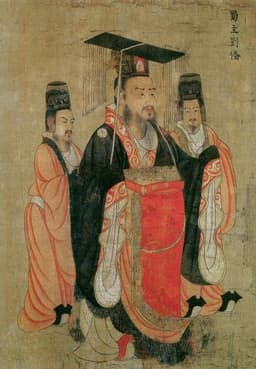
Liu Bei
Emperor · Ancient
59.5Total

Napoleon Bonaparte
General · Modern
70.9Total
Basic Information
Born
161
1769
Died
223
1821
Era
Ancient
Modern
Nationality
China
France
Occupation
Emperor
General
Civilization
Eastern
Western
Score Comparison
Military (10%)
65.0
94.0
Political (20%)
68.0
72.0
Influence (20%)
55.0
40.0
Legacy (20%)
72.0
80.0
Leadership (15%)
40.0
78.0
Strategy (15%)
50.0
90.0
TOTAL
59.5
70.9
Liu Bei — Complete Timeline
208 AD
Battle of Red CliffsWar
Liu Bei and Sun Quan's combined forces defeated Cao Cao's navy at the Battle of Red Cliffs on the Yangtze River. The victory prevented Cao Cao from conquering the south and allowed Liu Bei to establish a base in Jing Province.
BattleRed CliffsAlliance
Impact: regional
Formation of the Alliance with Sun QuanPolitical Action◆ Major
Liu Bei, advised by Zhuge Liang, formed a strategic alliance with Sun Quan of Wu against the northern warlord Cao Cao. This alliance was crucial for the upcoming Battle of Red Cliffs and established the basis for the Three Kingdoms division.
AllianceSun QuanCao Cao
Impact: regionalconstructive
214 AD
Conquest of Yi ProvinceWar◆ Major
Liu Bei, with the help of Zhuge Liang and other advisors, conquered Yi Province (modern Sichuan) from its ruler Liu Zhang. This provided a wealthy and defensible base for his kingdom, fulfilling a key part of the Longzhong Plan.
ConquestYi ProvinceShu Han
Impact: regional
221 AD
Proclamation of the Shu Han DynastyPolitical Action
After Cao Pi usurped the Han throne, Liu Bei declared himself emperor of Shu Han in Chengdu, claiming to continue the Han dynasty. This formalized the Three Kingdoms period, with Shu, Wei, and Wu as rival states.
DynastyShu HanThree Kingdoms
Impact: national
222 AD
Battle of YilingWar◆ Major
Liu Bei launched a campaign against Sun Quan to avenge the death of his sworn brother Guan Yu. His forces were defeated by Wu general Lu Xun at the Battle of Yiling, resulting in heavy losses and Liu Bei's retreat to Baidi Cheng.
BattleDefeatWu
Impact: regionaltragic
Napoleon Bonaparte — Complete Timeline
1799 AD
Coup of 18 BrumaireOther◆ Major
Napoleon Bonaparte, with support from his brother Lucien and key political figures, overthrew the Directory in a bloodless coup. He established the Consulate with himself as First Consul, effectively becoming the ruler of France. This event ended the French Revolution's most unstable period.
French RevolutionCoupRise to Power
Impact: regional
1804 AD
Promulgation of the Napoleonic CodeOther◆ Major
Napoleon enacted the Civil Code of the French, known as the Napoleonic Code, a comprehensive set of laws that replaced the fragmented feudal legal systems. The code established legal equality, protected property rights, and secularized law. It became the basis for legal systems in many European and world countries.
Legal ReformNapoleonic CodeCivil Law
Impact: globalconstructive
1805 AD
Battle of AusterlitzWar◆ Major
Napoleon's Grande Arm
Napoleonic WarsBattleDecisive Victory
Impact: global
1812 AD
Invasion of RussiaWar◆ Major
Napoleon led the Grande Arm
Napoleonic WarsInvasionDisaster
Impact: globaldestructive
1815 AD
Battle of WaterlooWar◆ Major
Napoleon's French army was defeated by the combined forces of the Duke of Wellington's Anglo-Allied army and Gebhard Leberecht von Bl
Napoleonic WarsBattleFinal Defeat
Impact: globaldestructive
Expert Analysis
liu-bei-vs-napoleon-bonaparte
### The Emperor of Hearts and the Emperor of Eagles
On a summer day in 208, on the muddy banks of the Yangtze River, two men watched their fleets burn. One, a middle-aged wanderer with long arms and a reputation for weeping, had just won the battle that would define his life. The other, a short Corsican artillery officer, would not be born for another 561 years. Yet the question that haunts their stories is the same: What makes a man worthy of a crown? Liu Bei of Shu Han and Napoleon Bonaparte of France both rose from obscurity to near-total power, yet their paths—and their ends—could not be more different. One founded a dynasty on the strength of his virtue; the other built an empire on the force of his will. Their lives are a study in the two great engines of history: character and ambition.
### Origins
Liu Bei was born in 161, in a minor branch of the Han imperial family, but his father died young, and the family fell into poverty. He earned his living weaving straw mats and selling sandals. He was, by his own admission, a man of no great learning. Yet he carried within him a burning sense of duty: the Han dynasty, which had ruled for four centuries, was crumbling under corruption and rebellion. Liu Bei’s greatness lay not in his birth but in his belief that he could restore it. He was a man shaped by loss—loss of status, loss of stability, loss of the world his ancestors had built.
Napoleon Bonaparte, born in 1769 on the island of Corsica, was the son of a minor nobleman. He spoke French with a thick Italian accent and was mocked by his classmates at military school. Where Liu Bei’s world was ancient and collapsing, Napoleon’s was modern and exploding. The French Revolution had shattered the old order, opening a path for talent over birth. Napoleon’s Corsican identity made him an outsider, but the Revolution made him a Frenchman. He was shaped not by nostalgia for a lost dynasty, but by a hunger to create a new one.
### Rise to Power
Liu Bei’s rise was slow, patient, and marked by repeated failure. He wandered from warlord to warlord, offering his sword and his reputation for loyalty. He had no territory of his own until he was nearly fifty. His turning point came in 208, when he formed an alliance with Sun Quan of Wu. Advised by the brilliant strategist Zhuge Liang, Liu Bei understood that he could not win alone. The Battle of Red Cliffs that year was not his victory alone—it was a coalition victory. But Liu Bei’s genius was in making himself the man others would follow.
Napoleon’s rise was meteoric. By 1796, at age twenty-six, he was commanding the French Army of Italy, winning battle after battle through speed, deception, and devastating artillery. His turning point came not in a single battle but in a series of lightning campaigns that shattered the old monarchies of Europe. In 1799, he seized power in a coup d’état. He did not wait for history to hand him a throne; he took it.
### Leadership & Governance
Liu Bei ruled by example. He treated his officers as brothers—literally, in the case of his sworn brothers Guan Yu and Zhang Fei. His leadership style was personal and emotional. When his people suffered, he wept. When his generals failed, he forgave. His political wisdom was embodied in his alliance with Sun Quan: he knew when to yield. His military genius was not in grand strategy but in resilience. He lost battles, but he never lost his army’s loyalty.
Napoleon ruled by law and force. The Napoleonic Code, introduced in 1804, standardized French law, abolished feudal privileges, and spread the ideals of the Revolution across Europe. His military genius was absolute: he redefined warfare, using corps of soldiers that could march independently and concentrate at the decisive point. He won the Battle of Austerlitz in 1805 with a brilliance that still stuns historians. But his political wisdom had a fatal flaw: he could not stop. He could not compromise. He could not share power.
### Triumph & Tragedy
Liu Bei’s greatest moment was his proclamation of the Shu Han dynasty in 221, after Cao Pi usurped the Han throne. He claimed to be the legitimate successor, the restorer of the Han. It was the fulfillment of a lifetime of wandering. But his tragedy came swiftly. In 222, he launched a campaign against Sun Quan to avenge the death of Guan Yu. At the Battle of Yiling, his army was burned in a trap of fire and retreat. He died the following year, broken in body and spirit, having destroyed his own kingdom’s best army.
Napoleon’s greatest moment was perhaps his coronation as Emperor in 1804, when he took the crown from the Pope’s hands and placed it on his own head. It was a gesture of supreme self-confidence. His tragedy was the Russian campaign of 1812. He invaded with over 600,000 men; fewer than 100,000 returned. His final defeat at Waterloo in 1815 ended the Napoleonic Wars. He died in exile on Saint Helena, a prisoner of the British, abandoned by the generals he had made great.
### Character & Destiny
Liu Bei’s character was defined by *ren*—benevolence, the Confucian virtue of human-heartedness. He believed that a ruler must earn the loyalty of his people through kindness and justice. This made him slow to act and prone to emotional decisions, like the disastrous Yiling campaign. But it also made him beloved. When he fled his enemies, he refused to abandon the civilians who followed him, even though it slowed his army. That choice cost him time, but it built a legend.
Napoleon’s character was defined by *will*. He believed that a man could shape his own destiny through sheer force of intellect and ambition. This made him fast, decisive, and terrifyingly effective. But it also made him arrogant. He could not tolerate rivals, could not accept limits, could not stop expanding. His character drove him to conquer Europe, and his character drove him to lose it.
### Legacy
Liu Bei’s legacy is moral. In Chinese culture, he is remembered as the ideal ruler—the man who valued righteousness over power. The novel *Romance of the Three Kingdoms* immortalized him as the hero of the story. His kingdom fell within sixty years of his death, but his name lives on in every story of a just leader who fights for the people.
Napoleon’s legacy is institutional. He reshaped Europe. His legal code, his administrative system, his military tactics—they outlasted his empire. He is remembered as a genius and a tyrant, a liberator and a conqueror. His tomb in Paris is a monument to glory, but also to the cost of glory.
### Conclusion
Liu Bei and Napoleon both rose from nothing. Both wore crowns. Both died defeated. But they embody two different answers to the same ancient question. Liu Bei built his empire on the loyalty of others; Napoleon built his on the force of himself. One was a man who wept for his people; the other, a man who wept only for himself. In the end, Liu Bei’s kingdom fell, but his story inspired centuries. Napoleon’s empire fell, and his reforms changed the world. Which is greater? Perhaps the answer lies not in their victories, but in what they left behind in the hearts of those who remember them.
Rankings
🥇
Napoleon BonaparteLeader
Mil: 94.0Pol: 72.0Inf: 40.0
70.9
🥈
Liu Bei
Mil: 65.0Pol: 68.0Inf: 55.0
59.5
+11.4 behind
How This Comparison Works
Algorithm
Each figure is scored on 6 dimensions (0—100 scale) based on structured historical data: Military (10%), Political (20%), Influence (20%), Legacy (20%), Leadership (15%), Strategy (15%). The weighted total produces the final ranking.
Data Sources
Scores are computed from structured sub-indicators in the database. Scale factors adjust for era (Ancient ×0.85, Modern ×1.0) and civilization size (Eastern ×1.05, Other ×0.80) to account for differences in population and military scale.
Maximum 3 Figures
Comparisons are limited to 2—3 figures to ensure readability and statistical meaningfulness.
Error Margins
±5 points per dimension — Sub-scores are derived from historical records with inherent uncertainty. Two figures within 5 points on a dimension should be considered roughly equivalent in that area.
Total Score Accuracy
±3 points overall — The weighted combination of 6 dimensions produces a total score with approximately ±3 points of uncertainty. Differences of less than 3 points are not statistically significant— the figures are effectively tied.
Known Limitations
- Historical records are incomplete and uneven across civilizations
- Figures from oral-tradition societies may be underrepresented
- Occupation labels can misclassify multi-role figures
- Scores measure capability and impact, not moral character
- Quantitative scoring is a comparison tool, not absolute truth
Capability Radar
Military (10%) — Battles & Warfare
Battles
65
95
Win Rate
55
90
Expansion
65
95
Political (20%) — Governance & Reform
Reform
45
95
Diplomacy
75
80
Economy
50
85
Influence (20%) — Cultural & Global Reach
Cultural
80
85
Global
70
90
Legacy (20%) — Historical Impact
Historical
85
95
Longevity
85
90
Leadership (15%) — Power & Stability
Tenure
60
85
Stability
55
70
Strategy (15%) — Tactics & Innovation
Strategy
70
95
Tactics
60
98
Reform
40
92
Similar Comparisons
Comments & Discussion
BattleAxeBarbarossa6/17/2026
Liu Bei's "virtue" is just a PR campaign for illiterate warlords. Any serious military historian knows Napoleon actually fought and won over 60 battles, while Liu Bei's greatest "victory" at Red Cliffs was orchestrated by Zhou Yu and Zhuge Liang. His so-called "righteousness" cost him Yiling—a disastrous campaign that mirrors Napoleon's own hubris at Waterloo. Ambition wins empires; tears just make good novels.
墨守史官6/17/2026
拿儒家道德去比拿破仑,这本身就荒唐。刘备的“仁义”不过是乱世里的政治表演,他投靠过公孙瓒、陶谦、曹操、袁绍、刘表——换老板比换鞋子还勤。拿破仑至少坦坦荡荡权力至上,不假装流泪。真要论道德,拿破仑的《民法典》比刘备的“汉室正统”靠谱一万倍。少看三国演义,多读点欧洲史。
DataPointDuellist6/17/2026
The numbers don't lie: Napoleon ruled an empire of 70+ million people; Liu Bei never controlled more than 1-2 million. Napoleon's armies marched from Madrid to Moscow; Liu Bei's domain barely stretched across modern Sichuan. On a per-capita basis, Napoleon's impact on global history is orders of magnitude larger. Comparing them is like comparing a supernova to a campfire—both give light, but let's not pretend they're in the same league.
孤城铁粉6/17/2026
你们这些数字党根本不懂什么叫“人心所向”。刘备逃亡时带着十万百姓渡江,宁死不弃民;拿破仑呢?为了省粮食把伤员丢在俄国雪地里等死。刘备的成都从来不是巴黎那种消费天堂,但他死后蜀地百姓自发祭祀几百年。拿破仑的死亡人数乘以十都比不上他的政治遗产脆弱。数字可以衡量疆域,却称不出人心的重量。
CorsicanCritic6/17/2026
Let's be honest: Napoleon's military genius is overrated by Western textbooks. His Egyptian campaign? A strategic disaster. His Continental System? Collapsed his economy. Meanwhile, Liu Bei built a legitimate kingdom out of nothing but reputation and wooden sandals. Napoleon inherited a revolutionary army and a broken state—Liu Bei started with two sworn brothers and a dream. That's not just different; that's a different category of achievement entirely.