Loading...
Levon I of Armenia vs Napoleon Bonaparte
Napoleon Bonaparte leads by 13.0 pts · 2 figures compared
…
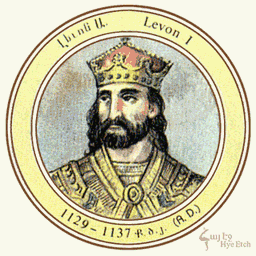
Levon I of Armenia
Emperor · Medieval
57.9Total

Napoleon Bonaparte
General · Modern
70.9Total
Basic Information
Born
1150
1769
Died
1219
1821
Era
Medieval
Modern
Nationality
Cilician Armenia
France
Occupation
Emperor
General
Civilization
Middle Eastern
Western
Score Comparison
Military (10%)
55.0
94.0
Political (20%)
68.0
72.0
Influence (20%)
57.2
40.0
Legacy (20%)
49.2
80.0
Leadership (15%)
64.0
78.0
Strategy (15%)
60.0
90.0
TOTAL
57.9
70.9
Levon I of Armenia — Complete Timeline
1187 AD
Conquest of the Cilician PlainWar◆ Major
Levon I conquered the fertile Cilician plain from the Byzantine Empire and local Armenian lords. This territorial expansion provided the economic and agricultural base for his kingdom and secured access to the Mediterranean coast.
ConquestCiliciaExpansion
Impact: regionalconstructive
1190 AD
Alliance with the Crusader StatesPolitical Action◆ Major
Levon I formed alliances with the Crusader states, particularly the Principality of Antioch. He married Sibylla of Lusignan and established close ties with the Knights Templar and Hospitaller, integrating Cilician Armenia into the Crusader political system.
AllianceCrusadersDiplomacy
Impact: regionalconstructive
1198 AD
Promulgation of the Code of Levon IReform◆ Major
Levon I issued a legal code that combined Armenian customary law with elements of Byzantine and Frankish law. This code regulated feudal relations, trade, and criminal justice, and became the foundation of Cilician Armenian jurisprudence.
Legal CodeReformFeudalism
Impact: nationalconstructive
Coronation as First King of Armenian CiliciaPolitical Action◆ Major
Levon I was crowned King of Armenian Cilicia by the Archbishop of Mainz, acting on behalf of the Holy Roman Emperor, and also received recognition from the Byzantine Empire. This coronation established the Kingdom of Cilician Armenia as a sovereign state.
CoronationCilician ArmeniaSovereignty
Impact: regionalconstructive
Napoleon Bonaparte — Complete Timeline
1799 AD
Coup of 18 BrumaireOther◆ Major
Napoleon Bonaparte, with support from his brother Lucien and key political figures, overthrew the Directory in a bloodless coup. He established the Consulate with himself as First Consul, effectively becoming the ruler of France. This event ended the French Revolution's most unstable period.
French RevolutionCoupRise to Power
Impact: regional
1804 AD
Promulgation of the Napoleonic CodeOther◆ Major
Napoleon enacted the Civil Code of the French, known as the Napoleonic Code, a comprehensive set of laws that replaced the fragmented feudal legal systems. The code established legal equality, protected property rights, and secularized law. It became the basis for legal systems in many European and world countries.
Legal ReformNapoleonic CodeCivil Law
Impact: globalconstructive
1805 AD
Battle of AusterlitzWar◆ Major
Napoleon's Grande Arm
Napoleonic WarsBattleDecisive Victory
Impact: global
1812 AD
Invasion of RussiaWar◆ Major
Napoleon led the Grande Arm
Napoleonic WarsInvasionDisaster
Impact: globaldestructive
1815 AD
Battle of WaterlooWar◆ Major
Napoleon's French army was defeated by the combined forces of the Duke of Wellington's Anglo-Allied army and Gebhard Leberecht von Bl
Napoleonic WarsBattleFinal Defeat
Impact: globaldestructive
Expert Analysis
levon-i-of-armenia-vs-napoleon-bonaparte
### The Emperor and the King: Napoleon and Levon I, Two Paths to Power
History rarely offers a more jarring contrast than the one between Napoleon Bonaparte and Levon I of Armenia. One was a titan of the modern age, a Corsican artilleryman who shook the foundations of Europe, his name forever linked with cannon fire, the Napoleonic Code, and a final, bleak exile on a remote Atlantic island. The other was a medieval prince of a forgotten kingdom, crowning himself in a mountain fortress, forging alliances with Crusaders, and leaving behind a legal code that would outlast his dynasty. Napoleon’s world was one of mass armies and revolutionary ideology; Levon’s was a chessboard of feudal lords, Byzantine intrigues, and the distant, fading glow of the Crusades. What drove these two men—separated by six centuries and a gulf of circumstance—to such different ends? The answer lies not just in their talents, but in the worlds they were born to rule.
### Origins
Napoleon Bonaparte was born in 1769 on the island of Corsica, a recent French acquisition, into a minor noble family with little wealth. His rise was a product of the French Revolution, a cataclysm that shattered the old order and opened doors to talent, not birth. He was a child of the Enlightenment and the cannon’s roar, a man forged in the crucible of a society at war with itself. Levon I, born in 1150, emerged from an entirely different universe. Cilician Armenia was a fragile Christian kingdom clinging to the eastern edge of the Mediterranean, a sliver of land caught between the Byzantine Empire, the Seljuk Turks, and the arriving Crusader states. Levon was a prince of the Rubenid dynasty, his legitimacy rooted in bloodlines and the ancient memory of a lost Armenian homeland. Where Napoleon’s ambition was fueled by the chaos of revolution, Levon’s was shaped by the slow, patient diplomacy of a small kingdom fighting for survival.
### Rise to Power
Napoleon’s ascent was a sprint. By 1796, at just 26, he was commanding the French army in Italy, winning dazzling victories that made him a national hero. His path was paved with military genius—his 93.0 strategy score is no abstraction—and a ruthless political instinct. He seized power in the 1799 coup of 18 Brumaire, crowning himself Emperor in 1804. Levon’s rise was a slow, deliberate climb. He spent decades consolidating power in the Cilician plain, a process marked not by a single, brilliant campaign but by a series of careful moves. The conquest of the Cilician plain in 1187 was a major event, but it was a war of attrition against Byzantine and local lords, not a lightning strike. Levon’s true genius was political. He understood that his kingdom’s survival depended on alliances, and he cultivated them with the patience of a master. In 1190, he formed an alliance with the Crusader Principality of Antioch, marrying Sibylla of Lusignan to seal the bond. His coronation in 1198, sanctioned by the Holy Roman Emperor and the Archbishop of Mainz, was a diplomatic triumph, not a military one. Napoleon conquered his throne; Levon negotiated his.
### Leadership & Governance
As rulers, their styles were as different as their paths. Napoleon was a modernizer, a centralizer, a man who believed in order imposed from above. His Napoleonic Code, promulgated in 1804, was a revolutionary document that swept away feudal privileges, established legal equality, and influenced civil law across Europe. He was a military commander of breathtaking skill—his 94.0 military score speaks to his ability to move armies like pieces on a board—but his governance was autocratic and often brittle. He trusted his own genius above all else. Levon, by contrast, was a synthesizer. His great reform, the Code of Levon I, promulgated in 1198, was a fusion of Armenian customary law, Byzantine imperial decrees, and Frankish feudal practices. It was a legal framework designed to hold a diverse, multi-ethnic kingdom together, not to remake the world. His political score of 81.4, higher than Napoleon’s 75.0, reflects a ruler who understood that in a small, vulnerable state, power came from persuasion, compromise, and the careful balancing of factions, not from the force of a single will.
### Triumph & Tragedy
Napoleon’s greatest triumph was his empire at its height in 1810, stretching from the Pyrenees to the Polish plains. His greatest tragedy was its collapse, sealed by the disastrous invasion of Russia in 1812 and the final defeat at Waterloo in 1815. He died in exile on Saint Helena, a prisoner of the world he had once dominated. Levon’s triumph was more modest but more enduring: the establishment of a recognized Armenian kingdom that would last for nearly two centuries after his death. His tragedy was that he could not fully secure his dynasty’s future against the rising power of the Mamluks and Mongols. He died in 1219, his kingdom intact but always precarious, a candle in a storm.
### Character & Destiny
Napoleon’s character was a force of nature: brilliant, arrogant, insatiable. He believed in his own star, and his decisions—from the sale of Louisiana to the invasion of Russia—were gambles born of supreme self-confidence. That self-confidence was his greatest strength and his fatal flaw. Levon was a different kind of ruler: pragmatic, patient, and deeply aware of his kingdom’s limits. He did not seek to conquer the world; he sought to keep his world from being conquered. His strategy score of 58.0, far below Napoleon’s 93.0, reflects not a lack of skill but a different kind of strategic thinking—one focused on survival, not expansion. Napoleon’s destiny was to burn bright and fast; Levon’s was to endure.
### Legacy
Napoleon’s legacy is immense and contested. He is remembered as a military genius, a lawgiver, and a tyrant, his name synonymous with ambition and its limits. His influence score of 82.0 and legacy score of 78.0 reflect a figure who reshaped Europe, for better and worse. Levon’s legacy is quieter but no less profound for his people. He is remembered as the first king of a reborn Armenia, a symbol of national identity and resilience. His influence score of 72.6 and legacy score of 62.1 reflect a figure who mattered deeply to a specific world, even if that world has largely faded from the global stage.
### Conclusion
In the end, Napoleon and Levon I offer two models of leadership, each perfectly adapted to its time. Napoleon was a storm, reshaping the landscape in a single, violent season. Levon was a foundation, laid stone by stone, meant to hold against the earthquakes of history. One sought to conquer the world; the other sought to build a home for his people. Neither fully succeeded, but both left marks that time has not erased. Perhaps the deepest lesson is this: greatness is not a single measure. It is the shape of the ambition, the nature of the age, and the quiet, stubborn persistence of a legacy that outlasts the man.
Rankings
🥇
Napoleon BonaparteLeader
Mil: 94.0Pol: 72.0Inf: 40.0
70.9
🥈
Levon I of Armenia
Mil: 55.0Pol: 68.0Inf: 57.2
57.9
+13.0 behind
How This Comparison Works
Algorithm
Each figure is scored on 6 dimensions (0—100 scale) based on structured historical data: Military (10%), Political (20%), Influence (20%), Legacy (20%), Leadership (15%), Strategy (15%). The weighted total produces the final ranking.
Data Sources
Scores are computed from structured sub-indicators in the database. Scale factors adjust for era (Ancient ×0.85, Modern ×1.0) and civilization size (Eastern ×1.05, Other ×0.80) to account for differences in population and military scale.
Maximum 3 Figures
Comparisons are limited to 2—3 figures to ensure readability and statistical meaningfulness.
Error Margins
±5 points per dimension — Sub-scores are derived from historical records with inherent uncertainty. Two figures within 5 points on a dimension should be considered roughly equivalent in that area.
Total Score Accuracy
±3 points overall — The weighted combination of 6 dimensions produces a total score with approximately ±3 points of uncertainty. Differences of less than 3 points are not statistically significant— the figures are effectively tied.
Known Limitations
- Historical records are incomplete and uneven across civilizations
- Figures from oral-tradition societies may be underrepresented
- Occupation labels can misclassify multi-role figures
- Scores measure capability and impact, not moral character
- Quantitative scoring is a comparison tool, not absolute truth
Capability Radar
Military (10%) — Battles & Warfare
Battles
45
95
Win Rate
50
90
Expansion
50
95
Political (20%) — Governance & Reform
Reform
50
95
Diplomacy
60
80
Economy
45
85
Influence (20%) — Cultural & Global Reach
Cultural
45
85
Global
30
90
Legacy (20%) — Historical Impact
Historical
55
95
Longevity
40
90
Leadership (15%) — Power & Stability
Tenure
55
85
Stability
40
70
Strategy (15%) — Tactics & Innovation
Strategy
45
95
Tactics
40
98
Reform
35
92
Similar Comparisons
Comments & Discussion
CannonLawyer6/17/2026
Napoleon had the Code, Levon had the Datastanagirk’, and I know which one shaped modern law. Levon I was no Bonaparte, but he played a smarter long game. Napoleon’s codes were brilliant, yes, but they were imposed by bayonets and lasted only as long as his empire. Levon’s legal code outlived his dynasty—and it kept Armenian identity alive for centuries. That’s legacy, not just cannon smoke.
DataSkeptic6/17/2026
This comparison inflates Levon I because he’s obscure and exotic. Let’s be real: Napoleon commanded armies of half a million, reshaped continental borders, and his battles still fill textbooks. Levon’s “major” engagements were skirmishes involving a few thousand knights and crossbowmen. Scale matters. Romanticizing a minor Crusader king as Napoleon’s equal is historical clickbait, not analysis. We don’t need to balance every narrative.
ClassicsScholar6/17/2026
What fascinates me is the timing. Napoleon rose when Europe was shedding feudal structures; Levon I ruled when feudalism was the only game. Napoleon could manipulate mass media and revolutionary zeal. Levon had to charm Byzantine emperors, Papal legates, and Mongol envoys—a far more delicate diplomatic dance. Both were master tacticians, but Levon’s stage was multidimensional, not just a battlefield. That requires different genius.
历史侦探6/17/2026
拿破仑是个赌徒,总爱押上一切,滑铁卢就是代价。利奥一世相反,他从不动摇国本——当十字军衰落时,他火速与埃及马穆鲁克谈判保境安民。拿破仑的剧本是“输赢决定一切”,利奥的剧本是“活着才有明天”。谁能想到,那位山巅小国的王,在国际博弈上比科西嘉炮手更老辣?这才是真功夫。
帝国冷眼6/17/2026
拿拿破仑比利奥,本身就是侮辱。拿破仑用二十年改写了世界史,利奥统治期连塞浦路斯都打不下来。你说他编了法典?那是为了对抗拜占庭法,本质上是个文化防御工程。拿破仑的法典征服了半个欧洲的司法系统。一个是征服者,一个是勉强守成的领主,别拿乡村地主跟帝国皇帝比。