Loading...
Leopold I vs Rudolf II
Leopold I leads by 21.9 pts · 2 figures compared
…
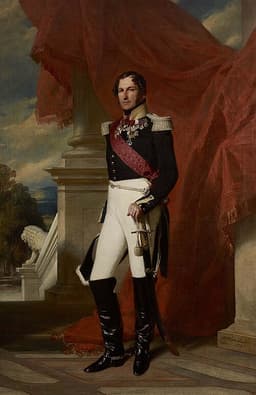
Leopold I
Emperor · Modern
68.0Total

Rudolf II
Emperor · Modern
46.1Total
Basic Information
Born
1640
1552
Died
1705
1612
Era
Modern
Modern
Nationality
Holy Roman Empire
Holy Roman Empire
Occupation
Emperor
Emperor
Civilization
Western
Western
Score Comparison
Military (10%)
74.0
20.0
Political (20%)
78.0
33.6
Influence (20%)
72.0
58.0
Legacy (20%)
52.0
43.3
Leadership (15%)
75.0
55.3
Strategy (15%)
66.3
54.3
TOTAL
68.0
46.1
Leopold I — Complete Timeline
1683 AD
Battle of ViennaWar
Leopold I, as Holy Roman Emperor, organized the relief of Vienna from the Ottoman siege. A combined imperial, Polish, and German army under John III Sobieski defeated the Ottoman forces, halting Ottoman expansion into Central Europe and marking the beginning of the Great Turkish War.
Great Turkish WarOttoman EmpireSiege
Impact: global
1688 AD
War of the Grand AllianceWar◆ Major
Leopold I led the Holy Roman Empire in the War of the Grand Alliance against Louis XIV of France. The conflict, fought across Europe and the colonies, ended with the Treaty of Ryswick in 1697, which confirmed French gains but checked French expansion.
War of the Grand AllianceLouis XIVTreaty of Ryswick
Impact: global
1699 AD
Treaty of KarlowitzPolitical Action
Leopold I's forces, under Prince Eugene of Savoy, defeated the Ottomans, leading to the Treaty of Karlowitz. The treaty ceded Hungary, Transylvania, and Slavonia to the Habsburgs, establishing Austria as a major European power and ending Ottoman dominance in the region.
Great Turkish WarTreatyHabsburg Expansion
Impact: regional
Rudolf II — Complete Timeline
1580 AD
Patronage of Alchemy and the ArtsCultural◆ Major
Rudolf II established a renowned court in Prague, attracting alchemists, astronomers, and artists from across Europe. He employed Tycho Brahe and Johannes Kepler, and his art collection was one of the largest in Europe. However, his obsession with the occult and neglect of governance led to political instability.
PatronageAlchemyPrague Court
Impact: globalconstructive
1593 AD
Long Turkish WarWar◆ Major
Rudolf II's reign saw the outbreak of the Long Turkish War against the Ottoman Empire, which lasted from 1593 to 1606. The war was costly and indecisive, draining the imperial treasury and leading to unrest among the nobility. Rudolf's inability to effectively manage the war contributed to his declining authority.
Long Turkish WarOttoman EmpireMilitary Conflict
Impact: regionaldestructive
1609 AD
Letter of MajestyPolitical Action◆ Major
Rudolf II issued the Letter of Majesty, granting religious freedom to the Protestant estates of Bohemia. This was a concession forced upon him by the Bohemian nobility, who threatened rebellion. The Letter of Majesty became a key document in the lead-up to the Thirty Years' War, as it was later revoked by Rudolf's successor.
Letter of MajestyReligious FreedomBohemia
Impact: regionalprogressive
1611 AD
Deposition as King of BohemiaPolitical Action◆ Major
Rudolf II was deposed as King of Bohemia by his brother Matthias, who had the support of the Habsburg family and the Bohemian estates. Rudolf was forced to cede the crown of Bohemia to Matthias, retaining only the imperial title. This marked the end of his effective rule and a humiliating defeat.
DepositionHabsburg Family FeudBohemia
Impact: regionaltragic
Expert Analysis
Origins
Leopold I was born in 1640 in Vienna, the third son of Emperor Ferdinand III. As a younger son, he was initially destined for the church, receiving a rigorous Jesuit education focused on theology and languages. However, after the deaths of his older brothers, he became heir apparent and succeeded his father in 1658. Rudolf II was born in 1552 in Vienna, the eldest son of Emperor Maximilian II. He was educated at the Spanish court under Philip II, imbibing a strict Catholic and Habsburg worldview. Unlike Leopold, Rudolf was groomed for rule from birth, but his temperament was more suited to scholarship than governance.
Rise to Power
Leopold I ascended the throne in 1658 at age 18, inheriting a fragmented empire still recovering from the Thirty Years' War. His early reign was marked by the need to assert authority over the German princes and manage conflicts with France and the Ottomans. His rise was solidified by his decisive role in the Battle of Vienna in 1683, where he organized a coalition that broke the Ottoman siege, earning him European prestige. Rudolf II became emperor in 1576 at age 24. His early years saw initial success, including the defense of the empire against the Long Turkish War (1593-1606). However, his reclusive nature and patronage of alchemists rather than politicians led to increasing political isolation. By 1608, he was forced to issue the Letter of Majesty, granting religious freedom to Bohemian Protestants, and in 1611 he was deposed as King of Bohemia by his brother Matthias.
Leadership & Governance
Leopold I was a hands-on ruler who personally directed military campaigns and diplomatic negotiations. He centralized administration, promoted mercantilist policies, and strengthened the Habsburg hold on Hungary. His leadership during the War of the Grand Alliance (1688-1697) against Louis XIV showcased his ability to forge coalitions. Rudolf II, by contrast, ruled from his court in Prague, delegating authority to favorites while immersing himself in alchemy, astronomy, and art. He neglected state affairs, allowing the empire to drift into financial crisis and religious conflict. His indecisiveness led to the loss of effective control over Hungary and Bohemia. Leopold's political score of 78.0 reflects his effective governance, while Rudolf's 33.6 shows his failure to manage the state.
Triumph & Tragedy
Leopold's greatest triumph was the victory at the Battle of Vienna (1683) and the subsequent Treaty of Karlowitz (1699), which ended Ottoman expansion and secured Habsburg dominance in Central Europe. He also thwarted French ambitions in the War of the Grand Alliance. His tragedy was the costly nature of these wars, which drained resources and led to peasant revolts. Rudolf's triumph was his patronage of the arts and sciences: he attracted Tycho Brahe and Johannes Kepler to Prague, making it a cultural center. His tragedy was his political collapse: the Long Turkish War was indecisive and expensive, his deposition in 1611 was a humiliating loss of power, and his religious concessions fueled the tensions that led to the Thirty Years' War. Leopold scored 74.0 in military and 66.3 in strategy, while Rudolf scored 20.0 and 54.3 respectively.
Character & Destiny
Leopold was disciplined, devout, and tenacious. He was known for his calm demeanor and careful planning, which allowed him to outlast his enemies. His character shaped his destiny as a successful defender of Christendom. Rudolf was intellectually curious but melancholic and reclusive. He suffered from bouts of depression and paranoia, which led him to withdraw from politics. His destiny was to be a failed ruler whose neglect allowed the Habsburg realm to weaken. Historians often note that Rudolf's patronage of the arts was a substitute for effective rule, while Leopold's military focus was a necessity of his time.
Legacy
Leopold I left a legacy as the emperor who broke Ottoman power and established Austria as a great power. His reign solidified Habsburg control over Hungary and laid the groundwork for the Austro-Hungarian Empire. Rudolf II's legacy is more cultural: he is remembered as a patron of the arts and a collector of curiosities, but his political failures contributed to the outbreak of the Thirty Years' War. His tolerance of religious diversity, however, is sometimes viewed as progressive. In terms of lasting impact, Leopold's military and political achievements scored higher (74.0 and 78.0) than Rudolf's influence (58.0) and legacy (43.3).
Conclusion
Leopold I had a greater impact on European history. His military victories reshaped the balance of power in Central Europe, while Rudolf II's failures weakened the Habsburg dynasty and set the stage for a century of religious war. With a total score of 68.0 against Rudolf's 46.1, Leopold's leadership in defending Europe from the Ottomans and containing French expansion was decisive. Rudolf's cultural contributions, while significant, did not alter the course of politics in the same way. Therefore, Leopold I is the more consequential emperor.
Rankings
🥇
Leopold ILeader
Mil: 74.0Pol: 78.0Inf: 72.0
68.0
🥈
Rudolf II
Mil: 20.0Pol: 33.6Inf: 58.0
46.1
+21.9 behind
How This Comparison Works
Algorithm
Each figure is scored on 6 dimensions (0—100 scale) based on structured historical data: Military (10%), Political (20%), Influence (20%), Legacy (20%), Leadership (15%), Strategy (15%). The weighted total produces the final ranking.
Data Sources
Scores are computed from structured sub-indicators in the database. Scale factors adjust for era (Ancient ×0.85, Modern ×1.0) and civilization size (Eastern ×1.05, Other ×0.80) to account for differences in population and military scale.
Maximum 3 Figures
Comparisons are limited to 2—3 figures to ensure readability and statistical meaningfulness.
Error Margins
±5 points per dimension — Sub-scores are derived from historical records with inherent uncertainty. Two figures within 5 points on a dimension should be considered roughly equivalent in that area.
Total Score Accuracy
±3 points overall — The weighted combination of 6 dimensions produces a total score with approximately ±3 points of uncertainty. Differences of less than 3 points are not statistically significant— the figures are effectively tied.
Known Limitations
- Historical records are incomplete and uneven across civilizations
- Figures from oral-tradition societies may be underrepresented
- Occupation labels can misclassify multi-role figures
- Scores measure capability and impact, not moral character
- Quantitative scoring is a comparison tool, not absolute truth
Capability Radar
Military (10%) — Battles & Warfare
Battles
85
5
Win Rate
80
5
Expansion
80
5
Political (20%) — Governance & Reform
Reform
75
20
Diplomacy
85
20
Economy
70
15
Influence (20%) — Cultural & Global Reach
Cultural
65
60
Global
70
30
Legacy (20%) — Historical Impact
Historical
75
40
Longevity
70
30
Leadership (15%) — Power & Stability
Tenure
90
40
Stability
75
10
Strategy (15%) — Tactics & Innovation
Strategy
85
5
Tactics
70
5
Reform
75
5
Similar Comparisons
Comments & Discussion
No comments yet. Be the first to share your thoughts!