Loading...
Le Loi vs Napoleon Bonaparte
Napoleon Bonaparte leads by 2.7 pts · 2 figures compared
…
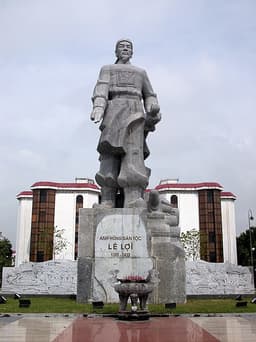
Le Loi
Emperor · Medieval
68.2Total

Napoleon Bonaparte
General · Modern
70.9Total
Basic Information
Born
1385
1769
Died
1433
1821
Era
Medieval
Modern
Nationality
Vietnam
France
Occupation
Emperor
General
Civilization
Eastern
Western
Score Comparison
Military (10%)
74.7
94.0
Political (20%)
60.0
72.0
Influence (20%)
68.0
40.0
Legacy (20%)
68.0
80.0
Leadership (15%)
72.0
78.0
Strategy (15%)
69.1
90.0
TOTAL
68.2
70.9
Le Loi — Complete Timeline
1418 AD
Lam Son Uprising BeginsWar
Le Loi launched the Lam Son uprising against Ming Chinese occupation of Dai Viet. He gathered a small force in the Lam Son region of Thanh Hoa province, beginning a decade-long guerrilla war.
Ming OccupationVietnamese IndependenceGuerrilla War
Impact: national
1426 AD
Siege of Dong QuanWar◆ Major
Le Loi's forces besieged the Ming-held citadel of Dong Quan (Hanoi). The siege cut off Ming supply lines and forced the Chinese to negotiate, leading to the eventual withdrawal of Ming forces.
SiegeMing OccupationDai Viet
Impact: national
1427 AD
Battle of Chi Lang PassWar◆ Major
Le Loi's forces ambushed and defeated a large Ming relief army at Chi Lang Pass. This decisive victory forced the Ming court to recognize Dai Viet's independence and withdraw its remaining troops.
BattleMing OccupationIndependence
Impact: regional
1428 AD
Founding of the Later Le DynastyPolitical Action
Le Loi ascended the throne as Emperor Le Thai To, founding the Later Le dynasty. He established a new capital at Dong Kinh (Hanoi) and implemented policies to rebuild the war-torn country.
Later Le DynastyVietnamese HistoryReconstruction
Impact: regionalconstructive
Napoleon Bonaparte — Complete Timeline
1799 AD
Coup of 18 BrumaireOther◆ Major
Napoleon Bonaparte, with support from his brother Lucien and key political figures, overthrew the Directory in a bloodless coup. He established the Consulate with himself as First Consul, effectively becoming the ruler of France. This event ended the French Revolution's most unstable period.
French RevolutionCoupRise to Power
Impact: regional
1804 AD
Promulgation of the Napoleonic CodeOther◆ Major
Napoleon enacted the Civil Code of the French, known as the Napoleonic Code, a comprehensive set of laws that replaced the fragmented feudal legal systems. The code established legal equality, protected property rights, and secularized law. It became the basis for legal systems in many European and world countries.
Legal ReformNapoleonic CodeCivil Law
Impact: globalconstructive
1805 AD
Battle of AusterlitzWar◆ Major
Napoleon's Grande Arm
Napoleonic WarsBattleDecisive Victory
Impact: global
1812 AD
Invasion of RussiaWar◆ Major
Napoleon led the Grande Arm
Napoleonic WarsInvasionDisaster
Impact: globaldestructive
1815 AD
Battle of WaterlooWar◆ Major
Napoleon's French army was defeated by the combined forces of the Duke of Wellington's Anglo-Allied army and Gebhard Leberecht von Bl
Napoleonic WarsBattleFinal Defeat
Impact: globaldestructive
Expert Analysis
le-loi-vs-napoleon-bonaparte
# The Conqueror and the Liberator
In the winter of 1812, Napoleon Bonaparte watched his Grand Army burn and freeze across the Russian steppes, a catastrophe that would seal his doom. Fifteen years earlier, in the spring of 1427, a Vietnamese guerrilla commander named Le Loi watched a Ming relief army march into a narrow mountain pass at Chi Lang, unaware that they were walking into a trap that would end a decade of occupation. One man built an empire that collapsed under its own weight; the other built a dynasty that would rule for three and a half centuries. What separates the conqueror from the liberator is not merely talent, but the soil from which their ambitions grew.
Origins
Napoleon was born in 1769 on the island of Corsica, a place that had belonged to Genoa before being sold to France the year before. His family were minor nobility, but poor enough that young Napoleon felt the sting of contempt from wealthier classmates at French military academies. He was an outsider in the nation he would one day rule—a Corsican who spoke Italian-accented French, a provincial in a world of Parisian sophistication. This outsider status forged in him a hunger for recognition that would never be satisfied.
Le Loi was born in 1385 in what is now Thanh Hoa province, in the heart of Dai Viet. His family were wealthy landowners, part of the local elite that had watched their country fall under Ming Chinese control in 1407. Unlike Napoleon, Le Loi was not an outsider but a rooted man, deeply connected to the land and its people. He grew up hearing stories of Vietnamese resistance, of generals like Tran Hung Dao who had repelled Mongol invasions. His ambition was not personal glory but national liberation.
The contrast is essential: Napoleon sought to remake the world in his image; Le Loi sought to restore his world to what it had been.
Rise to Power
Napoleon’s ascent was a masterpiece of opportunism. He rose through the chaos of the French Revolution, a time when talent could vault a man over birth. At twenty-four, he drove the British out of Toulon. At twenty-six, he put down a royalist uprising in Paris with a “whiff of grapeshot.” At twenty-seven, he conquered Italy. Each victory was a stepping stone, each campaign a negotiation for more power. By 1804, at thirty-five, he crowned himself Emperor of the French—not by inheritance, but by sheer force of will and the loyalty of an army that worshipped him.
Le Loi’s rise was slower, more patient, and far more desperate. In 1418, he launched the Lam Son Uprising with a small force hidden in the mountains of his home province. For years, he fought a guerrilla war—ambushing supply convoys, melting into forests, enduring Ming reprisals that burned villages and killed civilians. He was not conquering kingdoms; he was surviving. His turning point came in 1426, when his forces besieged the Ming-held citadel of Dong Quan, modern-day Hanoi. The siege cut off Ming supply lines and forced the occupiers to beg for reinforcements. When those reinforcements arrived at Chi Lang Pass in 1427, Le Loi’s trap sprang shut.
Leadership & Governance
Napoleon governed as he conquered: with speed, brilliance, and an iron will. He reformed French law into the Napoleonic Code, a system that enshrined equality before the law, protected property rights, and secularized the state. He centralized administration, built roads and schools, and created a meritocratic bureaucracy. But his governance was always an extension of his ambition. Every reform served the war machine; every institution fed the empire. He was a military genius—his strategic score of 93 reflects his ability to read a battlefield like a chessboard—but he was also a political gambler who overreached.
Le Loi governed as a healer. After founding the Later Le Dynasty in 1428, he declared himself Emperor Le Thai To, but his first acts were not conquests but repairs. He redistributed land to peasants, reduced taxes, and rebuilt villages destroyed by war. He established a new capital at Dong Kinh, but his vision was modest: a stable, independent Vietnam, not an empire. His military score of 67 does not capture his strategic brilliance in guerrilla warfare—his ambush at Chi Lang Pass was a masterpiece of terrain and timing—but it reflects a man who fought to end war, not to wage it forever.
Triumph & Tragedy
Napoleon’s greatest moment was Austerlitz in 1805, where he destroyed a combined Russian and Austrian army in a battle so perfect it became a textbook example of military genius. His worst was Waterloo in 1815, where his old magic failed him—a combination of bad weather, Prussian reinforcements, and his own exhaustion. He died in exile on Saint Helena in 1821, a prisoner of the British, his empire erased from the map.
Le Loi’s greatest moment was the victory at Chi Lang Pass in 1427, where his ambush killed the Ming general and forced the Chinese to negotiate. His tragedy was not defeat but the cost of victory: years of war had scarred his country, and he died in 1433 at age forty-eight, having ruled for only five years. He never saw the dynasty he founded reach its full height. But unlike Napoleon, he died free, on his own soil, surrounded by his people.
Character & Destiny
Napoleon’s personality was a forge of contradictions: brilliant but arrogant, charismatic but ruthless, visionary but blind to his own limits. He once said, “Impossible is a word to be found only in the dictionary of fools.” That confidence built an empire—and destroyed it. He could not stop. Every victory demanded another; every conquest required a war to hold it. His destiny was to rise so high that the fall was inevitable.
Le Loi’s character was defined by patience and humility. He knew that a guerrilla leader cannot afford grandiosity; the forest teaches you to wait. He said, “It is better to lose a battle than to lose the country.” That wisdom kept him alive through years of defeat and allowed him to win when it mattered. His destiny was to become a symbol, not a tyrant.
Legacy
Napoleon left behind the Napoleonic Code, which influences legal systems across Europe and the world. He left behind a legend—the little corporal who conquered a continent, the man who made France the center of the world for a decade. But he also left behind a warning: that genius without restraint becomes catastrophe.
Le Loi left behind a nation. Vietnam remembers him as the man who threw off Chinese rule and restored independence. His dynasty ruled until 1789, long after his death. His name is on streets, temples, and statues. He is not a conqueror but a liberator—and liberators are remembered differently. They do not need to conquer the world to be great; they only need to set their people free.
Conclusion
Standing at the end of their stories, we see two men who began as outsiders and ended as rulers. Napoleon wanted to remake the world and failed. Le Loi wanted to restore his home and succeeded. The difference is not in talent—Napoleon was the greater military genius by any measure—but in purpose. Napoleon’s ambition was a fire that consumed everything, including itself. Le Loi’s ambition was a root that grew into a tree. One died alone on a rock in the Atlantic; the other died in the land he had freed. Perhaps the deepest lesson is this: the greatest conquerors are not those who take the most, but those who give their people the one thing no empire can grant—the freedom to be themselves.
Rankings
🥇
Napoleon BonaparteLeader
Mil: 94.0Pol: 72.0Inf: 40.0
70.9
🥈
Le Loi
Mil: 74.7Pol: 60.0Inf: 68.0
68.2
+2.7 behind
How This Comparison Works
Algorithm
Each figure is scored on 6 dimensions (0—100 scale) based on structured historical data: Military (10%), Political (20%), Influence (20%), Legacy (20%), Leadership (15%), Strategy (15%). The weighted total produces the final ranking.
Data Sources
Scores are computed from structured sub-indicators in the database. Scale factors adjust for era (Ancient ×0.85, Modern ×1.0) and civilization size (Eastern ×1.05, Other ×0.80) to account for differences in population and military scale.
Maximum 3 Figures
Comparisons are limited to 2—3 figures to ensure readability and statistical meaningfulness.
Error Margins
±5 points per dimension — Sub-scores are derived from historical records with inherent uncertainty. Two figures within 5 points on a dimension should be considered roughly equivalent in that area.
Total Score Accuracy
±3 points overall — The weighted combination of 6 dimensions produces a total score with approximately ±3 points of uncertainty. Differences of less than 3 points are not statistically significant— the figures are effectively tied.
Known Limitations
- Historical records are incomplete and uneven across civilizations
- Figures from oral-tradition societies may be underrepresented
- Occupation labels can misclassify multi-role figures
- Scores measure capability and impact, not moral character
- Quantitative scoring is a comparison tool, not absolute truth
Capability Radar
Military (10%) — Battles & Warfare
Battles
75
95
Win Rate
80
90
Expansion
65
95
Political (20%) — Governance & Reform
Reform
70
95
Diplomacy
75
80
Economy
65
85
Influence (20%) — Cultural & Global Reach
Cultural
80
85
Global
55
90
Legacy (20%) — Historical Impact
Historical
85
95
Longevity
75
90
Leadership (15%) — Power & Stability
Tenure
60
85
Stability
70
70
Strategy (15%) — Tactics & Innovation
Strategy
82
95
Tactics
78
98
Reform
70
92
Similar Comparisons
Comments & Discussion
TheLanternBearer6/17/2026
Napoleon’s brilliance was in building armies, but Le Loi built a nation. Napoleon’s 1812 campaign killed half a million men—mostly for pride. Le Loi’s Chi Lang ambush in 1427 killed maybe 10,000 Ming soldiers and ended a twenty-year occupation. That’s not just better tactics; it’s better strategy. Le Loi knew when to fight and when to talk; Napoleon never learned. Le Loi liberated; Napoleon conquered himself into exile. Case closed.
MingDynastyData6/17/2026
Stop romanticizing "the people's general." Napoleon unified a fractured France with the Napoleonic Code and meritocracy—Le Loi's dynasty was just another noble clan grabbing power. Check the numbers: Napoleon fought 60-plus battles, losing only a handful; Le Loi skirmished in jungles for years with maybe 20,000 men total. Chi Lang was a lucky ambush, not a strategic masterstroke. Le Loi built a myth; Napoleon built a legacy.
古籍守卫6/17/2026
别被民族主义感动了。黎利烧掉明朝粮仓、打游击战,本质是地方土豪抢地盘,跟拿破仑的欧洲秩序差远了。拿破仑法典是现代法律的基础,黎利呢?恢复李、陈旧制,连税收都照抄明朝。Chi Lang之胜确实漂亮,但那是李篆的伏击,不是黎利亲自指挥的。他还杀了不少功臣,比如陈元==? 别捧太高了。
海内存知己6/17/2026
拿破仑的野心毁于莫斯科的冬天,黎利的智慧在Chi Lang山隘闪光。一个是征服者,一个是解放者——区别不是兵力,是根基。黎利是本地豪强,懂民心;拿破仑是科西嘉孤儿,只懂权力。黎利建立的王朝维持了360年,拿破仑的帝国只有十几年。结果说明一切:谁更懂“为什么而战”?黎利为国家,拿破仑为自己。