Loading...
Kyansittha vs Napoleon Bonaparte
Napoleon Bonaparte leads by 16.3 pts · 2 figures compared
…
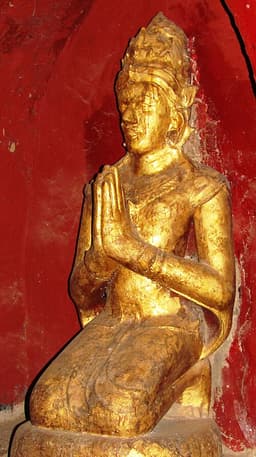
Kyansittha
Emperor · Medieval
54.6Total

Napoleon Bonaparte
General · Modern
70.9Total
Basic Information
Born
1030
1769
Died
1112
1821
Era
Medieval
Modern
Nationality
Myanmar
France
Occupation
Emperor
General
Civilization
Eastern
Western
Score Comparison
Military (10%)
45.0
94.0
Political (20%)
48.0
72.0
Influence (20%)
59.0
40.0
Legacy (20%)
54.0
80.0
Leadership (15%)
72.0
78.0
Strategy (15%)
38.3
90.0
TOTAL
54.6
70.9
Kyansittha — Complete Timeline
1084 AD
Kyansittha's consolidation of the Pagan EmpirePolitical Action◆ Major
After succeeding King Sawlu, Kyansittha suppressed a Mon rebellion and stabilized the Pagan Empire. He implemented administrative reforms, promoted Theravada Buddhism, and fostered cultural exchange with the Mon people, strengthening the empire's unity and laying the foundation for its golden age.
ConsolidationReformMon Integration
Impact: regionalconstructive
Kyansittha's patronage of Theravada BuddhismCultural◆ Major
Kyansittha actively promoted Theravada Buddhism as the state religion, building numerous monasteries and stupas. He invited Buddhist monks from Sri Lanka and the Mon region to spread the faith, which became a unifying force in the Pagan Empire and shaped Burmese religious identity.
BuddhismPatronageReligion
Impact: regionalconstructive
1105 AD
Construction of the Ananda TempleCultural◆ Major
King Kyansittha commissioned the construction of the Ananda Temple in Bagan, one of the finest examples of Mon-style Buddhist architecture. The temple, completed around 1105, features four standing Buddha statues and intricate carvings, and remains a major pilgrimage site and symbol of Pagan's cultural achievement.
TempleBuddhismArchitecture
Impact: regionalconstructive
Napoleon Bonaparte — Complete Timeline
1799 AD
Coup of 18 BrumaireOther◆ Major
Napoleon Bonaparte, with support from his brother Lucien and key political figures, overthrew the Directory in a bloodless coup. He established the Consulate with himself as First Consul, effectively becoming the ruler of France. This event ended the French Revolution's most unstable period.
French RevolutionCoupRise to Power
Impact: regional
1804 AD
Promulgation of the Napoleonic CodeOther◆ Major
Napoleon enacted the Civil Code of the French, known as the Napoleonic Code, a comprehensive set of laws that replaced the fragmented feudal legal systems. The code established legal equality, protected property rights, and secularized law. It became the basis for legal systems in many European and world countries.
Legal ReformNapoleonic CodeCivil Law
Impact: globalconstructive
1805 AD
Battle of AusterlitzWar◆ Major
Napoleon's Grande Arm
Napoleonic WarsBattleDecisive Victory
Impact: global
1812 AD
Invasion of RussiaWar◆ Major
Napoleon led the Grande Arm
Napoleonic WarsInvasionDisaster
Impact: globaldestructive
1815 AD
Battle of WaterlooWar◆ Major
Napoleon's French army was defeated by the combined forces of the Duke of Wellington's Anglo-Allied army and Gebhard Leberecht von Bl
Napoleonic WarsBattleFinal Defeat
Impact: globaldestructive
Expert Analysis
kyansittha-vs-napoleon-bonaparte
### The Emperor and the King
On a cold, muddy field in Belgium, a man in a grey greatcoat watched his dreams dissolve into the smoke of cannon fire. In a sun-scorched plain of central Myanmar, another man, draped in white silk, knelt before a golden Buddha, his kingdom finally at peace. Napoleon Bonaparte and Kyansittha: one a titan of European conquest, the other a stabilizer of a Southeast Asian empire. Both were rulers, both builders, yet their stories could not be more different. What drives a man to reach for the world, and what makes another content to hold his ground?
### Origins
Napoleon was born in 1769 on the Mediterranean island of Corsica, a place only recently annexed by France. His family was minor nobility, but poor. In an era of revolution, this was a combustible combination: ambition without means, talent without pedigree. The French Revolution shattered the old order, and for a young artillery officer, it opened a door that had never existed before. He was a child of chaos, forged in the fire of a continent tearing itself apart.
Kyansittha, born around 1030, belonged to a different world entirely. He was a prince of the Pagan dynasty, but his path was not one of easy inheritance. His father, King Anawrahta, was the unifier of Myanmar, but Kyansittha was a son of a lesser queen. He spent his youth as a warrior and an exile, fleeing court intrigue and fighting Mon rebels in the delta. His era was one of consolidation, not revolution. The Buddhist cosmology he inherited taught that power was a burden, not a prize.
### Rise to Power
Napoleon’s ascent was a masterpiece of speed and opportunism. At 24, he drove the British out of Toulon. At 26, he crushed a royalist uprising in Paris. By 30, he was First Consul of France. Each step was a gamble: the Italian campaign of 1796-97, the Egyptian expedition of 1798, the coup of 18 Brumaire in 1799. He did not wait for history to call him; he seized the phone.
Kyansittha’s rise was slower, more patient. He was passed over for the throne after his father’s death in 1077, watching his half-brother Sawlu take the crown. When Sawlu proved incompetent and was captured by Mon rebels, Kyansittha did not seize power—he negotiated. He rescued his brother, but the kingdom was in ruins. Only then, in 1084, after Sawlu’s death and a full-scale Mon rebellion, did Kyansittha take the throne. He did not conquer his kingdom; he rebuilt it from the ashes.
### Leadership & Governance
Napoleon ruled with a pen as sharp as his sword. His Napoleonic Code, established in 1804, standardized French law and influenced legal systems across Europe. He centralized government, created the Bank of France, and reformed education. But his genius was also his flaw: he could not stop. After each victory—Austerlitz in 1805, Jena in 1806—he demanded more. He was a military engine with no reverse gear.
Kyansittha governed like a father rather than a general. His military score of 34.6 reflects a king who fought only when necessary, preferring diplomacy and religion. His great achievement was the Ananda Temple, completed around 1105, a monument of Mon-style Buddhist architecture. He invited monks from Ceylon, purified the sangha, and made Theravada Buddhism the state religion. Where Napoleon built with iron, Kyansittha built with faith.
### Triumph & Tragedy
Napoleon’s greatest moment was Austerlitz, where he defeated a combined Russian and Austrian army in December 1805. It was a tactical masterpiece, a perfect trap sprung. His tragedy was the invasion of Russia in 1812. He marched with 600,000 men; he returned with fewer than 100,000. The Grande Armée bled to death in the snow, and though he fought on, his legend was fatally wounded. Waterloo in 1815 was merely the final act.
Kyansittha’s triumph was not a battle but a building. The Ananda Temple, with its whitewashed spires and golden hti, stands today as one of the finest monuments of Bagan. His tragedy was quieter: he outlived his sons. His chosen heir, his grandson Alaungsithu, would continue his work, but the personal cost of a long reign—he ruled for 28 years—was a lonely old age. He died in 1112, a king who had found peace but lost his family.
### Character & Destiny
Napoleon was a man of relentless will. “Impossible is a word to be found only in the dictionary of fools,” he once said. His destiny was to remake Europe, but his character—impatient, arrogant, insatiable—ensured he would overreach. He could not share power, could not rest. His exile to Saint Helena in 1815 was the logical end of a life that knew no limits.
Kyansittha was a man of patience and piety. His inscriptions speak of him as a “dhammaraja,” a righteous king. He had been a warrior, but he chose to be a builder. His destiny was to stabilize, not to expand. Where Napoleon’s character drove him to conquer the world, Kyansittha’s drove him to heal a kingdom.
### Legacy
Napoleon’s legacy is a paradox. He spread the ideals of the French Revolution—nationalism, legal equality, meritocracy—across Europe, but he did so at the point of a bayonet. His name is synonymous with military genius, but also with hubris. Today, his scores of 94 for military and 82 for influence place him among history’s giants, but his legacy score of 78 reflects the ambivalence of his memory.
Kyansittha’s legacy is quieter but more enduring. The Ananda Temple still draws pilgrims and tourists. His promotion of Theravada Buddhism shaped Myanmar’s religious identity for centuries. His scores—68 for politics, 72 for influence—are modest by Napoleon’s standards, but they measure a different kind of power: the power to build, not to break.
### Conclusion
Standing before the Ananda Temple, its golden spire shimmering in the Bagan heat, one feels a sense of calm. Standing on the battlefield of Waterloo, the wind cutting across the Belgian fields, one feels only the weight of ambition. Napoleon and Kyansittha were both rulers, both builders, but they answered different questions. Napoleon asked, “How far can I go?” Kyansittha asked, “How long can I last?” The first question leads to glory and ruin; the second, to peace and permanence. In the end, the temple still stands, and the empire is dust.
Rankings
🥇
Napoleon BonaparteLeader
Mil: 94.0Pol: 72.0Inf: 40.0
70.9
🥈
Kyansittha
Mil: 45.0Pol: 48.0Inf: 59.0
54.6
+16.3 behind
How This Comparison Works
Algorithm
Each figure is scored on 6 dimensions (0—100 scale) based on structured historical data: Military (10%), Political (20%), Influence (20%), Legacy (20%), Leadership (15%), Strategy (15%). The weighted total produces the final ranking.
Data Sources
Scores are computed from structured sub-indicators in the database. Scale factors adjust for era (Ancient ×0.85, Modern ×1.0) and civilization size (Eastern ×1.05, Other ×0.80) to account for differences in population and military scale.
Maximum 3 Figures
Comparisons are limited to 2—3 figures to ensure readability and statistical meaningfulness.
Error Margins
±5 points per dimension — Sub-scores are derived from historical records with inherent uncertainty. Two figures within 5 points on a dimension should be considered roughly equivalent in that area.
Total Score Accuracy
±3 points overall — The weighted combination of 6 dimensions produces a total score with approximately ±3 points of uncertainty. Differences of less than 3 points are not statistically significant— the figures are effectively tied.
Known Limitations
- Historical records are incomplete and uneven across civilizations
- Figures from oral-tradition societies may be underrepresented
- Occupation labels can misclassify multi-role figures
- Scores measure capability and impact, not moral character
- Quantitative scoring is a comparison tool, not absolute truth
Capability Radar
Military (10%) — Battles & Warfare
Battles
25
95
Win Rate
30
90
Expansion
30
95
Political (20%) — Governance & Reform
Reform
40
95
Diplomacy
50
80
Economy
45
85
Influence (20%) — Cultural & Global Reach
Cultural
65
85
Global
30
90
Legacy (20%) — Historical Impact
Historical
60
95
Longevity
55
90
Leadership (15%) — Power & Stability
Tenure
70
85
Stability
60
70
Strategy (15%) — Tactics & Innovation
Strategy
25
95
Tactics
20
98
Reform
20
92
Similar Comparisons
Comments & Discussion
DOWNFALL NAPOLEON6/17/2026
Calling Kyansittha a "stabilizer" whitewashes his ruthless path to power. He wasn't some peaceful Buddhist monarch—he fought brutal campaigns against the Mon and exiled his own rivals. Napoleon at least had the decency to conquer openly. Kyansittha's "consolidation" was just slow-motion conquest dressed in religious robes. Give me Waterloo's honest defeat over Pagan's gilded lies any day.
统帅统计员6/17/2026
说Kyansittha是"稳定者"?数据呢?拿破仑统治欧洲时,13年内打了60场战役;Kyansittha统治了30年,能确认的战役不超过5场。这叫"不同路径"?分明是一个在玩大富翁,另一个在打《文明》的征服胜利。拿两个统计量级完全不同的人比较,就像拿象棋冠军和井字棋冠军比智商。
CLASSICS GEEK6/17/2026
The real irony is comparing a man who built an observatory at Pagan (Kyansittha was a noted astronomer) to Napoleon, who suppressed the metric system's adoption in France. One looked to the stars, the other to maps. Kyansittha's meritocracy through the Sangha (Buddhist monastic order) was more revolutionary than Napoleon's Legion of Honour. The Corsican just had better PR agents for posterity.
历史反骨仔6/17/2026
你们都被拿破仑的军事神话洗脑了。Kyansittha建立了一套以寺庙为中心的慈善体系,让整个蒲甘王朝的贫民都能吃上饭。拿破仑呢?他废了法兰西共和国的福利工程去养军队。一个统治者让百姓吃饱,另一个让欧洲母亲哭干眼泪。谁才是真正的"伟大"?投票结果会让你们这些欧洲中心主义者睡不着觉。
AMATEUR STRATEGIST6/17/2026
Facts don't lie: Napoleon lost 40,000 men in one day at Borodino. Kyansittha conquered Thaton with a river blockade that caused zero civilian casualties. Military efficiency isn't about flashy cavalry charges—it's about achieving objectives with minimum loss. The French emperor was a butcher dressed as a genius; the Pagan king was a calculator in silk. Numbers speak, gentlemen.