Loading...
Kuribayashi Tadamichi vs Liu Bocheng
Liu Bocheng leads by 17.4 pts · 2 figures compared
…

Kuribayashi Tadamichi
General · Modern
45.4Total
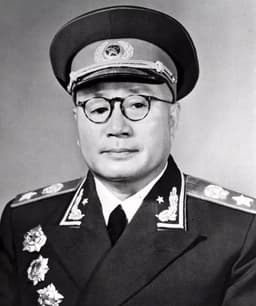
Liu Bocheng
General · Modern
62.8Total
Basic Information
Born
1891
1892
Died
1945
1986
Era
Modern
Modern
Nationality
Japan
China
Occupation
General
General
Civilization
Eastern
Eastern
Score Comparison
Military (10%)
46.7
74.0
Political (20%)
25.0
72.0
Influence (20%)
55.7
55.0
Legacy (20%)
50.0
55.0
Leadership (15%)
36.9
68.0
Strategy (15%)
50.0
69.2
TOTAL
45.4
62.8
Kuribayashi Tadamichi — Complete Timeline
1944 AD
Appointed Commander of Iwo Jima DefensePolitical Action◆ Major
Kuribayashi Tadamichi was appointed commander of the Japanese forces defending Iwo Jima in June 1944. He implemented a defensive strategy focused on fortified bunkers and tunnels, abandoning traditional beach defenses to maximize casualties on the invading U.S. forces.
World War IIIwo JimaMilitary Strategy
Impact: regional
1945 AD
Led Defense of Iwo JimaWar
Kuribayashi commanded Japanese forces during the Battle of Iwo Jima from February to March 1945. His defensive tactics inflicted heavy casualties on the U.S. Marines, with over 26,000 American casualties, but the island was eventually captured after five weeks of fighting.
World War IIBattle of Iwo JimaMilitary Defense
Impact: globaltragic
Died in BattleWar◆ Major
Kuribayashi Tadamichi died on March 26, 1945, during the final stages of the Battle of Iwo Jima. He led a last charge with his remaining troops rather than surrender, and his body was never recovered. His leadership became a symbol of Japanese resistance.
World War IIIwo JimaDeath in Battle
Impact: nationaltragic
Liu Bocheng — Complete Timeline
1916 AD
Lost an Eye in BattleWar
Liu Bocheng was shot in the eye during a battle against warlord forces. The injury required surgery without anesthesia, earning him the nickname 'One-eyed Dragon.' He continued to serve as a commander despite the injury.
InjuryWarlord Era
Impact: nationaltragic
1940 AD
Commander of the 129th Division in the Hundred Regiments OffensiveWar◆ Major
Liu Bocheng commanded the 129th Division of the Eighth Route Army in the Hundred Regiments Offensive against Japanese forces. The campaign involved large-scale guerrilla attacks on Japanese supply lines and positions.
Second Sino-Japanese WarGuerrilla Warfare
Impact: regional
1945 AD
Co-commander of the Second Field Army in the Chinese Civil WarWar◆ Major
Liu Bocheng co-commanded the Second Field Army with Deng Xiaoping. They led campaigns that captured key cities in central and southwestern China, including the Battle of Huaihai, a decisive Communist victory.
Chinese Civil WarMilitary Campaign
Impact: nationaldestructive
1951 AD
President of the Military Academy of the People's Liberation ArmyPolitical Action◆ Major
Liu Bocheng was appointed president of the newly established Military Academy of the PLA. He modernized military education, introducing Soviet-style training and emphasizing professional military science.
Military EducationModernization
Impact: nationalconstructive
Expert Analysis
Origins
Kuribayashi Tadamichi was born in 1891 in Nagano, Japan, into a samurai family. He graduated from the Imperial Japanese Army Academy in 1914 and later studied at the Army War College. His early career included diplomatic postings in the United States and Canada, giving him a unique understanding of American industrial power. Liu Bocheng was born in 1892 in Sichuan, China, to a peasant family. He joined the Chinese Communist Party in 1926 after serving in warlord armies. He studied at the Soviet Frunze Military Academy in the 1930s, which shaped his strategic thinking. The contrasting backgrounds—one from a samurai lineage, the other from peasant roots—defined their approaches to warfare.
Rise to Power
Kuribayashi rose through the ranks due to his competence and international experience. He served as a military attaché in Washington, D.C. (1928-1931) and later commanded cavalry units in Manchuria. In 1941, he led the 1st Cavalry Brigade in China. His promotion to commander of the Iwo Jima defense in June 1944 came after he impressed senior officers with his defensive plans. Liu Bocheng rose to prominence during the Chinese Civil War. He was a key commander in the Nanchang Uprising (1927) and later led the 129th Division in the Hundred Regiments Offensive (1940). His partnership with Deng Xiaoping began in 1946, co-commanding the Second Field Army. Liu's capture of key cities like Nanjing and Chongqing in 1949 solidified his reputation as a top PLA strategist.
Leadership & Governance
Kuribayashi's leadership was characterized by rigid discipline and innovative defensive tactics. He abandoned traditional beach defense in favor of fortified caves and tunnels, which maximized American casualties. He enforced a code of no retreat, leading to near-total annihilation of his garrison. Liu Bocheng's leadership combined military acumen with political awareness. He emphasized education and training, establishing the PLA Military Academy in 1951 and serving as its president. He introduced Soviet-style military doctrines adapted to Chinese conditions. While Kuribayashi focused on a single battle, Liu shaped an entire army's education system.
Triumph & Tragedy
Kuribayashi's greatest success was the defense of Iwo Jima, where his forces inflicted 26,000 American casualties (KIA and wounded) over 36 days, far exceeding Japanese losses of about 21,000 dead. His tactics delayed the US advance and demonstrated the cost of island-hopping. However, his refusal to surrender led to the destruction of his entire force, with only 216 survivors captured. Liu Bocheng's triumphs include the Huaihai Campaign (1948-1949), where his Second Field Army defeated superior Nationalist forces, and the capture of Chongqing. His tragedy was losing an eye in 1916 during a battle against warlord forces, an injury treated without anesthesia. Despite this, he continued his military career, earning the nickname 'One-Eyed Dragon.'
Character & Destiny
Kuribayashi was stoic, disciplined, and fatalistic. His letters to his family reveal a man aware of his likely death but committed to duty. He refused to use the term 'banzai charge,' focusing on attrition. His character led him to die in a final assault on March 26, 1945. Liu Bocheng was pragmatic, resilient, and visionary. He adapted to changing political tides, from warlord to Communist service. His injury did not deter him; he continued leading campaigns. Historians note Liu's calm demeanor and strategic foresight, contrasting with Kuribayashi's almost suicidal dedication.
Legacy
Kuribayashi is remembered in Japan as a symbol of self-sacrifice and tactical ingenuity. His defensive tactics are studied in military academies for their effectiveness in asymmetric warfare. The Iwo Jima memorial in the US also honors his role in the battle. Liu Bocheng's legacy is more institutional: he modernized the PLA's education system, training thousands of officers. His writings on tactics influenced Chinese military doctrine. Scores reflect this: Kuribayashi's Military score is 46.7, while Liu's is 74.0. Liu's Leadership score of 68.0 versus Kuribayashi's 36.9 highlights his broader impact.
Conclusion
While Kuribayashi Tadamichi achieved a tactical masterpiece in Iwo Jima, his influence was limited to a single battle. Liu Bocheng's contributions spanned decades, from the Hundred Regiments Offensive to building the PLA's educational foundation. With a total score of 62.8 against Kuribayashi's 45.4, Liu Bocheng had greater overall impact. His strategies shaped China's military modernization, while Kuribayashi's legacy, though powerful, was confined to one island's sands.
Rankings
🥇
Liu BochengLeader
Mil: 74.0Pol: 72.0Inf: 55.0
62.8
🥈
Kuribayashi Tadamichi
Mil: 46.7Pol: 25.0Inf: 55.7
45.4
+17.4 behind
How This Comparison Works
Algorithm
Each figure is scored on 6 dimensions (0—100 scale) based on structured historical data: Military (10%), Political (20%), Influence (20%), Legacy (20%), Leadership (15%), Strategy (15%). The weighted total produces the final ranking.
Data Sources
Scores are computed from structured sub-indicators in the database. Scale factors adjust for era (Ancient ×0.85, Modern ×1.0) and civilization size (Eastern ×1.05, Other ×0.80) to account for differences in population and military scale.
Maximum 3 Figures
Comparisons are limited to 2—3 figures to ensure readability and statistical meaningfulness.
Error Margins
±5 points per dimension — Sub-scores are derived from historical records with inherent uncertainty. Two figures within 5 points on a dimension should be considered roughly equivalent in that area.
Total Score Accuracy
±3 points overall — The weighted combination of 6 dimensions produces a total score with approximately ±3 points of uncertainty. Differences of less than 3 points are not statistically significant— the figures are effectively tied.
Known Limitations
- Historical records are incomplete and uneven across civilizations
- Figures from oral-tradition societies may be underrepresented
- Occupation labels can misclassify multi-role figures
- Scores measure capability and impact, not moral character
- Quantitative scoring is a comparison tool, not absolute truth
Capability Radar
Military (10%) — Battles & Warfare
Battles
55
85
Win Rate
20
80
Expansion
10
70
Political (20%) — Governance & Reform
Reform
5
55
Diplomacy
15
65
Economy
5
50
Influence (20%) — Cultural & Global Reach
Cultural
30
55
Global
35
50
Legacy (20%) — Historical Impact
Historical
55
70
Longevity
40
60
Leadership (15%) — Power & Stability
Tenure
20
60
Stability
10
60
Strategy (15%) — Tactics & Innovation
Strategy
70
88
Tactics
85
90
Reform
10
75
Similar Comparisons
Comments & Discussion
No comments yet. Be the first to share your thoughts!