Loading...
This comparison has not been analyzed yet.
One-time AI generation (~1 minute). Scores and timeline are already available below.
Kolinda Grabar-Kitarovic vs Toomas Hendrik Ilves
Toomas Hendrik Ilves leads by 0.7 pts · 2 figures compared
…

Kolinda Grabar-Kitarovic
Politician · Modern
55.1Total
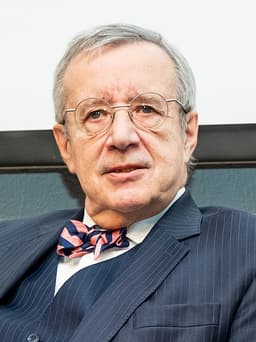
Toomas Hendrik Ilves
Politician · Modern
55.8Total
Basic Information
Born
1968
1953
Died
—
—
Era
Modern
Modern
Nationality
Croatia
Estonia
Occupation
Politician
Politician
Civilization
Western
Western
Score Comparison
Military (10%)
45.4
49.0
Political (20%)
68.0
72.0
Influence (20%)
54.9
53.3
Legacy (20%)
41.7
42.5
Leadership (15%)
68.0
79.8
Strategy (15%)
60.0
41.7
TOTAL
55.1
55.8
Kolinda Grabar-Kitarovic — Complete Timeline
2015 AD
Elected President of CroatiaPolitical Action◆ Major
Grabar-Kitarovic was elected as the first female President of Croatia, winning the runoff with 50.7% of the vote. She succeeded Ivo Josipovic and focused on economic development, demographic renewal, and strengthening NATO ties.
ElectionFirst Female PresidentNATO
Impact: nationalconstructive
2020 AD
Croatia assumed the rotating presidency of the Council of the European UnionPolitical Action◆ Major
During Grabar-Kitarovic's presidency, Croatia held the rotating presidency of the Council of the EU for the first time. The presidency focused on the EU's recovery from the COVID-19 pandemic, enlargement, and the Western Balkans.
EU PresidencyCOVID-19Enlargement
Impact: regionalconstructive
Lost presidential election to Zoran MilanovicPolitical Action◆ Major
Grabar-Kitarovic lost the presidential election in the runoff to Zoran Milanovic, receiving 47.3% of the vote. Her defeat was attributed to economic challenges and the impact of the COVID-19 pandemic.
Election LossPolitical ShiftCOVID-19
Impact: national
Toomas Hendrik Ilves — Complete Timeline
1996 AD
Appointed Minister of Foreign Affairs of EstoniaPolitical Action◆ Major
Ilves was appointed Minister of Foreign Affairs, serving until 1998 and again from 1999 to 2002. He was instrumental in advancing Estonia's NATO and EU membership bids, advocating for integration with Western institutions.
Foreign AffairsNATOEU Integration
Impact: nationalconstructive
2006 AD
Elected President of EstoniaPolitical Action◆ Major
Ilves was elected as the third President of Estonia, serving from 2006 to 2016. His presidency focused on digital innovation, cybersecurity, and strengthening Estonia's role in the European Union and NATO.
PresidencyDigital EstoniaCybersecurity
Impact: nationalconstructive
2007 AD
Advocated for Estonia's E-Government InitiativesReform◆ Major
Ilves strongly promoted Estonia's e-government and digital identity systems, including e-voting and e-residency. These initiatives made Estonia a global leader in digital governance and cybersecurity.
E-GovernmentDigital IdentityInnovation
Impact: globalconstructive
Led Estonia's Response to the 2007 CyberattacksPolitical Action
Ilves led Estonia's response to a series of cyberattacks targeting government, media, and banking websites. The attacks were attributed to Russian actors, and Ilves advocated for stronger international cybersecurity cooperation, leading to the creation of NATO's Cooperative Cyber Defence Centre of Excellence.
CybersecurityCyberattackNATO
Impact: global
2011 AD
Re-elected President for Second TermPolitical Action
Ilves was re-elected for a second term as President of Estonia, continuing his focus on digital society and foreign policy. His second term saw Estonia chair the EU Council and host the NATO Cyber Defence Centre.
PresidencyRe-electionDigital Policy
Impact: nationalconstructive
This comparison has not been analyzed yet.
One-time AI generation (~1 minute). Scores and timeline are already available below.
Rankings
🥇
Toomas Hendrik IlvesLeader
Mil: 49.0Pol: 72.0Inf: 53.3
55.8
🥈
Kolinda Grabar-Kitarovic
Mil: 45.4Pol: 68.0Inf: 54.9
55.1
+0.7 behind
How This Comparison Works
Algorithm
Each figure is scored on 6 dimensions (0—100 scale) based on structured historical data: Military (10%), Political (20%), Influence (20%), Legacy (20%), Leadership (15%), Strategy (15%). The weighted total produces the final ranking.
Data Sources
Scores are computed from structured sub-indicators in the database. Scale factors adjust for era (Ancient ×0.85, Modern ×1.0) and civilization size (Eastern ×1.05, Other ×0.80) to account for differences in population and military scale.
Maximum 3 Figures
Comparisons are limited to 2—3 figures to ensure readability and statistical meaningfulness.
Error Margins
±5 points per dimension — Sub-scores are derived from historical records with inherent uncertainty. Two figures within 5 points on a dimension should be considered roughly equivalent in that area.
Total Score Accuracy
±3 points overall — The weighted combination of 6 dimensions produces a total score with approximately ±3 points of uncertainty. Differences of less than 3 points are not statistically significant— the figures are effectively tied.
Known Limitations
- Historical records are incomplete and uneven across civilizations
- Figures from oral-tradition societies may be underrepresented
- Occupation labels can misclassify multi-role figures
- Scores measure capability and impact, not moral character
- Quantitative scoring is a comparison tool, not absolute truth
Capability Radar
Military (10%) — Battles & Warfare
Battles
46
32
Win Rate
51
32
Expansion
52
33
Political (20%) — Governance & Reform
Reform
40
60
Diplomacy
60
70
Economy
45
55
Influence (20%) — Cultural & Global Reach
Cultural
35
30
Global
35
20
Legacy (20%) — Historical Impact
Historical
30
25
Longevity
20
20
Leadership (15%) — Power & Stability
Tenure
55
65
Stability
50
65
Strategy (15%) — Tactics & Innovation
Strategy
59
37
Tactics
60
39
Reform
63
45
Similar Comparisons
Comments & Discussion
No comments yet. Be the first to share your thoughts!