Loading...
King Jangsu of Goguryeo vs Napoleon Bonaparte
Napoleon Bonaparte leads by 6.5 pts · 2 figures compared
…
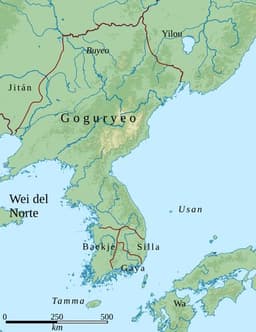
King Jangsu of Goguryeo
Emperor · Ancient
64.4Total

Napoleon Bonaparte
General · Modern
70.9Total
Basic Information
Born
394
1769
Died
491
1821
Era
Ancient
Modern
Nationality
Korea
France
Occupation
Emperor
General
Civilization
Eastern
Western
Score Comparison
Military (10%)
72.0
94.0
Political (20%)
70.0
72.0
Influence (20%)
60.0
40.0
Legacy (20%)
52.0
80.0
Leadership (15%)
80.0
78.0
Strategy (15%)
67.2
90.0
TOTAL
64.4
70.9
King Jangsu of Goguryeo — Complete Timeline
427 AD
Construction of the Gungnae FortressOther◆ Major
King Jangsu moved the Goguryeo capital from Gungnae to Pyongyang, constructing a new fortress city. This relocation strengthened control over the southern territories and facilitated expansion into the Korean peninsula.
Capital RelocationFortificationUrban Development
Impact: nationalconstructive
475 AD
Conquest of the Han River BasinWar
King Jangsu led a military campaign that captured the Han River basin from the Baekje kingdom, including the capital Hanseong. This victory gave Goguryeo control over a strategic waterway and rich agricultural lands, significantly expanding its territory.
Territorial ExpansionBaekje WarHan River
Impact: regional
479 AD
Diplomatic Relations with Northern WeiPolitical Action
King Jangsu established diplomatic relations with the Northern Wei dynasty of China, exchanging envoys and tribute. This alliance balanced against the Southern Dynasties and secured Goguryeo's northern borders.
DiplomacyChina RelationsAlliance
Impact: regionalconstructive
481 AD
Submission of Silla as a VassalPolitical Action◆ Major
King Jangsu forced the Silla kingdom to become a vassal state of Goguryeo after a series of military campaigns. Silla paid tribute and accepted Goguryeo's suzerainty, establishing Goguryeo as the dominant power in the Korean peninsula.
VassalageSillaHegemony
Impact: regional
491 AD
Longest Reign in Korean HistoryOther◆ Major
King Jangsu died after a reign of 79 years, the longest of any Korean monarch. His rule saw Goguryeo reach its maximum territorial extent and peak power, controlling much of Manchuria and the Korean peninsula.
LongevityLegacyPeak Power
Impact: regional
Napoleon Bonaparte — Complete Timeline
1799 AD
Coup of 18 BrumaireOther◆ Major
Napoleon Bonaparte, with support from his brother Lucien and key political figures, overthrew the Directory in a bloodless coup. He established the Consulate with himself as First Consul, effectively becoming the ruler of France. This event ended the French Revolution's most unstable period.
French RevolutionCoupRise to Power
Impact: regional
1804 AD
Promulgation of the Napoleonic CodeOther◆ Major
Napoleon enacted the Civil Code of the French, known as the Napoleonic Code, a comprehensive set of laws that replaced the fragmented feudal legal systems. The code established legal equality, protected property rights, and secularized law. It became the basis for legal systems in many European and world countries.
Legal ReformNapoleonic CodeCivil Law
Impact: globalconstructive
1805 AD
Battle of AusterlitzWar◆ Major
Napoleon's Grande Arm
Napoleonic WarsBattleDecisive Victory
Impact: global
1812 AD
Invasion of RussiaWar◆ Major
Napoleon led the Grande Arm
Napoleonic WarsInvasionDisaster
Impact: globaldestructive
1815 AD
Battle of WaterlooWar◆ Major
Napoleon's French army was defeated by the combined forces of the Duke of Wellington's Anglo-Allied army and Gebhard Leberecht von Bl
Napoleonic WarsBattleFinal Defeat
Impact: globaldestructive
Expert Analysis
king-jangsu-of-goguryeo-vs-napoleon-bonaparte
# The Emperor Who Outlasted Empires
On a June evening in 1815, a man who had once ruled from Madrid to Moscow stood on a muddy field in Belgium, watching his Imperial Guard march into the cannons of Wellington. Within hours, Napoleon Bonaparte’s dream of a European empire lay shattered. Across the world and fourteen centuries earlier, another ruler—King Jangsu of Goguryeo—died peacefully in his bed at the age of ninety-seven, having reigned for seventy-nine years. One man conquered the world in a decade and lost it in a day; the other built an empire that outlasted his own lifetime by centuries. What drove such different outcomes?
Origins
Napoleon was born in 1769 on the island of Corsica, a place recently annexed by France. His family was minor nobility, but they were not wealthy. The young Napoleon grew up speaking Italian-accented French, an outsider in the nation he would one day rule. The French Revolution, which erupted when he was twenty, tore down the old order and opened paths that had been closed to men of his birth. He was a product of chaos—ambitious, restless, and hungry for glory.
King Jangsu, born in 394, entered a world of order and continuity. He was the son of King Gwanggaeto the Great, who had already expanded Goguryeo’s territory across the Korean Peninsula and into Manchuria. Jangsu was raised in the royal court of Gungnae, trained from childhood to rule. His world was not a revolution but a dynasty—a line of kings stretching back centuries. Where Napoleon had to seize his destiny, Jangsu inherited his.
Rise to Power
Napoleon’s rise was meteoric. In 1793, at age twenty-four, he drove British forces from Toulon. By 1796, he commanded the French army in Italy, winning battles that made him a national hero. In 1799, he staged a coup and became First Consul of France. Five years later, he crowned himself Emperor. Every step was a gamble, every victory a personal triumph. He climbed on the bodies of enemies and rivals alike, burning through allies as fast as he made them.
King Jangsu’s path was slower and steadier. He became king in 413 at age nineteen, inheriting a kingdom already powerful. His father had left him a strong army and a stable court. Jangsu’s first major act came in 427, when he moved the capital from Gungnae to Pyongyang—a strategic relocation that shifted Goguryeo’s center of power southward and prepared for future expansion. This was not a coup but a calculated decision, one that took years to execute. Jangsu did not need to seize power; he needed to consolidate it.
Leadership & Governance
Napoleon ruled through sheer force of will. He reorganized French law into the Napoleonic Code, a system that influenced legal codes across Europe and beyond. He built roads, schools, and a centralized bureaucracy. But his governance was always a tool for war. Every reform was designed to strengthen the state for conquest. He demanded loyalty, not love, and he got it through fear and reward. His military genius was undeniable—scores of 94 in military ability and 93 in strategy—but it was a genius for destruction, not construction.
King Jangsu governed differently. His military score of 77.7 and strategy of 63.5 are lower than Napoleon’s, but his leadership score of 83.3 shows a different kind of strength. Jangsu did not win through brilliant tactics but through patient diplomacy and long-term planning. In 479, he established diplomatic relations with the Northern Wei dynasty of China, exchanging envoys and tribute. This was not submission but strategy—by befriending the Northern Wei, he secured Goguryeo’s northern border and isolated his enemies. In 481, after a series of campaigns, he forced the Silla kingdom to become a vassal state. Silla paid tribute and acknowledged Goguryeo’s supremacy. Jangsu expanded his empire not through a single decisive battle but through decades of pressure and negotiation.
Triumph & Tragedy
Napoleon’s greatest triumph was the Battle of Austerlitz in 1805, where he crushed the armies of Russia and Austria. His empire stretched from the Atlantic to the gates of Moscow. But his tragedy was equally grand: the invasion of Russia in 1812, where he lost half a million men to winter and starvation. Exiled to Elba, he returned for a hundred days, only to meet final defeat at Waterloo in 1815. He died in 1821 on the remote island of Saint Helena, a prisoner of the British.
King Jangsu’s greatest triumph came in 475, when he conquered the Han River basin from the Baekje kingdom, including its capital. This gave Goguryeo control over the most fertile and strategically vital region of the Korean Peninsula. There was no dramatic defeat, no final battle. Jangsu simply kept ruling—for seventy-nine years, the longest reign in Korean history. When he died in 491, Goguryeo was at its territorial peak, controlling much of Manchuria and the Korean Peninsula. His tragedy was not a single catastrophe but the slow decline that followed. Within a century of his death, Goguryeo’s power waned. By 668, it was conquered by the Silla-Tang alliance.
Character & Destiny
Napoleon’s character was his destiny. He was driven by an insatiable hunger for glory, a belief that he could bend the world to his will. He once said, “Power is my mistress. I have worked too hard at her conquest to allow anyone to take her away from me.” This ambition made him great, but it also made him blind. He could not stop conquering, even when conquest became self-destructive. His downfall was not the work of his enemies but the inevitable result of his own nature.
King Jangsu’s character was more measured. He was patient, calculating, and long-sighted. He understood that power was not about glory but about endurance. He once said, “A ruler must think of the future, not just the present.” This wisdom allowed him to reign for seventy-nine years, but it also limited his ambition. He expanded Goguryeo’s borders, but he did not try to conquer China or cross the sea. He knew his limits—and those of his kingdom.
Legacy
Napoleon is remembered as one of history’s greatest military commanders. His name is synonymous with ambition, genius, and hubris. The Napoleonic Code remains the foundation of civil law in many countries. His influence score of 82 reflects his lasting impact on Europe and the world. But his legacy is also one of destruction—millions dead, nations shattered, and a continent scarred by war.
King Jangsu is less known outside Korea, but his legacy is no less profound. Under his rule, Goguryeo became the dominant power in Northeast Asia. His diplomatic strategies and military campaigns shaped the political landscape of the Korean Peninsula for centuries. His legacy score of 65.4 is lower than Napoleon’s, but this reflects not his achievements but his obscurity. In Korea, he is remembered as a wise and long-reigning king who secured his kingdom’s golden age.
Conclusion
Napoleon and Jangsu represent two different visions of power. Napoleon was a comet—brilliant, brief, and burning out in a spectacular blaze. Jangsu was a mountain—slow, steady, and enduring. One conquered the world and lost it; the other built an empire that lasted beyond his own lifetime. Which was greater? The answer depends on what you value: the flash of genius or the patience of wisdom. Both men shaped history, but they did so in ways that reflect the worlds they inhabited—and the limits of their own characters. In the end, perhaps the most important lesson is this: power is not measured by how much you take, but by how long you keep it.
Rankings
🥇
Napoleon BonaparteLeader
Mil: 94.0Pol: 72.0Inf: 40.0
70.9
🥈
King Jangsu of Goguryeo
Mil: 72.0Pol: 70.0Inf: 60.0
64.4
+6.5 behind
How This Comparison Works
Algorithm
Each figure is scored on 6 dimensions (0—100 scale) based on structured historical data: Military (10%), Political (20%), Influence (20%), Legacy (20%), Leadership (15%), Strategy (15%). The weighted total produces the final ranking.
Data Sources
Scores are computed from structured sub-indicators in the database. Scale factors adjust for era (Ancient ×0.85, Modern ×1.0) and civilization size (Eastern ×1.05, Other ×0.80) to account for differences in population and military scale.
Maximum 3 Figures
Comparisons are limited to 2—3 figures to ensure readability and statistical meaningfulness.
Error Margins
±5 points per dimension — Sub-scores are derived from historical records with inherent uncertainty. Two figures within 5 points on a dimension should be considered roughly equivalent in that area.
Total Score Accuracy
±3 points overall — The weighted combination of 6 dimensions produces a total score with approximately ±3 points of uncertainty. Differences of less than 3 points are not statistically significant— the figures are effectively tied.
Known Limitations
- Historical records are incomplete and uneven across civilizations
- Figures from oral-tradition societies may be underrepresented
- Occupation labels can misclassify multi-role figures
- Scores measure capability and impact, not moral character
- Quantitative scoring is a comparison tool, not absolute truth
Capability Radar
Military (10%) — Battles & Warfare
Battles
75
95
Win Rate
80
90
Expansion
85
95
Political (20%) — Governance & Reform
Reform
70
95
Diplomacy
85
80
Economy
75
85
Influence (20%) — Cultural & Global Reach
Cultural
65
85
Global
55
90
Legacy (20%) — Historical Impact
Historical
70
95
Longevity
60
90
Leadership (15%) — Power & Stability
Tenure
95
85
Stability
80
70
Strategy (15%) — Tactics & Innovation
Strategy
85
95
Tactics
70
98
Reform
65
92
Similar Comparisons
Comments & Discussion
NapoleonBattleshipSinker6/17/2026
Comparing Jangsu to Napoleon is like comparing a tortoise to a meteor. Sure, Napoleon crashed gloriously—that’s what makes his story epic. Jangsu just sat there for 79 years, letting his daddy’s conquests coast. Give me the guy who burned across Europe, codified the Napoleonic Code, and rewired modern warfare in a decade. Longevity isn’t greatness; impact is. Jangsu’s a footnote; Napoleon’s a whole chapter.
极简史公爵6/17/2026
拿破仑一辈子打了六十多场仗,死了几百万人,最后栽在滑铁卢。长寿王呢?他爹打下的地盘,他靠外交和婚姻保住,七十九年就死了。拿破仑失败是因为他信自己神,长寿王成功是因为他信制度。别吹什么"东方智慧"——长寿王只是没撞上威灵顿。活得久不等于赢。
ClassicsOfClay6/17/2026
You can’t measure Jangsu by Napoleon’s yardstick. Jangsu ruled from 394 to 491—smack in the middle of the Three Kingdoms period in Korea, facing Chinese dynasties and nomadic threats. His ninetieth-century reign saw Goguryeo outlast the Northern Wei. That’s not passive sitting; that’s strategic endurance. Napoleon's empire died with his exile. Jangsu’s moved the capital to Pyongyang and secured a lineage that echoed for centuries. Compare apples to empires, not idols.
数字考古员6/17/2026
数据说话:拿破仑帝国的欧洲核心领土撑了十年,长寿王的王国绵延七百年。拿破仑每场战役烧掉国家预算的百分之十,长寿王靠农业税和朝贡体系攒了七十年家底。你会选哪个CEO?一个让你破产后流放小岛,一个让你家族富贵七代。别被滑铁卢的浪漫骗了——长寿王才是真正的赢家算法。
TrenchCoatTactician6/17/2026
Revisionist take: both were lucky. Napoleon got the Revolution’s chaos and a talent vacuum in Europe. Jangsu inherited Gwanggaeto’s war machine and a weak Chinese frontier. One gambled and lost; one played it safe and won. But let’s not pretend longevity is virtue. Jangsu’s reign saw Goguryeo’s peak, sure—but also the seeds of its decline. Napoleon’s fall was spectacular; Jangsu’s empire just rotted from inside. Which death is nobler? I’ll take the cannon over the bedbug.