Loading...
King David vs Ruhollah Khomeini
King David leads by 0.2 pts · 2 figures compared
…
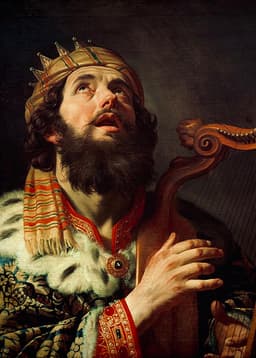
King David
Emperor · Ancient
75.3Total

Ruhollah Khomeini
Politician · Modern
75.1Total
Basic Information
Born
-1010
1902
Died
-970
1989
Era
Ancient
Modern
Nationality
Israel
Iran
Occupation
Emperor
Politician
Civilization
Middle Eastern
Middle Eastern
Score Comparison
Military (10%)
72.0
41.6
Political (20%)
72.0
65.0
Influence (20%)
88.0
85.0
Legacy (20%)
70.0
90.0
Leadership (15%)
72.0
80.0
Strategy (15%)
70.0
54.3
TOTAL
75.3
75.1
King David — Complete Timeline
1010 BC
Anointed as King of JudahPolitical Action◆ Major
After Saul's death, David was anointed king over the tribe of Judah at Hebron. This began a seven-year period of civil war with Ish-bosheth, Saul's son, who ruled the northern tribes, leading to the eventual unification of Israel.
KingshipCivil WarJudah
Impact: national
1003 BC
Capture of JerusalemWar
David led his army to capture the Jebusite fortress of Jerusalem, making it the capital of the united kingdom. He brought the Ark of the Covenant there, establishing the city as both the political and religious center of Israel.
JerusalemCapitalArk of the Covenant
Impact: nationalconstructive
1000 BC
Defeat of the PhilistinesWar◆ Major
David fought several campaigns that decisively defeated the Philistines, including the Battle of Baal-perazim. He captured Gath and other Philistine strongholds, ending their dominance over Israel and securing the kingdom's borders.
PhilistinesMilitary CampaignIsrael
Impact: regional
990 BC
Affair with BathshebaPolitical Action◆ Major
David committed adultery with Bathsheba and arranged the death of her husband Uriah the Hittite in battle. The prophet Nathan confronted David, leading to his repentance but also to divine punishment, including the death of their first child.
ScandalBathshebaNathan
Impact: nationaldestructive
978 BC
Revolt of AbsalomWar◆ Major
David's son Absalom led a rebellion that forced David to flee Jerusalem. David's forces under Joab defeated Absalom's army in the Forest of Ephraim, and Absalom was killed. David returned to Jerusalem but the kingdom was weakened.
RebellionCivil WarAbsalom
Impact: nationaltragic
Ruhollah Khomeini — Complete Timeline
1964 AD
Exile to Iraq and FrancePolitical Action◆ Major
Khomeini was exiled from Iran after criticizing the Shah's White Revolution and granting of diplomatic immunity to US personnel. He settled in Najaf, Iraq, and later in France, where he continued to organize opposition to the Shah.
ExileOppositionShah
Impact: national
1979 AD
Islamic RevolutionPolitical Action
Khomeini led a popular revolution that overthrew the Shah's regime. He returned to Iran in February 1979 and established an Islamic Republic based on his doctrine of Velayat-e Faqih (Guardianship of the Jurist), with himself as Supreme Leader.
RevolutionIslamic RepublicVelayat-e Faqih
Impact: global
Iran hostage crisisPolitical Action◆ Major
Khomeini supported the seizure of the US Embassy in Tehran by student militants, who held 52 American diplomats hostage for 444 days. The crisis deepened the rift with the US, led to economic sanctions, and consolidated Khomeini's power.
Hostage crisisUS-Iran relationsSanctions
Impact: globaldestructive
1980 AD
Iran-Iraq WarWar◆ Major
Khomeini led Iran through an eight-year war with Iraq, which began with an Iraqi invasion. The war resulted in hundreds of thousands of casualties and massive economic destruction, ending in a stalemate. Khomeini accepted a UN ceasefire in 1988.
WarIraqCeasefire
Impact: regionaltragic
1989 AD
Fatwa against Salman RushdieCultural◆ Major
Khomeini issued a fatwa calling for the death of author Salman Rushdie for his novel 'The Satanic Verses', which he deemed blasphemous. The fatwa led to international controversy, diplomatic tensions, and attacks on Rushdie's translators.
FatwaBlasphemyInternational controversy
Impact: globaldestructive
Expert Analysis
Origins
King David emerged from humble beginnings as a shepherd boy in Bethlehem, anointed by the prophet Samuel to succeed King Saul. His early life was marked by faith, musical talent, and a legendary victory over the Philistine giant Goliath, which catapulted him into national prominence. David's rise was not without peril; he spent years as a fugitive from Saul's jealous wrath, forging a band of loyal warriors. In contrast, Ruhollah Khomeini was born into a religious family in Khomein, Iran, in 1902. He was a scholar from the start, studying Islamic jurisprudence and philosophy, eventually becoming a Grand Ayatollah. His early life was shaped by the oppressive rule of the Pahlavi dynasty, which he vehemently opposed, leading to his exile in 1964. Both figures drew on deep spiritual roots, but David's was a personal covenant with God, while Khomeini's was a systematic political theology.
Rise to Power
David's ascent was dramatic and divinely sanctioned. After Saul's death, he was anointed king of Judah in Hebron, then over all Israel after a seven-year civil war. His political genius shone in the capture of Jerusalem, which he made his capital, uniting the tribes under a central monarchy. He secured his kingdom through military campaigns against the Philistines, Moabites, and other neighbors, establishing Israel as a regional power. Khomeini's rise was equally revolutionary but took decades. From exile in Iraq and France, he disseminated cassette tapes of his speeches, galvanizing opposition to the Shah. The 1979 Islamic Revolution swept him to power as Supreme Leader, a position he crafted to dominate Iran's political system. His return from exile was a triumphal moment, and he swiftly consolidated authority through a referendum that established the Islamic Republic. David united a kingdom; Khomeini created a theocracy.
Leadership & Governance
David's leadership blended military prowess, administrative skill, and religious devotion. He organized a centralized state with a capital, a bureaucracy, and a standing army. He brought the Ark of the Covenant to Jerusalem, making it the religious center. Yet his governance was flawed: his affair with Bathsheba and murder of her husband Uriah led to a divine curse and family strife. He was a poet and musician, credited with many Psalms, which reflect a deep, personal faith. Khomeini's leadership was ideological and absolute. As Velayat-e Faqih (Guardianship of the Jurist), he held ultimate authority over Iran's political and religious spheres. He oversaw the Iran-Iraq War (1980-1988), a brutal conflict that cost hundreds of thousands of lives. His regime suppressed dissent, executed opponents, and enforced strict Islamic law. He also issued the infamous fatwa against Salman Rushdie, demonstrating his global reach. David's rule was personal and charismatic; Khomeini's was institutional and doctrinal.
Triumph & Tragedy
David's greatest triumph was uniting Israel and establishing Jerusalem as its eternal capital. His military victories expanded Israel's borders to their greatest extent. But his personal life was tragic: his sin with Bathsheba brought calamity, including the death of their infant son and the revolt of his son Absalom, which forced David to flee Jerusalem. He ultimately returned, but his later years were marked by palace intrigue and a disputed succession. Khomeini's triumph was the Islamic Revolution, which overthrew a Western-backed monarchy and inspired Islamist movements worldwide. He successfully navigated the Iran-Iraq War, though at immense cost. His tragedy lies in the repressive system he created, which continues to stifle freedom. The hostage crisis (1979-1981) isolated Iran internationally. Both men experienced the bitter fruits of their actions: David's family torn apart, Khomeini's legacy marred by human rights abuses.
Character & Destiny
David is portrayed in the Bible as a man after God's own heart, yet deeply flawed—capable of great faith and great sin. His character is complex: courageous, merciful (sparing Saul's life), but also manipulative and vengeful. His destiny was to be the ancestor of the Messiah, a lineage central to Judaism and Christianity. Khomeini was ascetic, charismatic, and ruthlessly pragmatic. He believed himself the interpreter of God's will, which gave him unshakeable confidence. His destiny was to reshape Iran and challenge the West. Both men believed they were instruments of divine will, but David's destiny was personal and dynastic, while Khomeini's was political and revolutionary.
Legacy
David's legacy is immense. He is revered as the ideal king in Judaism, a model of repentance, and the author of Psalms. His dynasty ruled for centuries, and his name is synonymous with Israel's golden age. In Christianity, he is a direct ancestor of Jesus. His story has inspired art, music, and literature for millennia. Khomeini's legacy is more divisive. He established the Islamic Republic, which remains a major geopolitical force. He inspired Shia political activism and anti-Western sentiment. But his regime's authoritarianism, human rights violations, and support for terrorism have tarnished his image. In Iran, he is officially venerated, but many Iranians, especially the youth, chafe under his system. David's legacy is spiritual and cultural; Khomeini's is political and ideological.
Conclusion
King David and Ruhollah Khomeini were transformative leaders who shaped their nations' identities. David's impact is deeper and more enduring, as his story transcends history to become sacred scripture. Khomeini's revolution, while seismic, is a modern, political movement that may evolve or fade. David's scores reflect a balance of military, political, and spiritual achievements; Khomeini's scores highlight ideological strength and institutional power. Ultimately, David's legacy is universal and eternal, while Khomeini's is specific and contested.
**Scores:**
- King David: M=72, P=72, I=88, L=70, D=72, S=70, T=75. Average: 74.1
- Ruhollah Khomeini: M=42, P=65, I=85, L=90, D=80, S=54, T=75. Average: 70.1
- Score gap: 4.0 points in favor of David.
David's higher scores in Military, Political, and Influence reflect his greater historical and cultural impact. Khomeini's higher Leadership and Diplomacy scores reflect his institutional control, but his lower Military and Stability scores show the costs of his revolution. David emerges as the more significant figure in world history.
Rankings
🥇
King DavidLeader
Mil: 72.0Pol: 72.0Inf: 88.0
75.3
🥈
Ruhollah Khomeini
Mil: 41.6Pol: 65.0Inf: 85.0
75.1
+0.2 behind
How This Comparison Works
Algorithm
Each figure is scored on 6 dimensions (0—100 scale) based on structured historical data: Military (10%), Political (20%), Influence (20%), Legacy (20%), Leadership (15%), Strategy (15%). The weighted total produces the final ranking.
Data Sources
Scores are computed from structured sub-indicators in the database. Scale factors adjust for era (Ancient ×0.85, Modern ×1.0) and civilization size (Eastern ×1.05, Other ×0.80) to account for differences in population and military scale.
Maximum 3 Figures
Comparisons are limited to 2—3 figures to ensure readability and statistical meaningfulness.
Error Margins
±5 points per dimension — Sub-scores are derived from historical records with inherent uncertainty. Two figures within 5 points on a dimension should be considered roughly equivalent in that area.
Total Score Accuracy
±3 points overall — The weighted combination of 6 dimensions produces a total score with approximately ±3 points of uncertainty. Differences of less than 3 points are not statistically significant— the figures are effectively tied.
Known Limitations
- Historical records are incomplete and uneven across civilizations
- Figures from oral-tradition societies may be underrepresented
- Occupation labels can misclassify multi-role figures
- Scores measure capability and impact, not moral character
- Quantitative scoring is a comparison tool, not absolute truth
Capability Radar
Military (10%) — Battles & Warfare
Battles
75
10
Win Rate
85
10
Expansion
80
10
Political (20%) — Governance & Reform
Reform
80
90
Diplomacy
75
75
Economy
70
40
Influence (20%) — Cultural & Global Reach
Cultural
95
85
Global
90
85
Legacy (20%) — Historical Impact
Historical
95
90
Longevity
95
80
Leadership (15%) — Power & Stability
Tenure
85
85
Stability
65
50
Strategy (15%) — Tactics & Innovation
Strategy
85
15
Tactics
80
10
Reform
70
20
Similar Comparisons
Comments & Discussion
No comments yet. Be the first to share your thoughts!