Loading...
This comparison has not been analyzed yet.
One-time AI generation (~1 minute). Scores and timeline are already available below.
King Chungnyeol of Goryeo vs Stephen III of Moldavia
Stephen III of Moldavia leads by 16.3 pts · 2 figures compared
…

King Chungnyeol of Goryeo
Emperor · Medieval
47.1Total
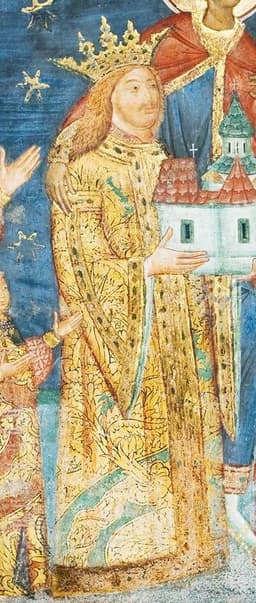
Stephen III of Moldavia
Emperor · Medieval
63.4Total
Basic Information
Born
1236
1433
Died
1308
1504
Era
Medieval
Medieval
Nationality
Korea
Moldavia
Occupation
Emperor
Emperor
Civilization
Eastern
Western
Score Comparison
Military (10%)
21.2
67.5
Political (20%)
46.6
72.0
Influence (20%)
53.3
55.0
Legacy (20%)
45.0
55.0
Leadership (15%)
65.0
79.8
Strategy (15%)
36.8
63.8
TOTAL
47.1
63.4
King Chungnyeol of Goryeo — Complete Timeline
1274 AD
Participated in Mongol Invasion of JapanWar◆ Major
King Chungnyeol provided Goryeo ships, troops, and supplies for the first Mongol invasion of Japan. Goryeo forces suffered heavy losses in the failed campaign, which ended with the destruction of the fleet by a typhoon. This strained Goryeo's resources and population.
Mongol CampaignsJapanMilitary
Impact: regionaldestructive
Married Mongol PrincessPolitical Action◆ Major
King Chungnyeol married Princess Jeguk, a daughter of Kublai Khan, becoming the first Goryeo king to take a Mongol wife. This marriage formalized the Mongol-Goryeo alliance and made Chungnyeol a Mongol son-in-law (kuregen), strengthening ties with the Yuan dynasty.
Marriage AllianceMongol InfluenceDiplomacy
Impact: national
1275 AD
Adopted Mongol Customs and DressCultural
King Chungnyeol ordered Goryeo officials to adopt Mongol hairstyles and clothing, and introduced Mongol court ceremonies. This policy aimed to appease the Yuan court but caused resentment among Korean nobles who saw it as a betrayal of Korean identity.
Cultural ChangeMongolizationControversy
Impact: national
1281 AD
Participated in Second Mongol Invasion of JapanWar◆ Major
King Chungnyeol again mobilized Goryeo's navy and army for the second Mongol invasion of Japan. The campaign ended in disaster when a typhoon (kamikaze) destroyed the combined Mongol-Goryeo fleet, resulting in massive casualties and further draining Goryeo's economy.
Mongol CampaignsJapanMilitary
Impact: regionaltragic
Stephen III of Moldavia — Complete Timeline
1475 AD
Battle of VasluiWar◆ Major
Stephen III defeated a large Ottoman army under Had
BattleOttoman-Moldavian WarMilitary Victory
Impact: regionalconstructive
1476 AD
Battle of Valea AlbăWar◆ Major
Stephen III was defeated by the Ottoman army led by Sultan Mehmed II at Valea Alb
BattleOttoman InvasionDefeat
Impact: regionaltragic
1488 AD
Built the Voroneț MonasteryCultural◆ Major
Stephen III commissioned the construction of the Vorone
MonasteryArchitectureUNESCO
Impact: regionalconstructive
1499 AD
Signed the Treaty of Suceava with PolandPolitical Action◆ Major
Stephen III signed a treaty with King John I Albert of Poland at Suceava, establishing an alliance against the Ottoman Empire and the Teutonic Knights. The treaty secured Moldavia's western border and provided for mutual military assistance.
TreatyAlliancePoland-Moldavia Relations
Impact: regionalconstructive
This comparison has not been analyzed yet.
One-time AI generation (~1 minute). Scores and timeline are already available below.
Rankings
🥇
Stephen III of MoldaviaLeader
Mil: 67.5Pol: 72.0Inf: 55.0
63.4
🥈
King Chungnyeol of Goryeo
Mil: 21.2Pol: 46.6Inf: 53.3
47.1
+16.3 behind
How This Comparison Works
Algorithm
Each figure is scored on 6 dimensions (0—100 scale) based on structured historical data: Military (10%), Political (20%), Influence (20%), Legacy (20%), Leadership (15%), Strategy (15%). The weighted total produces the final ranking.
Data Sources
Scores are computed from structured sub-indicators in the database. Scale factors adjust for era (Ancient ×0.85, Modern ×1.0) and civilization size (Eastern ×1.05, Other ×0.80) to account for differences in population and military scale.
Maximum 3 Figures
Comparisons are limited to 2—3 figures to ensure readability and statistical meaningfulness.
Error Margins
±5 points per dimension — Sub-scores are derived from historical records with inherent uncertainty. Two figures within 5 points on a dimension should be considered roughly equivalent in that area.
Total Score Accuracy
±3 points overall — The weighted combination of 6 dimensions produces a total score with approximately ±3 points of uncertainty. Differences of less than 3 points are not statistically significant— the figures are effectively tied.
Known Limitations
- Historical records are incomplete and uneven across civilizations
- Figures from oral-tradition societies may be underrepresented
- Occupation labels can misclassify multi-role figures
- Scores measure capability and impact, not moral character
- Quantitative scoring is a comparison tool, not absolute truth
Capability Radar
Military (10%) — Battles & Warfare
Battles
10
65
Win Rate
10
70
Expansion
10
55
Political (20%) — Governance & Reform
Reform
30
65
Diplomacy
70
75
Economy
30
60
Influence (20%) — Cultural & Global Reach
Cultural
30
65
Global
20
55
Legacy (20%) — Historical Impact
Historical
40
70
Longevity
30
60
Leadership (15%) — Power & Stability
Tenure
60
80
Stability
40
70
Strategy (15%) — Tactics & Innovation
Strategy
10
72
Tactics
10
75
Reform
10
60
Similar Comparisons
Comments & Discussion
No comments yet. Be the first to share your thoughts!