Loading...
King Abdullah II of Jordan vs Napoleon Bonaparte
Napoleon Bonaparte leads by 16.9 pts · 2 figures compared
…
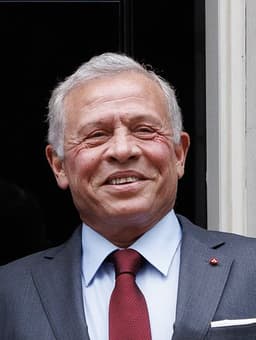
King Abdullah II of Jordan
Emperor · Modern
54.0Total

Napoleon Bonaparte
General · Modern
70.9Total
Basic Information
Born
1962
1769
Died
—
1821
Era
Modern
Modern
Nationality
Jordan
France
Occupation
Emperor
General
Civilization
Middle Eastern
Western
Score Comparison
Military (10%)
20.0
94.0
Political (20%)
72.0
72.0
Influence (20%)
58.0
40.0
Legacy (20%)
42.5
80.0
Leadership (15%)
80.0
78.0
Strategy (15%)
41.0
90.0
TOTAL
54.0
70.9
King Abdullah II of Jordan — Complete Timeline
1999 AD
Assumed the throne of JordanPolitical Action◆ Major
Abdullah II became King of Jordan on February 7, 1999, upon the death of his father King Hussein. His accession was unexpected as he was not the original heir, but Hussein changed the succession line shortly before his death.
SuccessionMonarchy
Impact: national
2000 AD
Launch of economic reforms and privatizationReform◆ Major
King Abdullah II initiated a series of economic reforms including privatization of state-owned enterprises, trade liberalization, and creation of special economic zones. These policies aimed to attract foreign investment and modernize Jordan's economy.
Economic ReformPrivatizationDevelopment
Impact: nationalconstructive
2011 AD
Jordanian role in the Arab Spring protestsPolitical Action◆ Major
King Abdullah II responded to widespread protests in Jordan during the Arab Spring by dismissing governments, enacting constitutional reforms, and promising political liberalization. He avoided the regime collapse seen in other Arab countries.
Arab SpringReformProtests
Impact: national
Syrian refugee crisis responseOther◆ Major
Under King Abdullah II's leadership, Jordan hosted over 1.3 million Syrian refugees fleeing the Syrian civil war. The influx strained Jordan's resources and infrastructure, leading to international aid agreements and humanitarian challenges.
RefugeesSyrian Civil WarHumanitarian
Impact: regional
2021 AD
Failed coup attempt and Prince Hamzah affairPolitical Action◆ Major
King Abdullah II placed his half-brother Prince Hamzah under house arrest, accusing him of involvement in a foreign-backed plot to destabilize Jordan. The incident exposed internal royal family tensions and was resolved through mediation.
Coup AttemptRoyal FamilySecurity
Impact: nationaldestructive
Napoleon Bonaparte — Complete Timeline
1799 AD
Coup of 18 BrumaireOther◆ Major
Napoleon Bonaparte, with support from his brother Lucien and key political figures, overthrew the Directory in a bloodless coup. He established the Consulate with himself as First Consul, effectively becoming the ruler of France. This event ended the French Revolution's most unstable period.
French RevolutionCoupRise to Power
Impact: regional
1804 AD
Promulgation of the Napoleonic CodeOther◆ Major
Napoleon enacted the Civil Code of the French, known as the Napoleonic Code, a comprehensive set of laws that replaced the fragmented feudal legal systems. The code established legal equality, protected property rights, and secularized law. It became the basis for legal systems in many European and world countries.
Legal ReformNapoleonic CodeCivil Law
Impact: globalconstructive
1805 AD
Battle of AusterlitzWar◆ Major
Napoleon's Grande Arm
Napoleonic WarsBattleDecisive Victory
Impact: global
1812 AD
Invasion of RussiaWar◆ Major
Napoleon led the Grande Arm
Napoleonic WarsInvasionDisaster
Impact: globaldestructive
1815 AD
Battle of WaterlooWar◆ Major
Napoleon's French army was defeated by the combined forces of the Duke of Wellington's Anglo-Allied army and Gebhard Leberecht von Bl
Napoleonic WarsBattleFinal Defeat
Impact: globaldestructive
Expert Analysis
king-abdullah-ii-of-jordan-vs-napoleon-bonaparte
# The Emperor and the King: Two Paths to Power in a Modern Age
On a gray February morning in 1999, a forty-six-year-old monarch with a lifetime of experience was laid to rest in Amman, and a thirty-seven-year-old former tank commander with no expectation of ruling ascended the throne. Half a world away and nearly two centuries earlier, a young artillery officer from Corsica was watching the chaos of revolution consume France, calculating his moment. Both men would become rulers. One would conquer Europe and die in exile on a remote island. The other would navigate the treacherous currents of the Middle East for a quarter-century, still reigning as his region burned around him. What made the difference?
Origins
Napoleon Bonaparte was born in 1769 on the island of Corsica, a place only recently annexed by France. His family was minor nobility, but poor—the kind of poverty that breeds either resentment or ambition. Young Napoleon spoke Italian before French, and his schoolmates mocked his accent. He was an outsider who desperately wanted in. The French Revolution, which toppled the old aristocracy, became his ladder. A world that had no place for a Corsican upstart suddenly needed talented officers, and Napoleon was nothing if not talented.
King Abdullah II of Jordan was born in 1962, the eldest son of King Hussein but not the intended heir. His father had designated his own brother Hassan as crown prince for decades. Abdullah grew up in palaces but was sent to British military academies, trained as a soldier, commanded a tank battalion. He was a professional warrior, not a politician. When his father lay dying in 1999, the king changed his mind on his deathbed, naming Abdullah as successor. The son had never prepared for this. He had prepared for combat.
The difference in their origins is not merely one of geography or century. Napoleon emerged from a world being torn apart, where old structures were collapsing and a single determined man could redraw the map. Abdullah inherited a fragile kingdom in a region where survival required not conquest but balance.
Rise to Power
Napoleon’s ascent was a series of calculated gambles that paid off spectacularly. In 1793, at age twenty-four, he drove British forces from Toulon and was promoted to brigadier general. In 1795, he saved the revolutionary government from a royalist uprising with a “whiff of grapeshot”—cannon fire into the streets of Paris. By 1796, he commanded the Army of Italy and proceeded to defeat larger Austrian forces with stunning speed. Each victory made him more indispensable. In 1799, he staged a coup and made himself First Consul. By 1804, he crowned himself Emperor.
Abdullah’s rise was a matter of fate, not strategy. He became king on February 7, 1999, because his father willed it. There was no coup, no battlefield, no dramatic seizure of power. There was only a dying king’s last decision and a son’s duty to accept it. The contrast is stark: Napoleon created his own opportunity through violence and genius; Abdullah received his through inheritance and responsibility.
Leadership & Governance
Napoleon ruled through force and brilliance. His military genius—scored at 94 for military and 93 for strategy—was undeniable. He reformed French law with the Napoleonic Code, established the Bank of France, and built a centralized state that outlasted his empire. But he also fought constantly, draining France of men and treasure. His political score of 75 reflects a ruler who could organize but could not compromise. He demanded absolute control and got it, until he didn’t.
Abdullah’s leadership score of 80.8 is remarkably close to Napoleon’s 80, but the content of their leadership could not differ more. Abdullah rules a small, resource-poor kingdom surrounded by chaos. He has no army to conquer neighbors. His military score of 50.8 reflects a country that cannot project power but must defend itself. Instead of conquest, he pursues stability. He launched economic reforms and privatization in 2000, trying to modernize a fragile economy. When the Arab Spring erupted in 2011, he dismissed governments and enacted constitutional changes to absorb pressure. He did not crush protests with cannon fire; he adapted.
Then came the Syrian refugee crisis. Jordan hosted over 1.3 million refugees, a number equal to roughly a fifth of its population. Napoleon would have seen refugees as a problem to be expelled or exploited. Abdullah saw them as a humanitarian obligation and a political burden he could not simply discard.
Triumph & Tragedy
Napoleon’s greatest triumph was the series of victories from Austerlitz in 1805 to Jena in 1806, when he dominated Europe as no one had since Charlemagne. His greatest tragedy was the invasion of Russia in 1812, where he lost his Grand Army to winter and Russian strategy. He was exiled to Elba in 1814, returned for one hundred days in 1815, and was finally defeated at Waterloo. He died in 1821 on Saint Helena, a prisoner.
Abdullah’s triumphs are quieter. He has kept Jordan stable while Iraq, Syria, and the Palestinian territories descended into violence. His tragedy might be the failed coup attempt in 2021, when he placed his half-brother Prince Hamzah under house arrest, accusing him of involvement in a foreign-backed plot. The drama unfolded not on a battlefield but in the royal court, with whispers of betrayal within his own family. Napoleon’s enemies were foreign armies; Abdullah’s enemies sometimes share his blood.
Character & Destiny
Napoleon was driven by an insatiable hunger for glory. “Impossible is a word to be found only in the dictionary of fools,” he said. He believed destiny had chosen him, and he acted accordingly. This confidence made him great and also doomed him. He could not stop. Conquest was not a means to an end; it was the end itself.
Abdullah, by contrast, seems to understand that survival is victory. He inherited a kingdom with few natural resources, no oil, and borders that touch Israel, Syria, Iraq, and Saudi Arabia. His strategy score of 53.6 reflects not a lack of intelligence but a reality in which grand strategy is impossible. He must react, adapt, and endure. His character is that of a caretaker, not a conqueror.
Legacy
Napoleon’s legacy score of 78 reflects the paradox of his life. He is remembered as a military genius, a reformer, and a tyrant. The Napoleonic Code influences legal systems worldwide. His name still evokes both admiration and horror. He changed the world, but he also devastated it.
Abdullah’s legacy is still being written. His score of 55.6 reflects uncertainty. Will Jordan survive the next decade? Will his reforms take root? Or will the kingdom collapse under the weight of refugees and regional war? He has not conquered anything, but he has kept a small country alive in a neighborhood where countries die.
Conclusion
Standing on a balcony in Paris in 1804, Napoleon placed a crown on his own head. He took what he wanted because he could. In a palace in Amman in 1999, a son knelt before his father’s body and accepted a crown he had not sought. Two men, two centuries, two different definitions of power. Napoleon proves that greatness can be seized. Abdullah proves that survival can be a kind of greatness too. The conqueror built an empire that collapsed. The caretaker built a kingdom that endures, day by day, crisis by crisis. Which is the greater achievement? The answer depends on whether you measure history by how much you take or how much you keep.
Rankings
🥇
Napoleon BonaparteLeader
Mil: 94.0Pol: 72.0Inf: 40.0
70.9
🥈
King Abdullah II of Jordan
Mil: 20.0Pol: 72.0Inf: 58.0
54.0
+16.9 behind
How This Comparison Works
Algorithm
Each figure is scored on 6 dimensions (0—100 scale) based on structured historical data: Military (10%), Political (20%), Influence (20%), Legacy (20%), Leadership (15%), Strategy (15%). The weighted total produces the final ranking.
Data Sources
Scores are computed from structured sub-indicators in the database. Scale factors adjust for era (Ancient ×0.85, Modern ×1.0) and civilization size (Eastern ×1.05, Other ×0.80) to account for differences in population and military scale.
Maximum 3 Figures
Comparisons are limited to 2—3 figures to ensure readability and statistical meaningfulness.
Error Margins
±5 points per dimension — Sub-scores are derived from historical records with inherent uncertainty. Two figures within 5 points on a dimension should be considered roughly equivalent in that area.
Total Score Accuracy
±3 points overall — The weighted combination of 6 dimensions produces a total score with approximately ±3 points of uncertainty. Differences of less than 3 points are not statistically significant— the figures are effectively tied.
Known Limitations
- Historical records are incomplete and uneven across civilizations
- Figures from oral-tradition societies may be underrepresented
- Occupation labels can misclassify multi-role figures
- Scores measure capability and impact, not moral character
- Quantitative scoring is a comparison tool, not absolute truth
Capability Radar
Military (10%) — Battles & Warfare
Battles
10
95
Win Rate
10
90
Expansion
5
95
Political (20%) — Governance & Reform
Reform
60
95
Diplomacy
75
80
Economy
55
85
Influence (20%) — Cultural & Global Reach
Cultural
40
85
Global
50
90
Legacy (20%) — Historical Impact
Historical
35
95
Longevity
30
90
Leadership (15%) — Power & Stability
Tenure
70
85
Stability
65
70
Strategy (15%) — Tactics & Innovation
Strategy
20
95
Tactics
15
98
Reform
30
92
Similar Comparisons
Comments & Discussion
TankCorsair6/17/2026
As a military historian, the real difference isn't ambition—it's terrain. Napoleon conquered open plains with massed artillery and speed. Abdullah rules a country with no oil, surrounded by Israel, Syria, Iraq, and Saudi Arabia. Napoleon never had to negotiate with four hostile neighbors while running a kingdom that’s 90% desert. One won battles, the other won survival. Give me the tank commander who kept his throne through the Iraq War and Arab Spring over any emperor who couldn't hold Waterloo
沙漠老兵6/17/2026
数据不会骗人:拿破仑打了60多场战役,赢了50多场,最后被流放孤岛;阿卜杜拉二世在位25年,一国GDP从90亿美元涨到500亿,失业率从15%降到12%。你们崇拜的战争天才让法国人口减少150万,而这位亲西方君主让约旦人均寿命从71岁升到76岁。说谁更成功?看数字,别吹嘘光荣。
LegitimacyLens6/17/2026
Classics scholar here. Napoleon’s legitimacy came from the sword—he crowned himself with stolen imperial laurels. Abdullah’s comes from lineage tracing back to the Prophet Muhammad through the Hashimite line. Napoleon had to conquer to prove he belonged; Abdullah was born into a role he never expected—his father’s brother was crown prince for decades. One built a throne on blood, the other inherited a fragile dynasty and chose to modernize. History will remember the emperor’s ambition, but the k
波斯湾旁观者6/17/2026
别吹什么伟大将领了,阿卜杜拉二世就是个美国傀儡。他爹侯赛因国王还敢在中东打几场仗,这位呢?2003年乖乖让美军借道入侵伊拉克,2011年镇压阿拉伯之春抗议者。拿破仑至少是个混蛋,但他是自己的混蛋。这位约旦国王有多少主权?他的“稳定”全靠美国每年15亿援助撑着。要我说,两个都是历史注脚,只是一个带着王冠跳舞。