Loading...
Khawaja Nazimuddin vs Vladko Macek
Vladko Macek leads by 3.0 pts · 2 figures compared
…
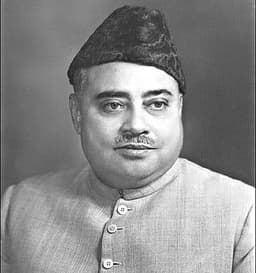
Khawaja Nazimuddin
Politician · Modern
50.1Total

Vladko Macek
Politician · Modern
53.1Total
Basic Information
Born
1894
1879
Died
1964
1964
Era
Modern
Modern
Nationality
Pakistan
Croatia
Occupation
Politician
Politician
Civilization
Indian
Western
Score Comparison
Military (10%)
46.3
50.0
Political (20%)
43.7
61.3
Influence (20%)
52.5
54.1
Legacy (20%)
41.7
45.0
Leadership (15%)
62.2
65.7
Strategy (15%)
60.0
43.2
TOTAL
50.1
53.1
Khawaja Nazimuddin — Complete Timeline
1948 AD
Appointed Governor-General of PakistanPolitical Action◆ Major
Khawaja Nazimuddin succeeded Muhammad Ali Jinnah as Governor-General after Jinnah's death. He served as the ceremonial head of state during a critical period of consolidation. His tenure saw the early challenges of nation-building and the Kashmir conflict.
Governor-GeneralSuccession
Impact: national
1951 AD
Became Prime Minister of PakistanPolitical Action◆ Major
After the assassination of Liaquat Ali Khan, Nazimuddin became Prime Minister. He faced economic difficulties and political unrest. His government struggled to maintain stability and was dismissed in 1953 by Governor-General Ghulam Muhammad.
Prime MinisterPolitical Instability
Impact: national
1953 AD
Dismissed by Governor-General Ghulam MuhammadPolitical Action◆ Major
Governor-General Ghulam Muhammad dismissed Nazimuddin's government, citing its failure to maintain law and order during the anti-Ahmadiyya riots. The dismissal was controversial and set a precedent for executive overreach. It highlighted the fragility of parliamentary democracy in Pakistan.
DismissalConstitutional Crisis
Impact: nationaldestructive
Vladko Macek — Complete Timeline
1928 AD
Leadership of the Croatian Peasant PartyPolitical Action
After the assassination of Stjepan Radi
Political LeadershipCroatian AutonomyHSS
Impact: regionalconstructive
1939 AD
Negotiation of the Cvetković-Maček AgreementPolitical Action
Maček negotiated the Cvetković-Maček Agreement with Yugoslav Prime Minister Dragiša Cvetković, creating the autonomous Banovina of Croatia within the Kingdom of Yugoslavia. This agreement granted Croats significant self-governance, including a separate parliament and administration.
Autonomy AgreementCroatian RightsYugoslavia
Impact: regionalconstructive
1941 AD
Refusal to Lead the Independent State of CroatiaPolitical Action◆ Major
After the Axis invasion of Yugoslavia, the Germans offered Ma
RefusalWorld War IIUstaše
Impact: regional
1945 AD
Exile and Return to YugoslaviaPolitical Action
After the war, Ma
ExileReturnCommunist Yugoslavia
Impact: national
Expert Analysis
Origins
Khawaja Nazimuddin was born in 1894 in Dhaka, then part of British India, into a wealthy Muslim landowning family. He studied at Aligarh Muslim University and later at Cambridge, where he earned a law degree. His early career included teaching and law practice before entering politics through the Muslim League in the 1920s.
Vladko Macek was born in 1879 in Jastrebarsko, Croatia, then part of Austria-Hungary, into a middle-class family. He studied law at the University of Zagreb and became a lawyer. He joined the Croatian Peasant Party (HSS) early, working under Stjepan Radić, and was deeply involved in agrarian politics.
Rise to Power
Nazimuddin rose through the Muslim League, becoming a close associate of Muhammad Ali Jinnah. He served as Chief Minister of East Bengal from 1947 until 1948, when he was appointed Governor-General of Pakistan after Jinnah's death. This was a major turning point, as he became the ceremonial head of state during a critical period of nation-building. After the assassination of Prime Minister Liaquat Ali Khan in 1951, Nazimuddin became Prime Minister, consolidating executive power.
Macek's rise came after the assassination of Stjepan Radić in 1928. As the new leader of the HSS, he transformed it into a disciplined political force, advocating for Croatian autonomy within Yugoslavia. His key turning point was the negotiation of the Cvetković-Maček Agreement in 1939, which created the autonomous Banovina of Croatia. This agreement scored him a political score of 61.3, reflecting his diplomatic skill.
Leadership & Governance
Nazimuddin's leadership style was cautious and consensus-oriented. As Prime Minister, he faced severe economic difficulties, including a food crisis and foreign exchange shortage. His government attempted to stabilize the economy but was hampered by political infighting. He also faced the anti-Ahmadiyya riots in 1953, which his government failed to contain. Ultimately, Governor-General Ghulam Muhammad dismissed him, citing failure to maintain law and order. His leadership score of 62.2 is balanced by low strategic and political scores.
Macek's governance approach was pragmatic and focused on autonomy. As leader of the HSS, he built a broad coalition of Croat interests. The Cvetković-Maček Agreement gave Croats significant self-government, including control over education, justice, and internal affairs. However, Macek refused to lead the Independent State of Croatia under Axis control in 1941, choosing instead to withdraw from active politics. This decision preserved his moral standing but limited his wartime influence. His political score of 61.3 and leadership score of 65.7 reflect his effectiveness.
Triumph & Tragedy
Nazimuddin's greatest success was his role in the early consolidation of Pakistan, serving as Governor-General during a time of transition. His greatest failure was his dismissal as Prime Minister, which highlighted his inability to manage crises. The anti-Ahmadiyya riots exposed the weakness of his government, and his removal set a precedent for military-bureaucratic intervention in politics. His total score of 50.1 reflects mixed effectiveness.
Macek's triumph was the Cvetković-Maček Agreement, which achieved Croatian autonomy without violence. His tragedy was the failure of the agreement to survive World War II, as the Axis invasion dismantled Yugoslavia. His refusal to lead the Independent State of Croatia, while principled, left him marginalized. After the war, he went into exile, returning only briefly before his death in 1964. His total score of 53.1 is slightly higher than Nazimuddin's.
Character & Destiny
Nazimuddin was known for his humility and piety, but his cautious nature made him indecisive in crises. He relied heavily on civil servants and failed to assert authority over his cabinet. His dismissal showed that he lacked the political ruthlessness needed in turbulent times. Historians often view him as a transitional figure who was overwhelmed by the challenges of new statehood.
Macek was a pragmatic negotiator, skilled in compromise. His refusal to collaborate with the Axis demonstrated his commitment to democratic principles, but it also removed him from power at a crucial moment. His destiny was shaped by the forces of war and nationalism, which ultimately sidelined him. His character allowed him to achieve autonomy but not to sustain it.
Legacy
Nazimuddin's legacy is mixed. He is remembered as a loyal lieutenant of Jinnah but a weak prime minister. His dismissal contributed to the erosion of democratic norms in Pakistan, as it empowered the governor-general to remove elected governments. His influence score of 52.5 reflects his role in early Pakistan, but his legacy score of 41.7 is low due to his limited lasting impact.
Macek's legacy is more substantial in Croatia. The Cvetković-Maček Agreement is seen as a milestone in Croatian autonomy, and the HSS continued as a political force. However, his decision to go into exile reduced his post-war influence. His legacy score of 45.0 is moderate, reflecting his contribution to Croatian national aspirations.
Conclusion
Vladko Macek had a greater impact than Khawaja Nazimuddin. Macek's negotiation of the Cvetković-Maček Agreement achieved concrete autonomy for Croats within Yugoslavia, a significant political achievement. His leadership score of 65.7 and political score of 61.3 are higher than Nazimuddin's 62.2 and 43.7. While Nazimuddin played a role in Pakistan's early years, his dismissal highlighted his failure to govern effectively. Macek's strategic decision to refuse Axis collaboration preserved his integrity, even if it limited his power. Overall, Macek's ability to secure autonomy for his people outweighs Nazimuddin's brief tenure as prime minister.
Rankings
🥇
Vladko MacekLeader
Mil: 50.0Pol: 61.3Inf: 54.1
53.1
🥈
Khawaja Nazimuddin
Mil: 46.3Pol: 43.7Inf: 52.5
50.1
+3.0 behind
How This Comparison Works
Algorithm
Each figure is scored on 6 dimensions (0—100 scale) based on structured historical data: Military (10%), Political (20%), Influence (20%), Legacy (20%), Leadership (15%), Strategy (15%). The weighted total produces the final ranking.
Data Sources
Scores are computed from structured sub-indicators in the database. Scale factors adjust for era (Ancient ×0.85, Modern ×1.0) and civilization size (Eastern ×1.05, Other ×0.80) to account for differences in population and military scale.
Maximum 3 Figures
Comparisons are limited to 2—3 figures to ensure readability and statistical meaningfulness.
Error Margins
±5 points per dimension — Sub-scores are derived from historical records with inherent uncertainty. Two figures within 5 points on a dimension should be considered roughly equivalent in that area.
Total Score Accuracy
±3 points overall — The weighted combination of 6 dimensions produces a total score with approximately ±3 points of uncertainty. Differences of less than 3 points are not statistically significant— the figures are effectively tied.
Known Limitations
- Historical records are incomplete and uneven across civilizations
- Figures from oral-tradition societies may be underrepresented
- Occupation labels can misclassify multi-role figures
- Scores measure capability and impact, not moral character
- Quantitative scoring is a comparison tool, not absolute truth
Capability Radar
Military (10%) — Battles & Warfare
Battles
42
31
Win Rate
46
29
Expansion
50
33
Political (20%) — Governance & Reform
Reform
30
45
Diplomacy
35
55
Economy
25
30
Influence (20%) — Cultural & Global Reach
Cultural
20
35
Global
25
20
Legacy (20%) — Historical Impact
Historical
30
40
Longevity
20
30
Leadership (15%) — Power & Stability
Tenure
40
40
Stability
20
25
Strategy (15%) — Tactics & Innovation
Strategy
53
40
Tactics
55
43
Reform
59
42
Similar Comparisons
Comments & Discussion
No comments yet. Be the first to share your thoughts!