Loading...
This comparison has not been analyzed yet.
One-time AI generation (~1 minute). Scores and timeline are already available below.
Kevin Rudd vs Nikola Pasic
Nikola Pasic leads by 4.2 pts · 2 figures compared
…
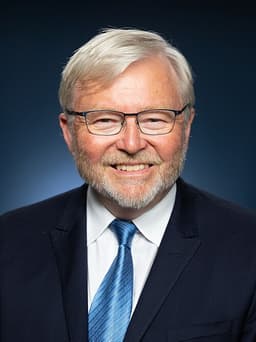
Kevin Rudd
Politician · Modern
56.0Total
Nikola Pasic
Politician · Modern
60.2Total
Basic Information
Born
1957
1845
Died
—
1926
Era
Modern
Modern
Nationality
Australia
Serbia
Occupation
Politician
Politician
Civilization
Western
Western
Score Comparison
Military (10%)
47.3
50.0
Political (20%)
68.0
78.0
Influence (20%)
60.0
58.0
Legacy (20%)
47.5
52.0
Leadership (15%)
67.0
78.0
Strategy (15%)
41.9
42.7
TOTAL
56.0
60.2
Kevin Rudd — Complete Timeline
2007 AD
Ratification of the Kyoto ProtocolPolitical Action◆ Major
Rudd's government ratified the Kyoto Protocol to the UN Framework Convention on Climate Change, reversing the Howard government's refusal. This committed Australia to reducing greenhouse gas emissions, though targets were later criticized as insufficient.
Climate ChangeEnvironment
Impact: globalconstructive
2008 AD
Global Financial Crisis stimulus packageReform◆ Major
Rudd's government implemented a $42 billion stimulus package in response to the Global Financial Crisis, including cash payments to households and infrastructure spending. Australia avoided recession, but the package increased national debt.
EconomyStimulus
Impact: nationalconstructive
Apology to the Stolen GenerationsPolitical Action◆ Major
Prime Minister Kevin Rudd delivered a formal apology in Parliament to Indigenous Australians affected by the forced removal of children, known as the Stolen Generations. The apology was a landmark moment in reconciliation, though it did not include compensation.
Indigenous RightsReconciliation
Impact: nationalconstructive
2009 AD
Defeat of the Carbon Pollution Reduction SchemePolitical Action◆ Major
Rudd's proposed Carbon Pollution Reduction Scheme, a cap-and-trade system, was rejected by the Senate twice. The failure to pass climate legislation damaged his political standing and contributed to his removal as Labor leader in 2010.
Climate ChangeLegislative Failure
Impact: nationaldestructive
Nikola Pasic — Complete Timeline
1878 AD
Led Serbia at the Congress of BerlinPolitical Action◆ Major
Pasic was a delegate at the Congress of Berlin, which recognized Serbia's independence from the Ottoman Empire. The congress also expanded Serbian territory, though not as much as hoped.
Congress of BerlinSerbian IndependenceDiplomacy
Impact: regionalconstructive
1881 AD
Co-founded the Radical PartyPolitical Action◆ Major
Nikola Pasic co-founded the People's Radical Party in Serbia, which became the dominant political force. The party advocated for parliamentary democracy, constitutional reform, and Serbian nationalism.
Radical PartySerbian PoliticsPolitical Party
Impact: nationalconstructive
1891 AD
Became Prime Minister of SerbiaPolitical Action◆ Major
Nikola Pasic became Prime Minister of Serbia for the first time in February 1891. He would serve multiple terms, becoming the longest-serving prime minister in Serbian history.
Prime MinisterSerbian GovernmentPolitical Leadership
Impact: nationalconstructive
1917 AD
Signed the Corfu DeclarationPolitical Action◆ Major
As Prime Minister in exile, Pasic signed the Corfu Declaration in July 1917 with the Yugoslav Committee. The declaration outlined the plan for a unified South Slavic state after World War I.
Corfu DeclarationYugoslav UnificationWorld War I
Impact: regionalconstructive
1918 AD
Became Prime Minister of the Kingdom of Serbs, Croats, and SlovenesPolitical Action◆ Major
Pasic became the first Prime Minister of the newly formed Kingdom of Serbs, Croats, and Slovenes in December 1918. He played a key role in shaping the new state's constitution and policies.
YugoslaviaPrime MinisterState Formation
Impact: regionalconstructive
This comparison has not been analyzed yet.
One-time AI generation (~1 minute). Scores and timeline are already available below.
Rankings
🥇
Nikola PasicLeader
Mil: 50.0Pol: 78.0Inf: 58.0
60.2
🥈
Kevin Rudd
Mil: 47.3Pol: 68.0Inf: 60.0
56.0
+4.2 behind
How This Comparison Works
Algorithm
Each figure is scored on 6 dimensions (0—100 scale) based on structured historical data: Military (10%), Political (20%), Influence (20%), Legacy (20%), Leadership (15%), Strategy (15%). The weighted total produces the final ranking.
Data Sources
Scores are computed from structured sub-indicators in the database. Scale factors adjust for era (Ancient ×0.85, Modern ×1.0) and civilization size (Eastern ×1.05, Other ×0.80) to account for differences in population and military scale.
Maximum 3 Figures
Comparisons are limited to 2—3 figures to ensure readability and statistical meaningfulness.
Error Margins
±5 points per dimension — Sub-scores are derived from historical records with inherent uncertainty. Two figures within 5 points on a dimension should be considered roughly equivalent in that area.
Total Score Accuracy
±3 points overall — The weighted combination of 6 dimensions produces a total score with approximately ±3 points of uncertainty. Differences of less than 3 points are not statistically significant— the figures are effectively tied.
Known Limitations
- Historical records are incomplete and uneven across civilizations
- Figures from oral-tradition societies may be underrepresented
- Occupation labels can misclassify multi-role figures
- Scores measure capability and impact, not moral character
- Quantitative scoring is a comparison tool, not absolute truth
Capability Radar
Military (10%) — Battles & Warfare
Battles
31
27
Win Rate
34
30
Expansion
36
37
Political (20%) — Governance & Reform
Reform
55
75
Diplomacy
60
80
Economy
45
60
Influence (20%) — Cultural & Global Reach
Cultural
40
40
Global
50
50
Legacy (20%) — Historical Impact
Historical
55
70
Longevity
30
60
Leadership (15%) — Power & Stability
Tenure
30
85
Stability
40
55
Strategy (15%) — Tactics & Innovation
Strategy
35
39
Tactics
42
40
Reform
43
44
Similar Comparisons
Comments & Discussion
No comments yet. Be the first to share your thoughts!