Loading...
Kato Takaaki vs Tarō Asō
Kato Takaaki leads by 6.7 pts · 2 figures compared
…
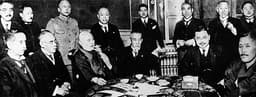
Kato Takaaki
Politician · Modern
52.3Total

Tarō Asō
Politician · Modern
45.6Total
Basic Information
Born
1860
1940
Died
1926
—
Era
Modern
Modern
Nationality
Japan
Japan
Occupation
Politician
Politician
Civilization
Eastern
Eastern
Score Comparison
Military (10%)
14.8
11.7
Political (20%)
55.0
68.0
Influence (20%)
59.0
53.3
Legacy (20%)
56.0
41.7
Leadership (15%)
72.0
53.2
Strategy (15%)
30.6
25.1
TOTAL
52.3
45.6
Kato Takaaki — Complete Timeline
1924 AD
Formation of the Kenseikai-CabinetPolitical Action
Kato became Prime Minister in June 1924, leading a coalition cabinet of the Kenseikai, Seiyukai, and Kakushin clubs. This government, known as the 'Mitsubishi Cabinet' due to Kato's ties to the Mitsubishi zaibatsu, pursued moderate foreign policy and domestic reforms.
Cabinet FormationCoalition Government
Impact: national
1925 AD
Enactment of Universal Male Suffrage LawReform◆ Major
As Prime Minister, Kato Takaaki pushed through the Universal Male Suffrage Law, which abolished tax-based voting qualifications and granted voting rights to all male citizens aged 25 and over. This expanded the electorate from about 3 million to over 12 million, marking a major step toward democracy in Japan.
DemocracyVoting RightsTaisho Democracy
Impact: nationalprogressive
Passage of the Peace Preservation LawPolitical Action◆ Major
Kato's government also enacted the Peace Preservation Law, which criminalized advocating for the abolition of private property or altering the national polity. This law was used to suppress leftist political movements and marked a turn toward authoritarianism.
RepressionAuthoritarianismPolitical Control
Impact: nationaldestructive
Normalization of Relations with the Soviet UnionPolitical Action◆ Major
Kato's government signed the Soviet-Japanese Basic Convention, establishing diplomatic relations with the Soviet Union. Japan recognized the Soviet government and withdrew troops from northern Sakhalin in exchange for oil and coal concessions.
DiplomacySoviet UnionForeign Policy
Impact: regionalconstructive
1926 AD
Death in OfficeOther◆ Major
Kato Takaaki died of pneumonia on January 28, 1926, while still serving as Prime Minister. His death ended the Kenseikai-led government and marked the end of the Taisho Democracy era's reformist momentum.
DeathEnd of Era
Impact: nationaltragic
Tarō Asō — Complete Timeline
2008 AD
Elected Prime Minister of JapanPolitical Action◆ Major
Asō was elected as Prime Minister of Japan after winning the LDP leadership election. He succeeded Yasuo Fukuda and formed a cabinet during the global financial crisis.
JapanPrime MinisterLDP
Impact: national
2009 AD
Implemented economic stimulus packageReform◆ Major
Asō's government enacted a 15.4 trillion yen economic stimulus package to combat the global financial crisis. The measures included cash handouts to households, tax cuts, and public works spending.
JapanEconomic StimulusFinancial Crisis
Impact: nationalconstructive
Lost general election to DPJPolitical Action◆ Major
Asō's LDP suffered a historic defeat in the 2009 general election, losing to the Democratic Party of Japan. This ended the LDP's nearly unbroken 54-year hold on power, and Asō resigned as party leader.
JapanElectionLDP Defeat
Impact: nationaltragic
2012 AD
Appointed Deputy Prime Minister and Finance MinisterPolitical Action◆ Major
Asō was appointed Deputy Prime Minister and Minister of Finance under Prime Minister Shinzo Abe. He served in this role from 2012 to 2021, implementing Abenomics policies including aggressive monetary easing and fiscal stimulus.
JapanFinance MinisterAbenomics
Impact: national
Expert Analysis
Origins
**Kato Takaaki** was born on January 3, 1860, in Aichi Prefecture, into a samurai family. He studied at the Imperial University of Tokyo and entered the Ministry of Finance in 1880. His early career as a diplomat included postings to London and Berlin, shaping his international perspective. He later joined the political party Kenseikai, advocating for constitutional governance.
**Tarō Asō** was born on September 20, 1940, in Fukuoka Prefecture, into a wealthy political family. His grandfather was Prime Minister Shigeru Yoshida, and his brother-in-law was Emperor Akihito. He studied at Gakushuin University and later at Stanford University. He entered the family business before becoming a member of the House of Representatives in 1979, representing the Liberal Democratic Party (LDP).
Rise to Power
Kato's rise came through diplomatic service and party politics. He served as Foreign Minister under multiple cabinets and became president of the Kenseikai in 1915. His key turning point came in 1924 when he formed a coalition cabinet with the Seiyukai and Kakushin clubs, known as the "Mitsubishi Cabinet" due to his ties with the Mitsubishi zaibatsu. He became Prime Minister on June 11, 1924.
Asō rose through the LDP ranks, holding ministerial posts in economic and foreign affairs. He became LDP Secretary-General and then Prime Minister on September 24, 2008, after winning the party leadership election. He succeeded Yasuo Fukuda during the global financial crisis.
Leadership & Governance
Kato's leadership focused on democratic reforms. His major achievement was the Universal Male Suffrage Law of 1925, which abolished tax-based voting qualifications, expanding the electorate from 3.3 million to 12.6 million. However, his government also passed the Peace Preservation Law, which suppressed leftist movements. Kato scored 72.0 in leadership, reflecting his ability to push through major legislation.
Asō's governance was dominated by economic crisis management. He implemented a 15.4 trillion yen stimulus package, including cash handouts and infrastructure spending. However, his leadership score of 53.2 reflects his unpopularity, with approval ratings falling below 20%. His political score of 68.0 indicates his skill in navigating party politics.
Triumph & Tragedy
Kato's triumph was the universal suffrage law, a landmark in Japanese democracy. His tragedy was the simultaneous Peace Preservation Law, which curbed civil liberties. He died in office on January 28, 1926, from pneumonia, ending his reform agenda.
Asō's triumph was his role as Finance Minister under Shinzo Abe from 2012 to 2021, implementing Abenomics' stimulus policies. His tragedy was the 2009 election loss, where the LDP suffered a historic defeat to the Democratic Party of Japan, ending its 54-year rule. He scored 41.7 in legacy, lower than Kato's 56.0.
Character & Destiny
Kato was a pragmatic diplomat, willing to compromise for reform. His decision to pass both suffrage and peace preservation laws shows his balancing act between democracy and order. His death cut short his potential.
Asō was known for blunt remarks, often causing controversy. His aristocratic background and gaffe-prone style contributed to his low approval. He persisted in politics, returning as Finance Minister, showing resilience.
Legacy
Kato's universal suffrage law laid the foundation for Japan's post-war democracy. His scores: military 14.8, political 55.0, influence 59.0, legacy 56.0, leadership 72.0, strategy 30.6, total 52.3.
Asō's legacy is tied to Abenomics and the LDP's resilience. His scores: military 11.7, political 68.0, influence 53.3, legacy 41.7, leadership 53.2, strategy 25.1, total 45.6. The score gap of 6.7 points reflects Kato's greater impact.
Conclusion
Kato Takaaki had a greater impact than Tarō Asō. His universal suffrage law was a foundational democratic reform, while Asō's economic policies, though significant, were less transformative. Kato's 72.0 leadership score and 56.0 legacy score surpass Asō's 53.2 and 41.7. Despite Asō's longer career, Kato's single term produced more enduring change.
Rankings
🥇
Kato TakaakiLeader
Mil: 14.8Pol: 55.0Inf: 59.0
52.3
🥈
Tarō Asō
Mil: 11.7Pol: 68.0Inf: 53.3
45.6
+6.7 behind
How This Comparison Works
Algorithm
Each figure is scored on 6 dimensions (0—100 scale) based on structured historical data: Military (10%), Political (20%), Influence (20%), Legacy (20%), Leadership (15%), Strategy (15%). The weighted total produces the final ranking.
Data Sources
Scores are computed from structured sub-indicators in the database. Scale factors adjust for era (Ancient ×0.85, Modern ×1.0) and civilization size (Eastern ×1.05, Other ×0.80) to account for differences in population and military scale.
Maximum 3 Figures
Comparisons are limited to 2—3 figures to ensure readability and statistical meaningfulness.
Error Margins
±5 points per dimension — Sub-scores are derived from historical records with inherent uncertainty. Two figures within 5 points on a dimension should be considered roughly equivalent in that area.
Total Score Accuracy
±3 points overall — The weighted combination of 6 dimensions produces a total score with approximately ±3 points of uncertainty. Differences of less than 3 points are not statistically significant— the figures are effectively tied.
Known Limitations
- Historical records are incomplete and uneven across civilizations
- Figures from oral-tradition societies may be underrepresented
- Occupation labels can misclassify multi-role figures
- Scores measure capability and impact, not moral character
- Quantitative scoring is a comparison tool, not absolute truth
Capability Radar
Military (10%) — Battles & Warfare
Battles
13
14
Win Rate
15
19
Expansion
23
20
Political (20%) — Governance & Reform
Reform
75
45
Diplomacy
70
50
Economy
55
55
Influence (20%) — Cultural & Global Reach
Cultural
40
20
Global
45
30
Legacy (20%) — Historical Impact
Historical
60
25
Longevity
50
15
Leadership (15%) — Power & Stability
Tenure
60
60
Stability
50
40
Strategy (15%) — Tactics & Innovation
Strategy
24
26
Tactics
26
23
Reform
29
31
Similar Comparisons
Comments & Discussion
No comments yet. Be the first to share your thoughts!