Loading...
Kaikhusrau Jahan vs Napoleon Bonaparte
Napoleon Bonaparte leads by 16.6 pts · 2 figures compared
…
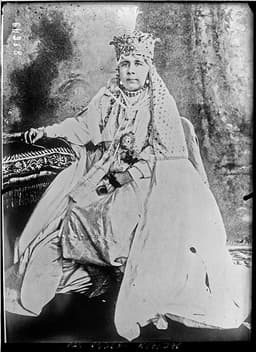
Kaikhusrau Jahan
Emperor · Modern
54.3Total

Napoleon Bonaparte
General · Modern
70.9Total
Basic Information
Born
1858
1769
Died
1930
1821
Era
Modern
Modern
Nationality
India
France
Occupation
Emperor
General
Civilization
Indian
Western
Score Comparison
Military (10%)
42.8
94.0
Political (20%)
59.3
72.0
Influence (20%)
57.2
40.0
Legacy (20%)
45.8
80.0
Leadership (15%)
72.0
78.0
Strategy (15%)
46.0
90.0
TOTAL
54.3
70.9
Kaikhusrau Jahan — Complete Timeline
1901 AD
Accession as Begum of BhopalPolitical Action◆ Major
Kaikhusrau Jahan, also known as Sultan Jahan Begum, became the ruling Begum of Bhopal after her mother's death. She was a progressive female Muslim ruler.
SuccessionFemale Ruler
Impact: regional
1905 AD
Women's Education Reforms in BhopalReform◆ Major
The Begum implemented reforms to expand girls' education in Bhopal, including opening new schools and training female teachers. She also advocated for women's rights within Islamic law.
Women's EducationReformIslamic
Impact: regionalprogressive
1912 AD
Publication of AutobiographyCultural
Kaikhusrau Jahan published her autobiography, 'An Account of My Life', detailing her reign and views on governance. It is a rare primary source on a female Muslim ruler in India.
AutobiographyLiteratureWomen's History
Impact: regional
1920 AD
Establishment of Aligarh Muslim UniversityCultural◆ Major
Kaikhusrau Jahan was a key supporter and donor to the establishment of Aligarh Muslim University. She served as its first chancellor, promoting modern education for Muslims.
EducationUniversityMuslim
Impact: nationalprogressive
Napoleon Bonaparte — Complete Timeline
1799 AD
Coup of 18 BrumaireOther◆ Major
Napoleon Bonaparte, with support from his brother Lucien and key political figures, overthrew the Directory in a bloodless coup. He established the Consulate with himself as First Consul, effectively becoming the ruler of France. This event ended the French Revolution's most unstable period.
French RevolutionCoupRise to Power
Impact: regional
1804 AD
Promulgation of the Napoleonic CodeOther◆ Major
Napoleon enacted the Civil Code of the French, known as the Napoleonic Code, a comprehensive set of laws that replaced the fragmented feudal legal systems. The code established legal equality, protected property rights, and secularized law. It became the basis for legal systems in many European and world countries.
Legal ReformNapoleonic CodeCivil Law
Impact: globalconstructive
1805 AD
Battle of AusterlitzWar◆ Major
Napoleon's Grande Arm
Napoleonic WarsBattleDecisive Victory
Impact: global
1812 AD
Invasion of RussiaWar◆ Major
Napoleon led the Grande Arm
Napoleonic WarsInvasionDisaster
Impact: globaldestructive
1815 AD
Battle of WaterlooWar◆ Major
Napoleon's French army was defeated by the combined forces of the Duke of Wellington's Anglo-Allied army and Gebhard Leberecht von Bl
Napoleonic WarsBattleFinal Defeat
Impact: globaldestructive
Expert Analysis
kaikhusrau-jahan-vs-napoleon-bonaparte
# The Emperor and the Begum: Two Paths to Power in a Modernizing World
On a June morning in 1815, Napoleon Bonaparte stood on a muddy field near Waterloo, watching his Imperial Guard march into the maw of British cannon fire. He had conquered most of Europe, crowned himself Emperor, and rewritten the laws of France. Within weeks, he would be a prisoner on a remote Atlantic island, his empire reduced to ash. Across the world, in the princely state of Bhopal, a different kind of ruler was taking her first steps into power. Kaikhusrau Jahan, a young Muslim princess, was learning the arts of diplomacy and governance in a world that had no place for female sovereigns—except that she would prove them wrong. What drove these two figures, born ninety years apart, to such radically different destinies? The answer lies not merely in their talents, but in the worlds they chose to conquer.
Origins
Napoleon Bonaparte was born in 1769 on the island of Corsica, a place of fierce independence that had only recently become French. His family was minor nobility, poor enough that young Napoleon’s path to glory came through military academies, where he was mocked for his accent and small stature. The French Revolution tore open a society rigid with hierarchy, and for a man of ambition and genius, it was the chance of centuries. He devoured books on military strategy, on history, on the art of war. His world was one of upheaval, where the old order had crumbled and everything was possible for those bold enough to seize it.
Kaikhusrau Jahan, born in 1858, entered a world already shaped by colonial power. Her family, the ruling dynasty of Bhopal, was a rare exception in India: a Muslim princely state where women had held the throne for generations. Her grandmother, Sikandar Begum, had ruled with iron will, and her mother, Shah Jahan Begum, had continued the tradition. Young Kaikhusrau was educated in Urdu, Persian, and English, trained in statecraft and Islamic law. But her world was bounded by the British Raj, which allowed princely states autonomy only so long as they remained loyal. Her ambition would be channeled not into conquest, but into reform.
Rise to Power
Napoleon’s ascent was a thunderbolt. At 24, he crushed a royalist uprising in Paris; at 26, he led a brilliant campaign in Italy that stunned Europe. By 30, he was First Consul of France, and by 35, Emperor. Each victory fed the next: Austerlitz, Jena, Friedland. He created a system where talent—not birth—determined advancement, and he rewarded his marshals with crowns. The path was clear: conquer, consolidate, conquer again. There was no other way for him, because the Europe of his time was a battlefield, and the only law was the sword.
Kaikhusrau Jahan’s rise was slower, subtler. She became Begum of Bhopal in 1901, at age 43, after her mother’s death. Her power came not from military victory but from inheritance, and from the careful cultivation of relationships. She navigated the treacherous waters of colonial politics with patience and grace, never challenging British authority directly but expanding her influence within its limits. Where Napoleon seized thrones, she built schools.
Leadership & Governance
Napoleon governed as he fought: with overwhelming force and meticulous planning. His Napoleonic Code standardized French law, guaranteeing equality before the law and protecting property rights—a revolutionary legacy that endures across Europe. He built roads, canals, and a centralized education system. But his genius was also his flaw: he could not stop conquering. His Continental System, designed to strangle Britain economically, instead strangled his own empire. He installed his brothers on thrones across Europe, but they proved incompetent. His ambition consumed itself.
Kaikhusrau Jahan governed as a reformer, not a conqueror. In 1905, she implemented sweeping women’s education reforms, opening new schools and training female teachers. She modernized Bhopal’s infrastructure, building hospitals, roads, and water systems. She was a key supporter of Aligarh Muslim University, serving as its first chancellor in 1920, and her autobiography, published in 1912, offered a rare glimpse into the mind of a female Muslim monarch. Her military score of 38.1 reflects a ruler who never led an army into battle—but her leadership score of 83.9 shows a different kind of strength: the ability to build institutions that outlasted her reign.
Triumph & Tragedy
Napoleon’s greatest triumph was Austerlitz in 1805, where he destroyed an Austro-Russian army with a masterful feint. His greatest tragedy was the invasion of Russia in 1812, where 600,000 men marched into snow and only a fraction returned. He was exiled to Elba, escaped, raised another army, and met his final defeat at Waterloo in 1815. His tragedy was not that he failed, but that he could not stop—the very ambition that made him great also destroyed him.
Kaikhusrau Jahan’s triumph was quieter but no less real: she ruled for 25 years, modernized her state, and left it stronger than she found it. Her tragedy was the shadow of colonialism: for all her achievements, Bhopal was never truly independent. The British held ultimate power, and her reforms operated within their permission. She died in 1930, her state still a princely appendage of the Raj, her legacy a foundation for future generations rather than a monument to herself.
Character & Destiny
Napoleon’s character was a furnace of will and intelligence, but also of arrogance and impatience. He once said, “Impossible is a word to be found only in the dictionary of fools.” He believed he could shape history by sheer force of will. And he was right—until he was wrong. His destiny was to create a legend so powerful that it still defines military genius today, but also to be a cautionary tale about the limits of ambition.
Kaikhusrau Jahan’s character was shaped by necessity: a woman in power must be wise, patient, and strategic. She could not afford Napoleon’s grand gestures. Her destiny was to prove that power could be exercised differently—not through conquest, but through cultivation. She wrote, “The true ruler is not one who conquers territories, but one who conquers hearts.” In that, she succeeded where Napoleon ultimately failed.
Legacy
Napoleon’s legacy is written in the laws of Europe, the boundaries of nations, and the very concept of modern warfare. His name is synonymous with military genius, and his shadow falls across every general who has since dreamed of conquest. But his legacy is also one of destruction: millions dead, Europe scarred, and a lesson about the cost of unchecked ambition.
Kaikhusrau Jahan’s legacy is less visible but no less real. The schools she built educated generations of Indian women. Aligarh Muslim University stands as a testament to her vision. She is remembered as one of the few female Muslim rulers in history, a pioneer of women’s education in a deeply conservative society, and a model of progressive governance within the constraints of colonialism.
Conclusion
What separates the Emperor from the Begum is not talent—both were extraordinary—but context and choice. Napoleon lived in a world being remade by revolution, where a man with a sword could conquer an empire. Kaikhusrau Jahan lived in a world already remade by colonialism, where a woman with wisdom could reform a state. One chose to expand, the other to deepen. One burned bright and fast, the other burned steady and long. In the end, both left their marks on history—but the Begum’s lesson may be the more relevant one for our own age, where the greatest triumphs are not won on battlefields, but in classrooms, hospitals, and the quiet work of building a better world.
Rankings
🥇
Napoleon BonaparteLeader
Mil: 94.0Pol: 72.0Inf: 40.0
70.9
🥈
Kaikhusrau Jahan
Mil: 42.8Pol: 59.3Inf: 57.2
54.3
+16.6 behind
How This Comparison Works
Algorithm
Each figure is scored on 6 dimensions (0—100 scale) based on structured historical data: Military (10%), Political (20%), Influence (20%), Legacy (20%), Leadership (15%), Strategy (15%). The weighted total produces the final ranking.
Data Sources
Scores are computed from structured sub-indicators in the database. Scale factors adjust for era (Ancient ×0.85, Modern ×1.0) and civilization size (Eastern ×1.05, Other ×0.80) to account for differences in population and military scale.
Maximum 3 Figures
Comparisons are limited to 2—3 figures to ensure readability and statistical meaningfulness.
Error Margins
±5 points per dimension — Sub-scores are derived from historical records with inherent uncertainty. Two figures within 5 points on a dimension should be considered roughly equivalent in that area.
Total Score Accuracy
±3 points overall — The weighted combination of 6 dimensions produces a total score with approximately ±3 points of uncertainty. Differences of less than 3 points are not statistically significant— the figures are effectively tied.
Known Limitations
- Historical records are incomplete and uneven across civilizations
- Figures from oral-tradition societies may be underrepresented
- Occupation labels can misclassify multi-role figures
- Scores measure capability and impact, not moral character
- Quantitative scoring is a comparison tool, not absolute truth
Capability Radar
Military (10%) — Battles & Warfare
Battles
30
95
Win Rate
33
90
Expansion
35
95
Political (20%) — Governance & Reform
Reform
70
95
Diplomacy
65
80
Economy
60
85
Influence (20%) — Cultural & Global Reach
Cultural
50
85
Global
35
90
Legacy (20%) — Historical Impact
Historical
45
95
Longevity
40
90
Leadership (15%) — Power & Stability
Tenure
55
85
Stability
65
70
Strategy (15%) — Tactics & Innovation
Strategy
39
95
Tactics
40
98
Reform
43
92
Similar Comparisons
Comments & Discussion
GeneralNey'sGhost6/17/2026
Waterloo wasn't just Napoleon's failure—it was the triumph of coalition warfare over individual genius. The 'right moment' argument for Napoleon ignores that he made catastrophic blunders: dividing his forces at Quatre-Bras, relying on Grouchy's incompetence, and ordering those suicidal cavalry charges against British squares. No amount of tactical brilliance saves you from strategic arrogance. Meanwhile, Kaikhusrau Jahan wisely avoided pitched battles altogether, and she kept her throne for 46
史料侦探6/17/2026
拿破仑的失败恰恰证明所谓"天才领导力"的局限性——滑铁卢战役中,皇帝居然把四分之一军队交给格鲁希去追"影子普军",结果这位元帅听着炮声发呆。反观卡克赫斯劳·杰汉,她接手的是一个被英国东印度公司控制、连女性继承权都没有的伯帕尔,却通过精妙的外交平衡在英印博弈中存活。谁更懂政治?不是战场上横冲直撞的军神,而是会算账的女王。
AusterlitzEcho6/17/2026
Let's be clear: Napoleon remade the map of Europe and codified modern law with the Code Napoleon. Kaikhusrau Jahan managed a minor princely state under British suzerainty. Apples to oranges. The comparison is absurd unless we're measuring survival skills in a cage—which is exactly what colonial 'rulers' did. Napoleon bent reality to his will; she bent to reality. There's a difference between conqueror and caretaker.
帝国斜阳6/17/2026
拿拿破仑跟伯帕尔女苏丹比就像把雄狮与家猫并列。拿破仑废除封建制度、建立现代行政体系、推动《拿破仑法典》传遍欧洲——他改变了一个文明。而卡克赫斯劳呢?她只是在高尔夫球棍式的英帝国框架下维持一个土邦稳定。不,这不能相提并论。真正的问题是:为什么一个历史沙文的创作者会认为"统治一个小土邦"能跟"撼动整个欧洲"同框对比?