Loading...
Justin I vs Romulus Augustulus
Romulus Augustulus leads by 2.1 pts · 2 figures compared
…
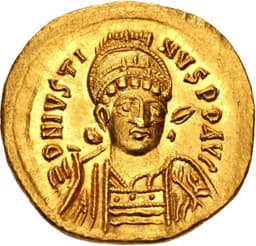
Justin I
Emperor · Ancient
41.8Total

Romulus Augustulus
Emperor · Ancient
43.9Total
Basic Information
Born
450
460
Died
527
507
Era
Ancient
Ancient
Nationality
Byzantine Empire
Roman Empire
Occupation
Emperor
Emperor
Civilization
Western
Western
Score Comparison
Military (10%)
25.9
29.6
Political (20%)
39.4
68.0
Influence (20%)
46.3
42.4
Legacy (20%)
37.5
35.8
Leadership (15%)
65.7
45.0
Strategy (15%)
25.0
44.0
TOTAL
41.8
43.9
Justin I — Complete Timeline
518 AD
Became Emperor of ByzantiumPolitical Action◆ Major
Upon the death of Emperor Anastasius I, Justin, the commander of the imperial guard, was elected emperor by the army and the Senate. His rise from a peasant background to the throne marked a significant change in the imperial administration.
AccessionByzantine EmpirePolitical Change
Impact: national
519 AD
Ended the Acacian SchismPolitical Action◆ Major
Justin, under the influence of his nephew Justinian, reconciled with the Papacy by accepting the Council of Chalcedon. This ended the Acacian Schism that had divided the Eastern and Western churches for 35 years.
Religious PolicyChurch UnityByzantine Empire
Impact: regionalconstructive
527 AD
Appointed Justinian as co-emperorPolitical Action◆ Major
As his health declined, Justin elevated his nephew Justinian to the rank of co-emperor. This ensured a smooth succession and allowed Justinian to assume full power upon Justin's death later that year.
SuccessionByzantine EmpireJustinian
Impact: national
Romulus Augustulus — Complete Timeline
476 AD
Deposition by OdoacerPolitical Action
Odoacer, a Germanic foederati leader, deposed Romulus Augustulus, the last Western Roman emperor. Odoacer sent the imperial regalia to Constantinople and declared himself King of Italy, marking the conventional end of the Western Roman Empire.
Fall of Western Roman EmpireBarbarian Succession
Impact: globaltragic
Expert Analysis
Origins
Justin I was born around 450 AD in the village of Bederiana in the province of Dacia Mediterranea (modern-day Serbia). He was of Thraco-Roman or Illyrian origin and came from a peasant family. His early life was marked by poverty and obscurity. Seeking opportunity, he and two companions left for Constantinople, joining the imperial guard (the Excubitors). He had little formal education, learning to read and write only later in life. In contrast, Romulus Augustulus was born around 460 AD, likely in Ravenna or Rome. His father, Orestes, was a Roman aristocrat and former secretary of Attila the Hun. Romulus was a child of privilege, but his exact birth year and background are poorly documented. He was named after the founder of Rome and the first emperor, Augustus, a grandiose name that would become ironic.
Rise to Power
Justin's rise was gradual and based on military service. He joined the Excubitors under Emperor Leo I and rose through the ranks due to his competence and loyalty. By the time of Emperor Anastasius I, he held the position of comes excubitorum (commander of the guard). Upon Anastasius's death in 518 AD, the succession was contested. The army and Senate elected Justin, partly because of his advanced age (about 68) and perceived malleability. His elevation marked a rare transition from peasant to emperor. Romulus Augustulus, by contrast, was placed on the throne by his father Orestes in 475 AD, after Orestes overthrew Emperor Julius Nepos. Romulus was a teenager, likely around 15, and never exercised real power. His reign lasted less than a year, from October 475 to September 476 AD.
Leadership & Governance
Justin I ruled from 518 to 527 AD. His governance was heavily influenced by his nephew Justinian, whom he adopted and appointed as co-emperor in 527 AD. Justin's major achievement was ending the Acacian Schism (484-519 AD) between the Eastern and Western churches. He accepted the Council of Chalcedon and reconciled with the Pope, restoring religious unity. He also pursued a policy of religious orthodoxy, suppressing Monophysitism. However, his military and administrative record was modest. He faced a rebellion by Vitalian, which he suppressed with difficulty. On the other hand, Romulus Augustulus's governance was nonexistent. He was a figurehead; his father Orestes ruled in his name. Orestes attempted to secure land grants for his Germanic foederati troops but failed, leading to Odoacer's revolt. Romulus's leadership score of 45.0 reflects his lack of agency, while Justin's 65.7 indicates competent, if not outstanding, rule.
Triumph & Tragedy
Justin's greatest triumph was the peaceful end of the Acacian Schism, which strengthened ties with the Papacy and stabilized the Eastern Church. He also ensured a smooth succession by appointing Justinian as co-emperor, allowing Justinian's ambitious reforms and reconquests to proceed. His tragedy was his lack of vision; he was a transitional figure who relied on Justinian. His military score of 25.9 reflects a lack of martial ambition. Romulus's triumph is purely symbolic: his deposition marks the traditional end of the Western Roman Empire. His tragedy was being a puppet emperor whose name became synonymous with the fall of Rome. Romulus's political score of 68.0 is inflated by his symbolic position, not actual power.
Character & Destiny
Justin was pragmatic, cautious, and loyal to his nephew. His peasant origins made him humble but also limited his ambitions. He was described as physically strong and brave in his youth, but as emperor, he was indecisive. His destiny was to be a bridge between the reign of Anastasius and the age of Justinian. Romulus was a child, and his character is unknown. His destiny was to be the last Western emperor, a tragic footnote. Historians note that his deposition by Odoacer in 476 AD was met with little resistance, as the empire had already fragmented. Romulus was allowed to live in retirement in Campania.
Legacy
Justin I's legacy is indirect but significant. By elevating Justinian, he enabled the Byzantine Empire's golden age. The end of the Acacian Schism also healed a major religious rift. His total score of 41.8 reflects his modest but real impact. Romulus Augustulus's legacy is immense as a symbol. His deposition is often cited as the fall of the Western Roman Empire. However, his personal influence was zero. His total score of 43.9 is slightly higher than Justin's, but this is misleading, as his score is driven by political and influence metrics that are based on his symbolic role, not his actions.
Conclusion
Justin I had greater actual impact than Romulus Augustulus. While Romulus's deposition marks a historical watershed, Justin's actions had tangible consequences: he ended a schism, secured the succession for Justinian, and helped shape the Byzantine Empire. Justin's leadership score of 65.7 versus Romulus's 45.0 reflects real governance. The score gap of 2.1 points in Romulus's favor is a statistical artifact; in substance, Justin was the more consequential figure. The peasant emperor who rose from nothing left a deeper mark than the boy emperor who was a passive symbol of an empire's end.
Rankings
🥇
Romulus AugustulusLeader
Mil: 29.6Pol: 68.0Inf: 42.4
43.9
🥈
Justin I
Mil: 25.9Pol: 39.4Inf: 46.3
41.8
+2.1 behind
How This Comparison Works
Algorithm
Each figure is scored on 6 dimensions (0—100 scale) based on structured historical data: Military (10%), Political (20%), Influence (20%), Legacy (20%), Leadership (15%), Strategy (15%). The weighted total produces the final ranking.
Data Sources
Scores are computed from structured sub-indicators in the database. Scale factors adjust for era (Ancient ×0.85, Modern ×1.0) and civilization size (Eastern ×1.05, Other ×0.80) to account for differences in population and military scale.
Maximum 3 Figures
Comparisons are limited to 2—3 figures to ensure readability and statistical meaningfulness.
Error Margins
±5 points per dimension — Sub-scores are derived from historical records with inherent uncertainty. Two figures within 5 points on a dimension should be considered roughly equivalent in that area.
Total Score Accuracy
±3 points overall — The weighted combination of 6 dimensions produces a total score with approximately ±3 points of uncertainty. Differences of less than 3 points are not statistically significant— the figures are effectively tied.
Known Limitations
- Historical records are incomplete and uneven across civilizations
- Figures from oral-tradition societies may be underrepresented
- Occupation labels can misclassify multi-role figures
- Scores measure capability and impact, not moral character
- Quantitative scoring is a comparison tool, not absolute truth
Capability Radar
Military (10%) — Battles & Warfare
Battles
10
4
Win Rate
10
8
Expansion
10
11
Political (20%) — Governance & Reform
Reform
35
0
Diplomacy
40
0
Economy
30
0
Influence (20%) — Cultural & Global Reach
Cultural
20
5
Global
15
5
Legacy (20%) — Historical Impact
Historical
25
15
Longevity
20
10
Leadership (15%) — Power & Stability
Tenure
40
5
Stability
45
0
Strategy (15%) — Tactics & Innovation
Strategy
10
17
Tactics
10
15
Reform
15
21
Similar Comparisons
Comments & Discussion
No comments yet. Be the first to share your thoughts!