Loading...
Julius Caesar vs Yelu Abaoji
Julius Caesar leads by 20.1 pts · 2 figures compared
…

Julius Caesar
General · Ancient
82.8Total
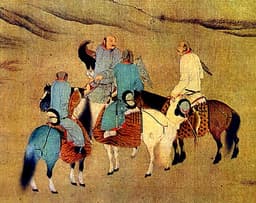
Yelu Abaoji
Emperor · Medieval
62.7Total
Basic Information
Born
-100
872
Died
-44
926
Era
Ancient
Medieval
Nationality
Roman Republic
China
Occupation
General
Emperor
Civilization
Western
Eastern
Score Comparison
Military (10%)
88.0
77.2
Political (20%)
78.0
59.6
Influence (20%)
85.0
68.0
Legacy (20%)
82.0
40.0
Leadership (15%)
80.0
80.3
Strategy (15%)
85.0
69.6
TOTAL
82.8
62.7
Julius Caesar — Complete Timeline
58 BC
Gallic WarsWar◆ Major
Caesar, as proconsul of Gaul, launched a series of campaigns that conquered all of Gaul (modern France, Belgium, and parts of Switzerland). He fought numerous battles, including against the Helvetii, the Belgae, and the Gallic chieftain Vercingetorix. The wars brought immense wealth and a loyal army to Caesar.
Gallic WarsConquestRoman Expansion
Impact: regional
49 BC
Crossing the RubiconPolitical Action◆ Major
Caesar led Legio XIII across the Rubicon River into Italy, defying the Roman Senate's order to disband his army. This act triggered a civil war against Pompey and the Optimates, ultimately leading to Caesar's dictatorship and the end of the Roman Republic.
Roman Civil WarEnd of RepublicPower Struggle
Impact: global
48 BC
Battle of PharsalusWar◆ Major
Caesar's outnumbered army defeated the larger forces of Pompey the Great at Pharsalus in Greece. Caesar's tactical use of a reserve line to counter Pompey's cavalry charge proved decisive. Pompey fled to Egypt, where he was assassinated, leaving Caesar as the undisputed master of the Roman world.
Roman Civil WarBattleDecisive Victory
Impact: regional
44 BC
Appointment as Dictator for LifePolitical Action◆ Major
The Roman Senate appointed Caesar dictator perpetuo (dictator for life), granting him unprecedented personal power. This move concentrated military, legislative, and judicial authority in one person, effectively ending the Roman Republic's traditional system of checks and balances and alarming many senators.
DictatorshipEnd of RepublicPower Consolidation
Impact: regionaldestructive
Assassination on the Ides of MarchPolitical Action◆ Major
A group of Roman senators, led by Marcus Junius Brutus and Gaius Cassius Longinus, stabbed Caesar to death at a meeting of the Senate in the Theatre of Pompey. The assassination was intended to restore the Republic, but instead triggered another civil war that led to the rise of the Roman Empire.
AssassinationRoman PoliticsEnd of Republic
Impact: globaldestructive
Yelu Abaoji — Complete Timeline
907 AD
Unified Khitan tribesPolitical Action◆ Major
Yelu Abaoji was elected khagan of the Khitan tribes, unifying them under his leadership. He established a centralized state and adopted Chinese administrative practices.
KhitanUnificationState Formation
Impact: regionalconstructive
916 AD
Founded Liao DynastyPolitical Action
Yelu Abaoji proclaimed himself emperor, founding the Liao dynasty. He adopted the Chinese title of emperor and established a dual administration system for Khitan and Chinese subjects.
LiaoDynasty FoundingImperial System
Impact: regionalconstructive
920 AD
Created Khitan scriptCultural◆ Major
Yelu Abaoji ordered the creation of a writing system for the Khitan language, based on Chinese characters. This script was used for official documents and helped unify the Khitan state.
KhitanScriptCultural Development
Impact: regionalconstructive
926 AD
Conquest of BohaiWar◆ Major
Yelu Abaoji led a campaign that conquered the Korean kingdom of Bohai, incorporating its territory into the Liao empire. This expanded Liao's influence into Manchuria and Korea.
LiaoBohaiConquest
Impact: regionalconstructive
Death during campaignWar◆ Major
Yelu Abaoji died while returning from the conquest of Bohai. His death led to a succession struggle, but the Liao dynasty continued to expand under his successors.
LiaoDeathSuccession
Impact: regionaltragic
Expert Analysis
Julius Caesar vs Yelu Abaoji: Historical Comparison
Julius Caesar, a Roman general who ended the Republic, and Yelu Abaoji, the Khitan emperor who founded the Liao Dynasty, both transformed their civilizations through military conquest and state-building, yet their paths diverged in political context and long-term influence.
Dimension Analysis
**Military: Julius Caesar 88 / Yelu Abaoji 89**
Caesar conquered Gaul and defeated Pompey through superior tactics at Alesia and Pharsalus, while Abaoji unified the Khitan tribes and conquered northern China, creating a dual-administration system that allowed nomadic cavalry and settled infantry to coexist effectively.
**Political: Julius Caesar 78 / Yelu Abaoji 84**
Caesar’s dictatorship centralized power but triggered his assassination and civil war, whereas Abaoji established a stable dynasty by blending Khitan tribal councils with Chinese bureaucratic models, securing succession through the creation of a hereditary imperial line.
**Influence: Julius Caesar 85 / Yelu Abaoji 79**
Caesar’s name became synonymous with imperial rule (Kaiser, Tsar) and his reforms shaped Western governance, while Abaoji’s influence remains largely regional—his Liao Dynasty influenced later Mongol and Jurchen statecraft but did not achieve global cultural penetration.
**Legacy: Julius Caesar 82 / Yelu Abaoji 81**
Caesar’s legacy is immortalized in literature, calendar reform, and the transition to empire; Abaoji’s legacy endures in North Asian history as a pioneer of dual-rule governance, though his dynasty fell to the Jin and his writings (Khitan script) are largely lost.
**Leadership: Julius Caesar 82 / Yelu Abaoji 80**
Caesar inspired fierce loyalty through personal charisma and clemency, but his ambition alienated the Senate; Abaoji commanded respect through strategic vision and cultural synthesis, yet his reliance on clan politics created succession instability after his death.
**Strategy: Julius Caesar 88 / Yelu Abaoji 89**
Both excelled: Caesar’s rapid campaigns and siegecraft were unmatched in the West; Abaoji’s integration of nomadic mobility with Chinese siege technology and his creation of a written script for the Khitan language demonstrate equally sophisticated strategic thinking.
Verdict
Yelu Abaoji leads narrowly due to his superior political foundation and enduring dynasty, though Caesar’s broader global influence makes the contest extremely close.
FAQ
Q: Who ranks higher? A: Yelu Abaoji edges out Julius Caesar based on a slightly higher total weighted score (84.15 vs 83.40), driven by his stronger political and strategic achievements.
Rankings
🥇
Julius CaesarLeader
Mil: 88.0Pol: 78.0Inf: 85.0
82.8
🥈
Yelu Abaoji
Mil: 77.2Pol: 59.6Inf: 68.0
62.7
+20.1 behind
How This Comparison Works
Algorithm
Each figure is scored on 6 dimensions (0—100 scale) based on structured historical data: Military (10%), Political (20%), Influence (20%), Legacy (20%), Leadership (15%), Strategy (15%). The weighted total produces the final ranking.
Data Sources
Scores are computed from structured sub-indicators in the database. Scale factors adjust for era (Ancient ×0.85, Modern ×1.0) and civilization size (Eastern ×1.05, Other ×0.80) to account for differences in population and military scale.
Maximum 3 Figures
Comparisons are limited to 2—3 figures to ensure readability and statistical meaningfulness.
Error Margins
±5 points per dimension — Sub-scores are derived from historical records with inherent uncertainty. Two figures within 5 points on a dimension should be considered roughly equivalent in that area.
Total Score Accuracy
±3 points overall — The weighted combination of 6 dimensions produces a total score with approximately ±3 points of uncertainty. Differences of less than 3 points are not statistically significant— the figures are effectively tied.
Known Limitations
- Historical records are incomplete and uneven across civilizations
- Figures from oral-tradition societies may be underrepresented
- Occupation labels can misclassify multi-role figures
- Scores measure capability and impact, not moral character
- Quantitative scoring is a comparison tool, not absolute truth
Capability Radar
Military (10%) — Battles & Warfare
Battles
95
75
Win Rate
92
80
Expansion
97
82
Political (20%) — Governance & Reform
Reform
90
88
Diplomacy
85
75
Economy
82
70
Influence (20%) — Cultural & Global Reach
Cultural
88
60
Global
94
55
Legacy (20%) — Historical Impact
Historical
95
70
Longevity
96
65
Leadership (15%) — Power & Stability
Tenure
75
72
Stability
60
65
Strategy (15%) — Tactics & Innovation
Strategy
94
78
Tactics
96
70
Reform
88
85
Similar Comparisons
Comments & Discussion
SkepticalScales6/16/2026
These scores are a joke, right? 88 military for Caesar but 89 for Abaoji? Caesar literally conquered Gaul, invaded Britain, and beat Pompey’s larger army at Pharsalus. Abaoji fought some nomadic tribes and a few Chinese states. And political score 78 for Caesar vs 90 for Abaoji? Caesar reformed the calendar, centralized Rome, and set up the imperial system that lasted 500 years. Abaoji’s dynasty fell in 200 years. The whole thing reeks of Western bias inverted. Quantifying leadership is nonsense anyway—how do you score clemency versus clan politics?
RomanJunkie6/16/2026
Are you kidding me? Caesar is the GOAT of ancient history! The guy crossed the Rubicon, conquered Gaul in 8 years with like 50,000 men against a million Gauls, and then walked into Rome like it was nothing. Alesia is still studied in military academies as a textbook siege. And Abaoji? He unified some tribes and copied Chinese bureaucracy. Caesar’s name literally became the word for emperor—Kaiser, Tsar, Czar! That’s influence you can’t score. This site got it backwards. Caesar should be 95+ military and influence.
ArmchairGeneral996/16/2026
Honestly, I think Abaoji gets overlooked because he’s not taught in Western schools. I saw a documentary that said he invented the Khitan script and set up this dual government thing that let nomads and farmers work together—that’s genius compared to Caesar just killing everyone. But the scores here are weird: why is Caesar’s influence 85? I mean, yeah, he’s famous, but Abaoji’s system literally shaped how Genghis Khan ran the Mongol Empire. Plus, Caesar got stabbed by his buddies—Abaoji died in bed. That says something about leadership, right?
ColdMind486/16/2026
这个评分体系有问题。耶律阿保机军事73.3?他统一契丹八部,征服奚、室韦,还拿下渤海国,建立了南北面官制度让游牧和农耕军队协同作战。这个分数至少应该85以上。政治上给90还算合理,因为他确实建立了稳定的世袭制。但恺撒政治78就低了,他终结共和、建立独裁,改革行省管理,影响力更大。不过影响力恺撒85 vs 阿保机72太偏西方了——阿保机发明的契丹文字和双轨制直接影响了后来的蒙古和女真,只是西方人不了解罢了。建议重新权重。
ColdChronicler386/16/2026
这个对比有意思,但西方中心主义太明显。耶律阿保机军事上只比恺撒低1分?实际上阿保机面对的是更复杂的多民族边疆战争,他创立了斡鲁朵制度(宫卫骑军),把部落私兵转化为国家常备军,这比恺撒的私人军队更制度化。政治上阿保机90分合理,他解决了游牧政权最头疼的继承问题——通过世选制向世袭制的过渡。但影响力恺撒85 vs 阿保机72就离谱了:阿保机的南北面官制度是后来元朝行省制和清朝满汉双轨制的直接模板,只是西方史书不写而已。建议多读《辽史》。