Loading...
Julius Caesar vs Suharto
Julius Caesar leads by 25.6 pts · 2 figures compared
…

Julius Caesar
General · Ancient
82.8Total
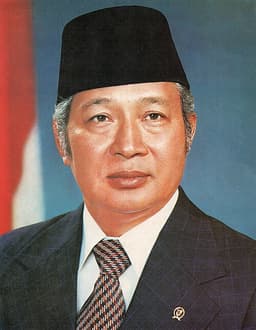
Suharto
General · Modern
57.2Total
Basic Information
Born
-100
1921
Died
-44
—
Era
Ancient
Modern
Nationality
Roman Republic
Indonesia
Occupation
General
General
Civilization
Western
Eastern
Score Comparison
Military (10%)
88.0
20.0
Political (20%)
78.0
59.3
Influence (20%)
85.0
60.0
Legacy (20%)
82.0
52.0
Leadership (15%)
80.0
82.0
Strategy (15%)
85.0
60.0
TOTAL
82.8
57.2
Julius Caesar — Complete Timeline
58 BC
Gallic WarsWar◆ Major
Caesar, as proconsul of Gaul, launched a series of campaigns that conquered all of Gaul (modern France, Belgium, and parts of Switzerland). He fought numerous battles, including against the Helvetii, the Belgae, and the Gallic chieftain Vercingetorix. The wars brought immense wealth and a loyal army to Caesar.
Gallic WarsConquestRoman Expansion
Impact: regional
49 BC
Crossing the RubiconPolitical Action◆ Major
Caesar led Legio XIII across the Rubicon River into Italy, defying the Roman Senate's order to disband his army. This act triggered a civil war against Pompey and the Optimates, ultimately leading to Caesar's dictatorship and the end of the Roman Republic.
Roman Civil WarEnd of RepublicPower Struggle
Impact: global
48 BC
Battle of PharsalusWar◆ Major
Caesar's outnumbered army defeated the larger forces of Pompey the Great at Pharsalus in Greece. Caesar's tactical use of a reserve line to counter Pompey's cavalry charge proved decisive. Pompey fled to Egypt, where he was assassinated, leaving Caesar as the undisputed master of the Roman world.
Roman Civil WarBattleDecisive Victory
Impact: regional
44 BC
Appointment as Dictator for LifePolitical Action◆ Major
The Roman Senate appointed Caesar dictator perpetuo (dictator for life), granting him unprecedented personal power. This move concentrated military, legislative, and judicial authority in one person, effectively ending the Roman Republic's traditional system of checks and balances and alarming many senators.
DictatorshipEnd of RepublicPower Consolidation
Impact: regionaldestructive
Assassination on the Ides of MarchPolitical Action◆ Major
A group of Roman senators, led by Marcus Junius Brutus and Gaius Cassius Longinus, stabbed Caesar to death at a meeting of the Senate in the Theatre of Pompey. The assassination was intended to restore the Republic, but instead triggered another civil war that led to the rise of the Roman Empire.
AssassinationRoman PoliticsEnd of Republic
Impact: globaldestructive
Suharto — Complete Timeline
1966 AD
Supersemar and Transfer of PowerPolitical Action
President Sukarno signed the Supersemar order, delegating authority to General Suharto to restore order after the 30 September Movement. Suharto used this to ban the Communist Party, purge leftists, and gradually assume executive power, effectively beginning his New Order regime.
SupersemarNew OrderIndonesia
Impact: nationaldestructive
1967 AD
New Order Economic DevelopmentReform◆ Major
Suharto implemented the New Order's economic policies, focusing on foreign investment, agricultural self-sufficiency, and industrialization. The government achieved high growth rates, reduced poverty, and stabilized the economy, but also fostered crony capitalism and corruption.
Economic GrowthDevelopmentIndonesia
Impact: nationalconstructive
1975 AD
Invasion of East TimorWar◆ Major
Suharto ordered the invasion of East Timor after Portugal withdrew. Indonesian forces occupied the territory, leading to a 24-year occupation marked by widespread human rights abuses, including massacres and forced displacement, resulting in an estimated 100,000-200,000 deaths.
East TimorOccupationHuman Rights
Impact: regionaldestructive
1998 AD
Asian Financial Crisis and Fall from PowerPolitical Action
The Asian Financial Crisis devastated Indonesia's economy, leading to massive unemployment and food shortages. Widespread protests and riots forced Suharto to resign in May 1998 after 31 years in power, ending his authoritarian rule and ushering in the Reformasi era.
Financial CrisisResignationReformasi
Impact: nationaltragic
Expert Analysis
Julius Caesar vs Suharto
### The Rubicon and the Rising Sun: Caesar and Suharto
The Ides of March, 44 BCE. On the floor of the Roman Senate, a dictator bleeds from twenty-three stab wounds. His name is Julius Caesar, and his death will launch a civil war that ends the Roman Republic. Now, jump forward two millennia and half a world away. In May 1998, another ruler—Suharto of Indonesia—sits in a palace in Jakarta, watching televised riots consume his capital. He has no dagger, no dramatic betrayal. He simply reads a resignation speech, then slips away to a quiet life with his family. One was murdered by his closest allies; the other was politely asked to leave. Why did one end in tragedy and the other in a quiet retirement? The answer lies not just in their different times, but in the very nature of power they each understood.
**Origins**
Julius Caesar was born into the chaotic twilight of the Roman Republic, a world of senatorial intrigue and populist turmoil. His family, the Julii, was ancient but not wealthy, and young Caesar was shaped by the ambition to restore its glory. He learned that in Rome, glory came from the sword. Suharto, born in 1921 on the island of Java, grew up in a very different world—a Dutch colony where opportunity was scarce and survival depended on navigating a rigid social hierarchy. He was a quiet, watchful boy who learned that in Javanese culture, power was not seized with a shout but accumulated through patience, loyalty, and the careful manipulation of unseen forces. One man was forged in the competitive arena of the West; the other in the subtle, shadowed corridors of the East.
**Rise to Power**
Caesar’s path was a lightning strike. He climbed the Roman political ladder—quaestor, aedile, pontifex maximus—but his true ascent began with the Gallic Wars (58–50 BCE). In eight years, he conquered a vast territory, built a legendary army loyal to him alone, and amassed immense wealth. His crossing of the Rubicon River in 49 BCE was a direct, illegal challenge to the Senate. He gambled everything on a single, decisive act. Suharto’s rise was slower, more opaque. In 1965–66, as Indonesia spiraled into chaos after an attempted coup, General Suharto did not charge forward. He waited. He let President Sukarno’s authority crumble, then accepted the *Supersemar* order—a piece of paper that transferred power to him. He did not conquer; he absorbed. Where Caesar declared war on the system, Suharto simply became the system.
**Leadership & Governance**
Caesar governed as a whirlwind. As dictator, he reformed the calendar, initiated public works, granted citizenship to provincials, and centralized state power. His military genius was aggressive and personal—he led from the front, shared his soldiers’ hardships, and inspired fanatical loyalty. But his political wisdom was flawed: he pardoned his enemies, believing they would be grateful, when in fact they plotted his death. Suharto’s style was the opposite. His “New Order” (1967–1998) was built on stability, not glory. He invited foreign investment, achieved rice self-sufficiency, and brought economic growth averaging 7% annually for decades. Yet his military scores (45.5) reflect a man who never fought a war for conquest. His strategy was not battlefield brilliance but bureaucratic control—a network of family, cronies, and military officers that ensured no rival could rise. Caesar conquered Gaul; Suharto conquered the state itself.
**Triumph & Tragedy**
Caesar’s greatest moment was his triumph over Pompey, celebrated in Rome with lavish parades. His tragedy was the Ides of March—a failure to understand that his clemency was seen as weakness, and that the Republic’s elite would rather kill him than accept a king. Suharto’s triumph was the economic transformation of Indonesia, lifting millions from poverty. His tragedy was the 1975 invasion of East Timor, a brutal occupation that left over 100,000 dead and stained his legacy. In 1998, the Asian Financial Crisis shattered his economic miracle, and the protests that followed forced him to resign. But unlike Caesar, he walked away alive. He died in 2008, not on a Senate floor, but in a hospital bed, surrounded by family.
**Character & Destiny**
Caesar was a man of boundless ego and restless ambition. He believed in his own myth, and that belief drove him to greatness and to death. He could not imagine a world where he was not the center. Suharto, by contrast, cultivated an air of humble detachment. He was known as the “Smiling General.” He understood that in Javanese tradition, a leader who appears too eager for power invites envy and betrayal. He built a system so entrenched that even his resignation did not dismantle it. Caesar’s character was a flame that burned out quickly; Suharto’s was a slow, steady fire that smoldered for three decades.
**Legacy**
Caesar’s legacy is the Roman Empire. His adopted heir, Octavian, became Augustus, and the Republic was gone. His name became a title for emperors: *Kaiser*, *Tsar*. He is remembered as a military genius and a tragic hero, a man whose ambition destroyed the old world and built a new one. Suharto’s legacy is more complex. Indonesia’s economy grew, but so did corruption and authoritarianism. He is celebrated by some as the “Father of Development” and condemned by others as a dictator who crushed dissent. His name does not grace a title; it is a reminder of how power can be both benevolent and brutal.
**Conclusion**
Standing at the edge of history, we see two generals who seized power in very different ways. Caesar crossed a river; Suharto signed a document. Caesar was killed by his peers; Suharto was gently pushed aside. The difference is not simply one of time or place—it is a difference in the very definition of power. For Caesar, power was a personal glory to be won. For Suharto, power was a system to be managed. One man’s ambition lit a fire that still burns in the Western imagination. The other’s careful control built a nation that still struggles with its own identity. And perhaps that is the deepest lesson: the most dangerous leaders are not always the ones who die dramatically, but the ones who simply refuse to leave until they are no longer needed.
Rankings
🥇
Julius CaesarLeader
Mil: 88.0Pol: 78.0Inf: 85.0
82.8
🥈
Suharto
Mil: 20.0Pol: 59.3Inf: 60.0
57.2
+25.6 behind
How This Comparison Works
Algorithm
Each figure is scored on 6 dimensions (0—100 scale) based on structured historical data: Military (10%), Political (20%), Influence (20%), Legacy (20%), Leadership (15%), Strategy (15%). The weighted total produces the final ranking.
Data Sources
Scores are computed from structured sub-indicators in the database. Scale factors adjust for era (Ancient ×0.85, Modern ×1.0) and civilization size (Eastern ×1.05, Other ×0.80) to account for differences in population and military scale.
Maximum 3 Figures
Comparisons are limited to 2—3 figures to ensure readability and statistical meaningfulness.
Error Margins
±5 points per dimension — Sub-scores are derived from historical records with inherent uncertainty. Two figures within 5 points on a dimension should be considered roughly equivalent in that area.
Total Score Accuracy
±3 points overall — The weighted combination of 6 dimensions produces a total score with approximately ±3 points of uncertainty. Differences of less than 3 points are not statistically significant— the figures are effectively tied.
Known Limitations
- Historical records are incomplete and uneven across civilizations
- Figures from oral-tradition societies may be underrepresented
- Occupation labels can misclassify multi-role figures
- Scores measure capability and impact, not moral character
- Quantitative scoring is a comparison tool, not absolute truth
Capability Radar
Military (10%) — Battles & Warfare
Battles
95
40
Win Rate
92
45
Expansion
97
30
Political (20%) — Governance & Reform
Reform
90
55
Diplomacy
85
60
Economy
82
65
Influence (20%) — Cultural & Global Reach
Cultural
88
40
Global
94
50
Legacy (20%) — Historical Impact
Historical
95
55
Longevity
96
45
Leadership (15%) — Power & Stability
Tenure
75
85
Stability
60
50
Strategy (15%) — Tactics & Innovation
Strategy
94
40
Tactics
96
35
Reform
88
50
Similar Comparisons
Comments & Discussion
LegionVet6/16/2026
Caesar didn't "die for the Republic"—he died because he thought his luck was invincible. A tactical genius, yes, but he dismissed the Senate's resentment like a gambler ignoring his losses. Suharto had no such ego. He read the riot, saw the IMF and student protests as his "Ides," and stepped aside to live off billions. Caesar the warrior vs. Suharto the accountant: both ruthless, but only one knew when to fold.
JakartaEyes6/16/2026
苏哈托不是退休,是跳船。1998年印尼盾暴跌80%,IMF逼他改革,他那些军队亲信都开始躲他。对比之下,恺撒在元老院还想靠赦免权挽回局面——结果挨了23刀。一个躲在幕后遥控,一个冲到前台硬刚。历史不偏爱谁,就看谁读懂风向。苏哈托读懂了,只是他吸走的血,够印尼还几十年债。
ClassicsNerd6/16/2026
Please—calling Caesar a "dictator" misses the point. He was a populist general who broke the Senate's aristocratic monopoly, and his land reforms fed veterans. Suharto was a kleptocrat who built a family empire from crony capitalism. The only parallel is they both crushed rivals. But Caesar's assassins were ideologues wanting oligarchy back; Suharto's fall was a bank run. Different crimes, different ends.
ReformasiKid6/16/2026
说苏哈托“安静退休”?他1998年5月辞职时,雅加达唐人街的废墟还在冒烟,死了上千人。他家族控制的基金会至今还在回收当年砍伐的森林利润。恺撒至少死在罗马广场上,像个罗马人。苏哈托死在医院床上,身后是600亿美元黑洞。别把贪官洗成贤者,他让“秩序”成了偷窃的代名词。
MapMaker6/16/2026
Scale matters: Caesar's conquests covered Gaul (modern France/Belgium) and parts of Britain—maybe 5 million people. Suharto presided over 200 million across 17,000 islands, crushing East Timor with a death toll of 100,000+. Caesar's war was expansion; Suharto's was occupation. One built a legacy in marble and Latin; the other in Swiss bank accounts and palm oil. Only the romantic would call them comparable.