Loading...
Julius Caesar vs Ptolemy IX Soter II
Julius Caesar leads by 42.2 pts · 2 figures compared
…

Julius Caesar
General · Ancient
82.8Total
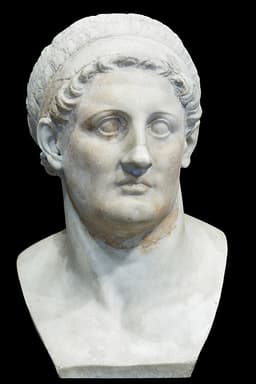
Ptolemy IX Soter II
Emperor · Ancient
40.6Total
Basic Information
Born
-100
-142
Died
-44
-80
Era
Ancient
Ancient
Nationality
Roman Republic
Ptolemaic Kingdom
Occupation
General
Emperor
Civilization
Western
Middle Eastern
Score Comparison
Military (10%)
88.0
45.0
Political (20%)
78.0
27.9
Influence (20%)
85.0
46.3
Legacy (20%)
82.0
39.2
Leadership (15%)
80.0
45.0
Strategy (15%)
85.0
38.3
TOTAL
82.8
40.6
Julius Caesar — Complete Timeline
58 BC
Gallic WarsWar◆ Major
Caesar, as proconsul of Gaul, launched a series of campaigns that conquered all of Gaul (modern France, Belgium, and parts of Switzerland). He fought numerous battles, including against the Helvetii, the Belgae, and the Gallic chieftain Vercingetorix. The wars brought immense wealth and a loyal army to Caesar.
Gallic WarsConquestRoman Expansion
Impact: regional
49 BC
Crossing the RubiconPolitical Action◆ Major
Caesar led Legio XIII across the Rubicon River into Italy, defying the Roman Senate's order to disband his army. This act triggered a civil war against Pompey and the Optimates, ultimately leading to Caesar's dictatorship and the end of the Roman Republic.
Roman Civil WarEnd of RepublicPower Struggle
Impact: global
48 BC
Battle of PharsalusWar◆ Major
Caesar's outnumbered army defeated the larger forces of Pompey the Great at Pharsalus in Greece. Caesar's tactical use of a reserve line to counter Pompey's cavalry charge proved decisive. Pompey fled to Egypt, where he was assassinated, leaving Caesar as the undisputed master of the Roman world.
Roman Civil WarBattleDecisive Victory
Impact: regional
44 BC
Appointment as Dictator for LifePolitical Action◆ Major
The Roman Senate appointed Caesar dictator perpetuo (dictator for life), granting him unprecedented personal power. This move concentrated military, legislative, and judicial authority in one person, effectively ending the Roman Republic's traditional system of checks and balances and alarming many senators.
DictatorshipEnd of RepublicPower Consolidation
Impact: regionaldestructive
Assassination on the Ides of MarchPolitical Action◆ Major
A group of Roman senators, led by Marcus Junius Brutus and Gaius Cassius Longinus, stabbed Caesar to death at a meeting of the Senate in the Theatre of Pompey. The assassination was intended to restore the Republic, but instead triggered another civil war that led to the rise of the Roman Empire.
AssassinationRoman PoliticsEnd of Republic
Impact: globaldestructive
Ptolemy IX Soter II — Complete Timeline
116 BC
First Reign as King of EgyptPolitical Action◆ Major
Ptolemy IX ascended to the throne after the death of Ptolemy VIII, ruling jointly with his mother Cleopatra III. His reign was marked by conflict with his mother, who favored his brother Ptolemy X.
AccessionCo-RulershipDynastic Conflict
Impact: national
107 BC
Expulsion by Cleopatra IIIPolitical Action◆ Major
Cleopatra III forced Ptolemy IX to flee Egypt, replacing him with his brother Ptolemy X. Ptolemy IX went to Cyprus, where he ruled as a client king, but continued to plot his return.
ExileDynastic IntrigueCyprus
Impact: nationaldestructive
88 BC
Second Reign as King of EgyptPolitical Action◆ Major
After Ptolemy X's death, Ptolemy IX returned to Egypt and reclaimed the throne. His second reign was short, lasting only until his death in 80 BC, but he managed to restore some stability.
RestorationSecond ReignStability
Impact: nationalconstructive
Expert Analysis
julius-caesar-vs-ptolemy-ix-soter-ii
# The Ides and the Labyrinth
On a March morning in 44 BCE, the most powerful man in the Mediterranean fell beneath twenty-three dagger blows at the foot of Pompey's theater. Julius Caesar, dictator for life, conqueror of Gaul, and master of Rome, died in a pool of blood that would stain the marble floor of the Senate chamber for hours. Three decades earlier and a thousand miles to the east, another ruler faced a more subtle but equally lethal threat: his own mother. Ptolemy IX Soter II, nicknamed Lathyros—"the Chickpea"—spent much of his reign fleeing from Cleopatra III, a woman who preferred his younger brother and who ultimately drove him from his own throne. One man reshaped the Western world. The other barely held together a crumbling kingdom. What separates a figure who changes history from one who is swept aside by it? The answer lies not only in talent but in the currents of the age that carried them.
Origins
Julius Caesar was born into the patrician Julian clan, one of Rome's oldest families, but one that had lost political influence. His father died when Caesar was sixteen, leaving him to navigate a Republic already tearing itself apart. The Social Wars, the rise of Sulla, and the proscriptions that followed taught the young aristocrat that survival meant knowing when to bend and when to strike. He grew up in a world where the old rules were breaking, where ambition could be rewarded or punished with death.
Ptolemy IX entered a different kind of chaos. The Ptolemaic dynasty, founded by Alexander the Great's general, had ruled Egypt for nearly two centuries, but by his birth around 142 BCE, it was a house divided against itself. His mother Cleopatra III was a woman of extraordinary political cunning who had already poisoned her own husband, Ptolemy VIII. The Ptolemaic court was not a place of senatorial debate but of poison, eunuchs, and family vendettas. Ptolemy IX learned early that in Alexandria, the greatest threat often slept in the next room.
Rise to Power
Caesar's path was one of calculated risk. He fled Rome during Sulla's purges, served with distinction in the military, and returned to build a political career through alliances. The First Triumvirate with Pompey and Crassus was a masterstroke—a secret pact that allowed him to command armies and win glory in Gaul. His conquest of the Gallic tribes from 58 to 50 BCE was not just a war; it was the creation of a personal army loyal to him, not the Republic. When the Senate ordered him to disband his legions, he knew that obedience meant political death. The Rubicon River, which he crossed in 49 BCE, was the point of no return.
Ptolemy IX's rise was more a matter of inheritance than conquest. When Ptolemy VIII died in 116 BCE, the throne passed to Cleopatra III and her chosen son. She selected Ptolemy IX, but only because he seemed pliable. He was not. The co-rule quickly soured. Cleopatra III wanted power; her son wanted independence. In 107 BCE, she forced him to flee Egypt to Cyprus, replacing him with his younger brother Ptolemy X. The Chickpea was outmaneuvered not by a rival general but by his own mother.
Leadership & Governance
Caesar governed as a revolutionary. As dictator, he reformed the calendar, granted citizenship to Gauls, initiated public works, and centralized authority. His military genius lay in speed and decisiveness—at the Battle of Alesia in 52 BCE, he defeated a Gallic coalition by building fortifications around both the besieged city and the relieving army, a double ring of steel that remains a textbook example of tactical brilliance. Politically, he understood that the Republic's institutions had failed; he did not destroy them so much as render them irrelevant. His reforms were designed to last, and many did.
Ptolemy IX's governance was reactive. His military campaigns in Cyprus and Coele-Syria were modest affairs, scoring a Military rating of 37.5 compared to Caesar's 88. He fought not to expand his kingdom but to hold it together. His Strategy score of 49 reflects a ruler who could defend but not dominate. When he finally reclaimed the throne in 88 BCE after Ptolemy X's death, he returned to an Egypt exhausted by civil strife. His second reign lasted only eight years, ending with his death in 80 BCE. He left no lasting reforms, no new institutions—only a dynasty that continued its slow decay.
Triumph & Tragedy
Caesar's triumph was absolute: the conquest of Gaul, the defeat of Pompey, the subjugation of Egypt itself. His tragedy was that he could not conceive of his own mortality. "The Ides of March have come," he joked to a soothsayer on the morning of his assassination. They had come, but they had not gone. His murder was not a failure of power but of imagination—he could not see that the Republic's old guard would rather kill him than accept his rule.
Ptolemy IX's greatest moment was simply surviving. He outlived his mother and his brother, reclaiming a throne that had been stolen from him. His tragedy was that survival was all he achieved. He ruled a kingdom that was already a client state of Rome, a shadow of the empire built by his ancestors. His name, Soter—"Savior"—was an irony he could not escape.
Character & Destiny
Caesar was a gambler who believed in his own star. He pardoned his enemies, promoted talent regardless of class, and wrote his own history in clear, relentless prose. His personality was magnetic, his ambition limitless. He understood that in a collapsing Republic, the man who moved fastest won.
Ptolemy IX was cautious, perhaps because he had to be. He was a son in a dynasty of mothers who killed sons, a king in a kingdom that had lost its greatness. His nickname Lathyros suggests a man who was perhaps underestimated, even mocked. He lacked the audacity to break free of his family's toxic patterns.
Legacy
Caesar's legacy is the Roman Empire. His name became a title—Kaiser, Tsar, Caesar—that echoed for two thousand years. His writings, his reforms, his very manner of ruling shaped Western civilization. He is remembered not as a tyrant but as a founder, a man whose ambition remade the world.
Ptolemy IX left little. His dynasty would end with Cleopatra VII, a woman far more famous than he, who would lose Egypt to Caesar's heir, Octavian. His Legacy score of 52 reflects a ruler remembered only by specialists. He is a footnote in the story of a family that could not adapt to a changing world.
Conclusion
The difference between Caesar and Ptolemy IX is not simply a matter of talent. It is a matter of context. Caesar rose in a Republic that was dying but still capable of producing greatness. Ptolemy IX ruled in a kingdom that was already dead, kept alive only by Roman sufferance. One man forged a new world from the ruins of an old one; the other tried to hold together a ruin. History remembers the builder, not the caretaker. The Ides of March made Caesar immortal. The Chickpea's long, quiet struggle made him invisible.
Rankings
🥇
Julius CaesarLeader
Mil: 88.0Pol: 78.0Inf: 85.0
82.8
🥈
Ptolemy IX Soter II
Mil: 45.0Pol: 27.9Inf: 46.3
40.6
+42.2 behind
How This Comparison Works
Algorithm
Each figure is scored on 6 dimensions (0—100 scale) based on structured historical data: Military (10%), Political (20%), Influence (20%), Legacy (20%), Leadership (15%), Strategy (15%). The weighted total produces the final ranking.
Data Sources
Scores are computed from structured sub-indicators in the database. Scale factors adjust for era (Ancient ×0.85, Modern ×1.0) and civilization size (Eastern ×1.05, Other ×0.80) to account for differences in population and military scale.
Maximum 3 Figures
Comparisons are limited to 2—3 figures to ensure readability and statistical meaningfulness.
Error Margins
±5 points per dimension — Sub-scores are derived from historical records with inherent uncertainty. Two figures within 5 points on a dimension should be considered roughly equivalent in that area.
Total Score Accuracy
±3 points overall — The weighted combination of 6 dimensions produces a total score with approximately ±3 points of uncertainty. Differences of less than 3 points are not statistically significant— the figures are effectively tied.
Known Limitations
- Historical records are incomplete and uneven across civilizations
- Figures from oral-tradition societies may be underrepresented
- Occupation labels can misclassify multi-role figures
- Scores measure capability and impact, not moral character
- Quantitative scoring is a comparison tool, not absolute truth
Capability Radar
Military (10%) — Battles & Warfare
Battles
95
30
Win Rate
92
35
Expansion
97
10
Political (20%) — Governance & Reform
Reform
90
15
Diplomacy
85
30
Economy
82
20
Influence (20%) — Cultural & Global Reach
Cultural
88
20
Global
94
15
Legacy (20%) — Historical Impact
Historical
95
25
Longevity
96
20
Leadership (15%) — Power & Stability
Tenure
75
40
Stability
60
15
Strategy (15%) — Tactics & Innovation
Strategy
94
25
Tactics
96
30
Reform
88
10
Similar Comparisons
Comments & Discussion
宫斗迷6/17/2026
"拿埃及艳后他妈跟罗马元老院比?笑死人啦!克娄巴特拉三世砍起儿子来比凯撒杀高卢人还狠,人家可是亲自带兵把亲儿子轰出亚历山大港的。凯撒再牛,也没被她妈追着满地中海跑吧?这波我站托勒密,能在疯批老娘手下活这么多年还回去当王,这宫斗级别放《甄嬛传》里活不过三集。"
BallistaBrain6/17/2026
"Let's talk force multipliers. Caesar had the 10th Legion—veterans who'd follow him into hell. Ptolemy had mercenaries who'd switch sides for a better offer. Caesar wrote the book on siege warfare (Alesia, 52 BCE—double circumvallation, genius). Ptolemy's big military achievement was… losing Cyprus? Numbers don't lie: Caesar conquered Gaul (800 cities, 1M dead). Ptolemy couldn't hold a dynasty propped up by Roman bribes. The Chickpea was a footnote. Caesar is a chapter."
考古毒舌6/17/2026
"数据控看过来:凯撒活了56年,托勒密九世大概活了50多岁。但这组对比最讽刺的是——凯撒是被人捅死的,托勒密九世居然是自然死亡!一个死于23刀,一个安稳躺平。高卢战争打了8年,托勒密在塞浦路斯流亡就流了10年。历史记住的不是活得久的,而是死得戏剧性的。Caesar wins by narrative, not lifespan."
Chronicler16966/17/2026
"Caesar didn't just survive chaos—he weaponized it. The Social Wars and Sulla's proscriptions were brutal finishing schools for a mind that could calculate odds faster than a legion could march. Ptolemy IX, by contrast, inherited a kingdom where the ruling family was its own worst enemy. Caesar crossed the Rubicon with one legion and gambled everything. Ptolemy couldn't even hold Alexandria against his own mother. One forged an empire from civil war; the other was ground to dust by family feuds.