Loading...
Julius Caesar vs Parakramabahu I
Julius Caesar leads by 16.7 pts · 2 figures compared
…

Julius Caesar
General · Ancient
82.8Total
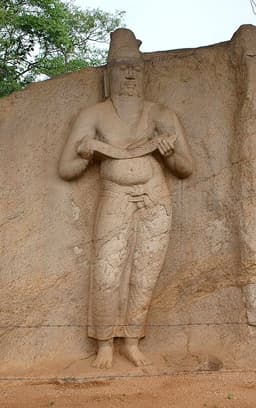
Parakramabahu I
Emperor · Medieval
66.1Total
Basic Information
Born
-100
1123
Died
-44
1186
Era
Ancient
Medieval
Nationality
Roman Republic
Sri Lanka
Occupation
General
Emperor
Civilization
Western
Indian
Score Comparison
Military (10%)
88.0
82.0
Political (20%)
78.0
72.0
Influence (20%)
85.0
61.0
Legacy (20%)
82.0
52.0
Leadership (15%)
80.0
82.0
Strategy (15%)
85.0
65.4
TOTAL
82.8
66.1
Julius Caesar — Complete Timeline
58 BC
Gallic WarsWar◆ Major
Caesar, as proconsul of Gaul, launched a series of campaigns that conquered all of Gaul (modern France, Belgium, and parts of Switzerland). He fought numerous battles, including against the Helvetii, the Belgae, and the Gallic chieftain Vercingetorix. The wars brought immense wealth and a loyal army to Caesar.
Gallic WarsConquestRoman Expansion
Impact: regional
49 BC
Crossing the RubiconPolitical Action◆ Major
Caesar led Legio XIII across the Rubicon River into Italy, defying the Roman Senate's order to disband his army. This act triggered a civil war against Pompey and the Optimates, ultimately leading to Caesar's dictatorship and the end of the Roman Republic.
Roman Civil WarEnd of RepublicPower Struggle
Impact: global
48 BC
Battle of PharsalusWar◆ Major
Caesar's outnumbered army defeated the larger forces of Pompey the Great at Pharsalus in Greece. Caesar's tactical use of a reserve line to counter Pompey's cavalry charge proved decisive. Pompey fled to Egypt, where he was assassinated, leaving Caesar as the undisputed master of the Roman world.
Roman Civil WarBattleDecisive Victory
Impact: regional
44 BC
Appointment as Dictator for LifePolitical Action◆ Major
The Roman Senate appointed Caesar dictator perpetuo (dictator for life), granting him unprecedented personal power. This move concentrated military, legislative, and judicial authority in one person, effectively ending the Roman Republic's traditional system of checks and balances and alarming many senators.
DictatorshipEnd of RepublicPower Consolidation
Impact: regionaldestructive
Assassination on the Ides of MarchPolitical Action◆ Major
A group of Roman senators, led by Marcus Junius Brutus and Gaius Cassius Longinus, stabbed Caesar to death at a meeting of the Senate in the Theatre of Pompey. The assassination was intended to restore the Republic, but instead triggered another civil war that led to the rise of the Roman Empire.
AssassinationRoman PoliticsEnd of Republic
Impact: globaldestructive
Parakramabahu I — Complete Timeline
1153 AD
Unification of Sri LankaWar
Parakramabahu I unified the entire island of Sri Lanka under his rule after a series of military campaigns. He defeated the rulers of Ruhuna and other regional kingdoms, ending a period of fragmentation.
Impact: national
1160 AD
Construction of Parakrama SamudraOther◆ Major
Parakramabahu I constructed the Parakrama Samudra, a massive man-made sea of interconnected tanks and canals near Polonnaruwa. This irrigation system, covering over 5,000 acres, was a major engineering achievement.
Impact: regionalconstructive
1165 AD
Invasion of BurmaWar◆ Major
Parakramabahu I launched a naval invasion of Burma (Pagan Kingdom) in retaliation for a trade dispute. The Sinhalese fleet captured the port of Kusumiya and sacked the city, demonstrating Sri Lanka's naval power.
Impact: regional
Reform of the Buddhist SanghaReform◆ Major
Parakramabahu I convened a council to purify the Buddhist Sangha. He expelled corrupt monks and re-established discipline, strengthening Theravada Buddhism in Sri Lanka.
Impact: nationalconstructive
1170 AD
Construction of Polonnaruwa VatadageCultural◆ Major
Parakramabahu I built the Polonnaruwa Vatadage, a circular relic house for the Tooth Relic of the Buddha. This structure is considered a masterpiece of Sinhalese architecture.
Impact: nationalconstructive
Expert Analysis
Julius Caesar vs Parakramabahu I
# The Two Faces of Power: Caesar and Parakramabahu
On the Ides of March, 44 BCE, a dictator lay bleeding at the foot of Pompey's statue, his body pierced by twenty-three daggers wielded by men he had once called friends. Half a world away and twelve centuries later, another ruler—Parakramabahu I—died in his bed in Polonnaruwa, having transformed a fractured island into a golden age of irrigation, faith, and military might. Both men sought to remake their worlds. One succeeded so completely that his name became synonymous with empire; the other, though less known, left a legacy of water and stone that still flows through Sri Lankan life. What drove these two figures along such different paths, and why does the world remember one as a titan and the other as a footnote?
Origins
Julius Caesar was born into the chaos of the late Roman Republic, a patrician family fallen on hard times. His uncle Marius had been a populist reformer; his father-in-law Cinna, a radical. From childhood, Caesar breathed the air of civil war, political betrayal, and the relentless competition for glory that defined Roman aristocracy. The Republic was dying, and ambitious men were sharpening their knives.
Parakramabahu I emerged from a different world entirely—the Sinhalese kingdom of Sri Lanka, where kingship was sacred and the Buddhist Sangha held moral authority. Born in 1123, he was a prince of the Polonnaruwa dynasty, but his path was not assured. The island was divided; rival claimants fought for the throne. His upbringing was steeped not in the forum's rhetoric but in the discipline of dharma, the engineering of water, and the memory of a once-unified island.
The difference in their origins is not merely geographic. Caesar was forged in a culture that worshipped personal ambition as a civic virtue—where a general could become consul, then dictator, then god. Parakramabahu was shaped by a civilization that measured kings by their ability to provide—to feed the people, to protect the faith, to build tanks that never ran dry.
Rise to Power
Caesar’s rise was a masterclass in calculated risk. He climbed the cursus honorum—quaestor, aedile, praetor—borrowing fortunes to fund games and bribes. His capture by pirates, whom he later crucified, became legend. But the true turning point came in 58 BCE, when he secured command of Gaul. Over eight years, he conquered a million men, enslaved another million, and built an army loyal to him alone, not the Republic. When the Senate ordered him to disband, he crossed the Rubicon in 49 BCE, igniting civil war. Within four years, he was dictator for life.
Parakramabahu’s path was slower, more patient, and rooted in legitimacy. In 1153, after years of maneuvering, he unified Sri Lanka under his rule—not by crossing a river with a legion, but by defeating rival kings in a series of campaigns that combined military skill with diplomatic alliances. His turning point was not a single dramatic act but a sustained effort to consolidate power through war and statecraft. He did not overthrow a republic; he restored a kingdom.
Leadership & Governance
Caesar governed like a storm. He reformed the calendar, extended citizenship to provincials, initiated public works, and centralized authority in his own hands. His military genius was undeniable: at Alesia, he besieged an army while simultaneously defending against a relief force—a feat of logistics and nerve. But his political wisdom was brittle. He pardoned his enemies, then underestimated their hatred. He accepted honors that smacked of monarchy—dictator perpetuo—without building the institutions to sustain his rule.
Parakramabahu governed like a river: patient, systematic, and life-giving. His greatest achievement was not a battle but a lake—the Parakrama Samudra, a massive man-made sea of interconnected tanks and canals built in 1160, which still irrigates thousands of acres today. He reformed the Buddhist Sangha in 1165, expelling corrupt monks and restoring discipline. He built the Polonnaruwa Vatadage in 1170, a circular relic house for the Tooth Relic, blending faith with architecture. His military campaigns—including a naval invasion of Burma in 1165—were strategic, not expansionist. He fought to protect trade routes, not to conquer the world.
Triumph & Tragedy
Caesar’s greatest triumph was his own apotheosis. He transformed the Republic into an empire, even if he did not live to wear the crown. His Commentaries remain a masterpiece of propaganda and military literature. His tragedy was his blindness to the limits of power. He thought he could charm his enemies into submission; instead, he gave them the dagger.
Parakramabahu’s triumph was the unification of Sri Lanka and the construction of a hydraulic civilization that outlasted his dynasty. His tragedy is that his empire did not endure. After his death in 1186, the kingdom fragmented, and within decades, the Chola invasions began. The waterworks remained, but the political unity dissolved.
Character & Destiny
Caesar was driven by an insatiable need for glory—ambition that was, as he himself said, "the very substance of my being." He was charismatic, ruthless, and brilliant, but he could not imagine a world where his enemies did not eventually admire him. That hubris cost him his life.
Parakramabahu was driven by a different vision: not personal immortality, but the prosperity of his people. His motto, as recorded in the Mahavamsa, was: "Not even a drop of water that falls as rain should be allowed to flow into the ocean without being made use of for the benefit of man." He thought in terms of generations, not moments. His destiny was to build, not to fall.
Legacy
Caesar’s legacy reshaped the West. His name became a title—Kaiser, Tsar. His reforms laid the foundation for the Roman Empire, which endured for five centuries. He is remembered as a genius and a tyrant, a man who destroyed a republic and created a world.
Parakramabahu’s legacy is quieter but no less profound. In Sri Lanka, the Parakrama Samudra still holds water. The Vatadage still stands. The Buddhist reforms he enacted shaped the island’s religious identity for centuries. But outside the Indian Ocean world, he is virtually unknown.
Conclusion
Standing at the edge of the Parakrama Samudra, watching the sun set over waters that have quenched thirst for eight centuries, one feels the weight of a different kind of greatness. Caesar built an empire of laws and legions; Parakramabahu built an empire of water and faith. One changed the course of Western history; the other sustained a civilization. Both were men of ambition, but their ambitions took different shapes—one reaching for the sky, the other sinking roots into the earth. In the end, perhaps the question is not who was greater, but what kind of greatness the world chooses to remember.
Rankings
🥇
Julius CaesarLeader
Mil: 88.0Pol: 78.0Inf: 85.0
82.8
🥈
Parakramabahu I
Mil: 82.0Pol: 72.0Inf: 61.0
66.1
+16.7 behind
How This Comparison Works
Algorithm
Each figure is scored on 6 dimensions (0—100 scale) based on structured historical data: Military (10%), Political (20%), Influence (20%), Legacy (20%), Leadership (15%), Strategy (15%). The weighted total produces the final ranking.
Data Sources
Scores are computed from structured sub-indicators in the database. Scale factors adjust for era (Ancient ×0.85, Modern ×1.0) and civilization size (Eastern ×1.05, Other ×0.80) to account for differences in population and military scale.
Maximum 3 Figures
Comparisons are limited to 2—3 figures to ensure readability and statistical meaningfulness.
Error Margins
±5 points per dimension — Sub-scores are derived from historical records with inherent uncertainty. Two figures within 5 points on a dimension should be considered roughly equivalent in that area.
Total Score Accuracy
±3 points overall — The weighted combination of 6 dimensions produces a total score with approximately ±3 points of uncertainty. Differences of less than 3 points are not statistically significant— the figures are effectively tied.
Known Limitations
- Historical records are incomplete and uneven across civilizations
- Figures from oral-tradition societies may be underrepresented
- Occupation labels can misclassify multi-role figures
- Scores measure capability and impact, not moral character
- Quantitative scoring is a comparison tool, not absolute truth
Capability Radar
Military (10%) — Battles & Warfare
Battles
95
75
Win Rate
92
80
Expansion
97
70
Political (20%) — Governance & Reform
Reform
90
80
Diplomacy
85
70
Economy
82
75
Influence (20%) — Cultural & Global Reach
Cultural
88
65
Global
94
40
Legacy (20%) — Historical Impact
Historical
95
70
Longevity
96
60
Leadership (15%) — Power & Stability
Tenure
75
85
Stability
60
80
Strategy (15%) — Tactics & Innovation
Strategy
94
75
Tactics
96
70
Reform
88
65
Similar Comparisons
Comments & Discussion
Gallic Gauntlet6/16/2026
Caesar conquered Gaul in 8 years with 60,000 men, building a bridge across the Rhine in 10 days to shock Germanic tribes into submission. Parakramabahu's five-year siege of Polonnaruwa was impressive locally, but compared to Caesar's lightning campaigns against 1.2 million Gauls? It's a provincial squabble. Caesar rewrote war itself; Parakramabahu just restored a kingdom's backyard.
数字侦探6/16/2026
别被灌溉系统和佛寺迷了眼。Parakramabahu的所谓"黄金时代"依赖极度模糊史料——他的《大史》记载修了165座水库,可考古只确认不到30处。而Caesar有《高卢战记》自述、西塞罗书信、硬币铭文三重证据。吹嘘一个没留下可靠数字记录的国王?数据上完败。
Aqueduct Skeptic6/16/2026
Everyone raves about Parakramabahu's irrigation, but Caesar built the Aqua Claudia in Rome—still flowing today. Parakramabahu's tanks silted up after a few centuries; Roman concrete lasts millennia. Plus, Caesar's calendar reform outlasts any reservoir. Water management is great, but connecting 100 million people with a time system? That's legacy that actually works in modern airports.
孤岛守望者6/16/2026
别把罗马的枪炮和斯里兰卡的运河硬比。Caesar杀了一百万高卢人,Parakramabahu推动了农田灌溉和文化复兴。一个用剑统一世界,一个用水滋养土地。历史不该只记住杀人者——Parakramabahu的僧伽罗语法典和佛教寺院至今是斯里兰卡身份基石。西方中心论者才觉得Caesar更"重要"。
Revisionist Rustler6/16/2026
Caesar's "genius" is just propaganda from his own pen and later imperial cheerleaders. He bankrupted Rome to chase glory, left Gaul in ruins, and his "reforms" were desperation moves by a dictator who knew he'd be stabbed. Parakramabahu actually built things that fed people for generations—tanks, temples, trade networks. Caesar's legacy is a statue pretending he's a god. Parakramabahu's legacy still waters paddy fields. Who's the real visionary?