Loading...
Julius Caesar vs Oduduwa
Julius Caesar leads by 23.1 pts · 2 figures compared
…

Julius Caesar
General · Ancient
82.8Total
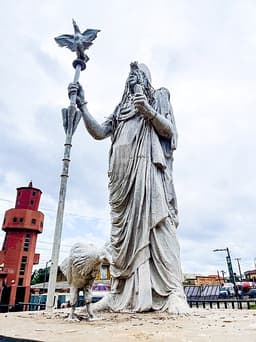
Oduduwa
Emperor · Medieval
59.7Total
Basic Information
Born
-100
950
Died
-44
1020
Era
Ancient
Medieval
Nationality
Roman Republic
Ife
Occupation
General
Emperor
Civilization
Western
Other
Score Comparison
Military (10%)
88.0
50.0
Political (20%)
78.0
46.6
Influence (20%)
85.0
68.0
Legacy (20%)
82.0
68.0
Leadership (15%)
80.0
67.0
Strategy (15%)
85.0
36.8
TOTAL
82.8
59.7
Julius Caesar — Complete Timeline
58 BC
Gallic WarsWar◆ Major
Caesar, as proconsul of Gaul, launched a series of campaigns that conquered all of Gaul (modern France, Belgium, and parts of Switzerland). He fought numerous battles, including against the Helvetii, the Belgae, and the Gallic chieftain Vercingetorix. The wars brought immense wealth and a loyal army to Caesar.
Gallic WarsConquestRoman Expansion
Impact: regional
49 BC
Crossing the RubiconPolitical Action◆ Major
Caesar led Legio XIII across the Rubicon River into Italy, defying the Roman Senate's order to disband his army. This act triggered a civil war against Pompey and the Optimates, ultimately leading to Caesar's dictatorship and the end of the Roman Republic.
Roman Civil WarEnd of RepublicPower Struggle
Impact: global
48 BC
Battle of PharsalusWar◆ Major
Caesar's outnumbered army defeated the larger forces of Pompey the Great at Pharsalus in Greece. Caesar's tactical use of a reserve line to counter Pompey's cavalry charge proved decisive. Pompey fled to Egypt, where he was assassinated, leaving Caesar as the undisputed master of the Roman world.
Roman Civil WarBattleDecisive Victory
Impact: regional
44 BC
Appointment as Dictator for LifePolitical Action◆ Major
The Roman Senate appointed Caesar dictator perpetuo (dictator for life), granting him unprecedented personal power. This move concentrated military, legislative, and judicial authority in one person, effectively ending the Roman Republic's traditional system of checks and balances and alarming many senators.
DictatorshipEnd of RepublicPower Consolidation
Impact: regionaldestructive
Assassination on the Ides of MarchPolitical Action◆ Major
A group of Roman senators, led by Marcus Junius Brutus and Gaius Cassius Longinus, stabbed Caesar to death at a meeting of the Senate in the Theatre of Pompey. The assassination was intended to restore the Republic, but instead triggered another civil war that led to the rise of the Roman Empire.
AssassinationRoman PoliticsEnd of Republic
Impact: globaldestructive
Oduduwa — Complete Timeline
1000 AD
Foundation of the Yoruba civilization at Ile-IfeCultural
According to Yoruba oral tradition, Oduduwa descended from heaven at Ile-Ife and founded the Yoruba civilization. He is credited with establishing the first Yoruba kingdom and the sacred city of Ile-Ife, which became the spiritual and cultural heartland of the Yoruba people.
Impact: regionalconstructive
1010 AD
Establishment of the Yoruba royal dynastiesPolitical Action◆ Major
Oduduwa is said to have sent his sons and grandsons to found the various Yoruba kingdoms, including Oyo, Benin, and Ketu. This act established the royal lineages that ruled these states for centuries, creating a network of related kingdoms under the spiritual authority of the Ooni of Ife.
Impact: regionalconstructive
Expert Analysis
Julius Caesar vs Oduduwa
# The General and the Sky-King: Caesar and Oduduwa, Founders of Worlds
On a January morning in 49 BCE, a Roman general stood at the edge of a small river in northern Italy, the Rubicon. He knew that crossing it meant civil war, the destruction of the Republic his ancestors had built, and likely his own death. He crossed anyway. A thousand years later and half a world away, a figure descended from the sky at a place called Ile-Ife, carrying a handful of earth and a rooster. He planted the earth, the rooster scattered it, and land was formed. One man broke a world to remake it; another created one from nothing. Both became fathers of civilizations. But why did one end with a dagger in his ribs and the other with a crown that never died?
Origins
Caesar was born into the patrician class of Rome, but his family had fallen from glory. His aunt had married Gaius Marius, the great populist general, but his father died when Caesar was sixteen, leaving him in a city torn between Marius’s faction and that of the dictator Sulla. Caesar refused Sulla’s order to divorce his wife, fled Rome, and spent his youth as a fugitive and a soldier. He learned early that survival required cunning, charm, and a willingness to take risks.
Oduduwa emerged from a different kind of silence. The Yoruba oral tradition says he descended from heaven at Ile-Ife, a place that already existed in the spiritual realm. He carried with him a calabash of earth, a rooster, and a palm nut—the tools of creation. In some versions, he was a prince from the east who migrated westward; in others, he was the son of the supreme god Olodumare. What matters is that he arrived as a stranger in a land that needed order, and he brought the authority of the divine with him.
The difference is profound. Caesar was forged in the chaos of a dying republic, where ambition was the only currency. Oduduwa was born from myth, where the ruler was not a man who seized power but a god who bestowed it.
Rise to Power
Caesar’s path was a ladder of blood and debt. He won the military command in Gaul at age forty, then spent eight years conquering a territory that made him rich, famous, and dangerous. His own writings—the *Commentarii*—turned his campaigns into propaganda. He crossed the Rubicon not because he had to, but because his enemies in the Senate had cornered him. He gambled everything on a single march into Rome.
Oduduwa’s rise was not a climb but a descent. In Yoruba cosmology, he did not conquer Ife; he founded it. He established the first palace, the first council of chiefs, the first rituals. His sons and grandsons—some accounts name sixteen of them—were sent out to found the kingdoms of Oyo, Benin, Ketu, and others. This was not military expansion in the Roman sense. It was a spreading of divine kingship, a planting of sacred cities.
Caesar fought his way to power; Oduduwa was power itself, arriving from above.
Leadership & Governance
As dictator of Rome, Caesar reformed the calendar, granted citizenship to provincials, launched massive building projects, and centralized authority in his own hands. He was a genius of administration—the Julian calendar remained standard for sixteen centuries. But he also insulted the Senate, accepted divine honors, and made himself dictator for life. He ruled like a king, which was exactly what the Romans would not tolerate.
Oduduwa’s governance was the opposite of personal rule. He established the *Ooni* of Ife as a spiritual authority, not a military tyrant. The Yoruba system was built on checks and balances: the *Oyo Mesi* council could advise the king, and the *Egungun* masked society held moral power. Oduduwa’s legacy was a structure so stable that it survived the transatlantic slave trade, colonialism, and independence. Yoruba kings still trace their lineage to him.
Caesar centralized; Oduduwa distributed. Caesar was a conqueror; Oduduwa was a planter.
Triumph & Tragedy
Caesar’s greatest moment was his triumph over Gaul—he had conquered a land larger than Italy and brought it to Rome. His worst was the Ides of March, 44 BCE, when sixty senators stabbed him to death in the Pompeian theater. His last words, according to Suetonius, were “*Et tu, Brute?*” He had trusted his friends, and they killed him.
Oduduwa’s triumph was the creation of a civilization that still exists. His tragedy, if it can be called that, is that he is more legend than man. We do not know where he was buried, how he died, or even if he lived exactly as the stories say. But that is also his victory: he became immortal because history could not pin him down.
Character & Destiny
Caesar was restless, arrogant, and brilliant. He forgave enemies, promoted talent, and took risks that would have destroyed a lesser man. He also never stopped moving. His character drove him to push the Republic until it broke, and then to try to hold the pieces together alone. That was his destiny: to be the man who ended the Republic and could not save himself.
Oduduwa was patient, ritualistic, and foundational. He did not seek personal glory; he created a system that would outlast him. His character was the opposite of Caesar’s—where Caesar burned bright and fast, Oduduwa built deep and slow. His destiny was to vanish into the very thing he created.
Legacy
Caesar’s legacy is the Roman Empire. His adopted heir, Octavian, became Augustus, the first emperor. The title “Caesar” became synonymous with ruler—Kaiser, Tsar, Qaysar. But that legacy came at a cost: the Republic died, and with it, centuries of republican governance.
Oduduwa’s legacy is the Yoruba civilization, with over forty million people today. His name means “the one who created the character of the world.” Every *Oba* in Yorubaland wears a crown that descends from him. The city of Ile-Ife remains the spiritual heart of a culture that never collapsed.
Conclusion
Caesar and Oduduwa both founded worlds, but they did so in opposite ways. Caesar’s world was born from ambition, war, and the death of a republic. Oduduwa’s was born from myth, ritual, and the birth of a kingdom. One died by the sword; the other lives in the story. Perhaps the difference is not in the men but in what their cultures needed. Rome needed a strong man to break an old order; the Yoruba needed a divine king to create a new one. Both got what they needed. But only one of them still rules, in the hearts of his people, without ever having to cross a river.
Rankings
🥇
Julius CaesarLeader
Mil: 88.0Pol: 78.0Inf: 85.0
82.8
🥈
Oduduwa
Mil: 50.0Pol: 46.6Inf: 68.0
59.7
+23.1 behind
How This Comparison Works
Algorithm
Each figure is scored on 6 dimensions (0—100 scale) based on structured historical data: Military (10%), Political (20%), Influence (20%), Legacy (20%), Leadership (15%), Strategy (15%). The weighted total produces the final ranking.
Data Sources
Scores are computed from structured sub-indicators in the database. Scale factors adjust for era (Ancient ×0.85, Modern ×1.0) and civilization size (Eastern ×1.05, Other ×0.80) to account for differences in population and military scale.
Maximum 3 Figures
Comparisons are limited to 2—3 figures to ensure readability and statistical meaningfulness.
Error Margins
±5 points per dimension — Sub-scores are derived from historical records with inherent uncertainty. Two figures within 5 points on a dimension should be considered roughly equivalent in that area.
Total Score Accuracy
±3 points overall — The weighted combination of 6 dimensions produces a total score with approximately ±3 points of uncertainty. Differences of less than 3 points are not statistically significant— the figures are effectively tied.
Known Limitations
- Historical records are incomplete and uneven across civilizations
- Figures from oral-tradition societies may be underrepresented
- Occupation labels can misclassify multi-role figures
- Scores measure capability and impact, not moral character
- Quantitative scoring is a comparison tool, not absolute truth
Capability Radar
Military (10%) — Battles & Warfare
Battles
95
10
Win Rate
92
10
Expansion
97
30
Political (20%) — Governance & Reform
Reform
90
50
Diplomacy
85
40
Economy
82
40
Influence (20%) — Cultural & Global Reach
Cultural
88
80
Global
94
70
Legacy (20%) — Historical Impact
Historical
95
80
Longevity
96
80
Leadership (15%) — Power & Stability
Tenure
75
40
Stability
60
50
Strategy (15%) — Tactics & Innovation
Strategy
94
10
Tactics
96
10
Reform
88
10
Similar Comparisons
Comments & Discussion
ROMAN_STOIC6/16/2026
Caesar built an empire; Oduduwa founded a cosmos. Let’s be real: one man conquered Gaul, rewrote the calendar, and faced a Senate of backstabbers. The other is a divine myth—impressive for spiritual unity, but not a historical actor. Caesar’s death proves his world was real: daggers don’t kill legends from heaven. Oduduwa is faith; Caesar is fact. I’ll take the Rubicon over a rooster any day.
天际行者6/16/2026
凯撒是真人,奥杜杜瓦是传说,别混为一谈。罗马将军渡过卢比孔河时,赌的是血肉之躯和现实权力;奥杜杜瓦从天堂降下,带着一只公鸡和一把土,那是神学的诗意,不是政治。凯撒死于元老院匕首,因为他挑战了实实在在的体制;奥杜杜瓦的王冠永不坠落,因为神话从不被凡人推翻。要我选,历史比神话更刺骨。
MYTH_MAKER6/16/2026
You data worshippers miss the point entirely. Oduduwa’s “game” is about world-building, not battlefield wins. He didn’t just conquer—he created land from nothing, planted the first palm nut, and gave Yoruba civilization its origin story. Caesar? A brilliant tactician who ended up a corpse on the Senate floor. Oduduwa’s legacy lives in every Ife bronze and festival crown, unbroken for centuries. That’s not “fiction”—it’s a foundation more durable than any Roman road.
赤脚史官6/16/2026
凯撒征服了高卢,可高卢人今天还说法语吗?奥杜杜瓦的传承才叫真实:约鲁巴人口超过四千万,伊费岛的青铜头像比任何罗马雕像都更有生命力。凯撒被刺杀后,罗马陷入内战;奥杜杜瓦死后,他的子嗣延续了十个世纪。数据告诉你:活着的文化比死去的帝国更有分量。别用罗马的尺子量非洲的天。