Loading...
Analysis will be generated on first visit.
Scores and timeline are available below. The page will refresh automatically when ready.
Juho Kusti Paasikivi vs Napoleon Bonaparte
Napoleon Bonaparte leads by 19.0 pts · 2 figures compared
…

Juho Kusti Paasikivi
Politician · Modern
63.4Total
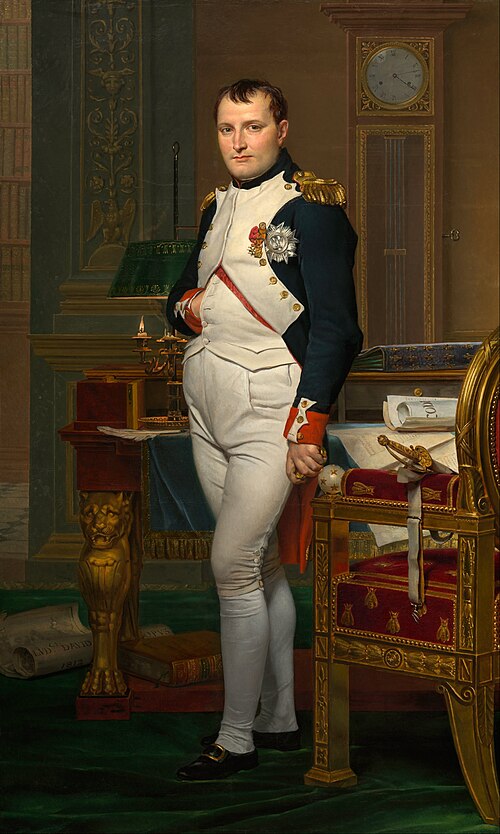
Napoleon Bonaparte
General · Modern
82.4Total
Basic Information
Born
1870
1769
Died
1956
1821
Era
Modern
Modern
Nationality
Finland
France
Occupation
Politician
General
Civilization
Western
Western
Score Comparison
Military (10%)
37.5
94.0
Political (20%)
72.0
75.0
Influence (20%)
72.3
82.0
Legacy (20%)
65.2
78.0
Leadership (15%)
83.2
80.0
Strategy (15%)
35.3
93.0
TOTAL
63.4
82.4
Rankings
🥇
Napoleon BonaparteLeader
Mil: 94.0Pol: 75.0Inf: 82.0
82.4
🥈
Juho Kusti Paasikivi
Mil: 37.5Pol: 72.0Inf: 72.3
63.4
+19.0 behind
How This Comparison Works
Algorithm
Each figure is scored on 6 dimensions (0—100 scale) based on structured historical data: Military (10%), Political (20%), Influence (20%), Legacy (20%), Leadership (15%), Strategy (15%). The weighted total produces the final ranking.
Data Sources
Scores are computed from structured sub-indicators in the database. Scale factors adjust for era (Ancient ×0.85, Modern ×1.0) and civilization size (Eastern ×1.05, Other ×0.80) to account for differences in population and military scale.
Maximum 3 Figures
Comparisons are limited to 2—3 figures to ensure readability and statistical meaningfulness.
Error Margins
±5 points per dimension — Sub-scores are derived from historical records with inherent uncertainty. Two figures within 5 points on a dimension should be considered roughly equivalent in that area.
Total Score Accuracy
±3 points overall — The weighted combination of 6 dimensions produces a total score with approximately ±3 points of uncertainty. Differences of less than 3 points are not statistically significant— the figures are effectively tied.
Known Limitations
- Historical records are incomplete and uneven across civilizations
- Figures from oral-tradition societies may be underrepresented
- Occupation labels can misclassify multi-role figures
- Scores measure capability and impact, not moral character
- Quantitative scoring is a comparison tool, not absolute truth
Capability Radar
Military (10%) — Battles & Warfare
Battles
26
95
Win Rate
34
90
Expansion
33
95
Political (20%) — Governance & Reform
Reform
70
95
Diplomacy
85
80
Economy
60
85
Influence (20%) — Cultural & Global Reach
Cultural
40
85
Global
55
90
Legacy (20%) — Historical Impact
Historical
65
95
Longevity
60
90
Leadership (15%) — Power & Stability
Tenure
65
85
Stability
75
70
Strategy (15%) — Tactics & Innovation
Strategy
35
95
Tactics
39
98
Reform
42
92
Analysis will be generated on first visit.
Scores and timeline are available below. The page will refresh automatically when ready.
Juho Kusti Paasikivi — Complete Timeline
1944 AD
Appointed Prime Minister of FinlandPolitical Action◆ Major
Paasikivi became Prime Minister of Finland in November 1944, succeeding the wartime government. He led the country through the final months of World War II and the transition to peace, overseeing the implementation of the Moscow Armistice terms.
World War IIPeace Transition
Impact: national
Negotiated the Moscow ArmisticePolitical Action◆ Major
As Prime Minister, Paasikivi led the Finnish delegation in negotiations for the Moscow Armistice in September 1944. The armistice ended the Continuation War with the Soviet Union, imposing heavy reparations and territorial losses on Finland.
World War IIArmisticeNegotiations
Impact: nationaltragic
1946 AD
Elected President of FinlandPolitical Action◆ Major
Paasikivi was elected President of Finland in March 1946, succeeding Carl Gustaf Emil Mannerheim. He served until 1956, guiding Finland's post-war foreign policy of neutrality and cooperation with the Soviet Union.
PresidencyPost-War
Impact: national
Implemented the Paasikivi LinePolitical Action◆ Major
Paasikivi developed and implemented the Paasikivi Line, a foreign policy doctrine emphasizing friendly relations with the Soviet Union while preserving Finnish independence. This approach shaped Finnish foreign policy for decades.
Foreign PolicyDoctrine
Impact: nationalconstructive
1948 AD
Signed the Treaty of Friendship, Cooperation, and Mutual Assistance with the Soviet UnionPolitical Action
Paasikivi signed the YYA Treaty with the Soviet Union in April 1948. This agreement defined Finnish-Soviet relations during the Cold War, committing Finland to resist attacks through Finnish territory while maintaining neutrality.
Cold WarForeign PolicyNeutrality
Impact: regional
Similar Comparisons
Comments & Discussion
No comments yet. Be the first to share your thoughts!