Loading...
Juba II of Mauretania vs Julius Caesar
Julius Caesar leads by 35.0 pts · 2 figures compared
…
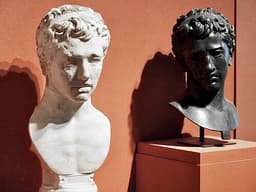
Juba II of Mauretania
Emperor · Ancient
47.8Total

Julius Caesar
General · Ancient
82.8Total
Basic Information
Born
-52
-100
Died
-23
-44
Era
Ancient
Ancient
Nationality
Mauretania
Roman Republic
Occupation
Emperor
General
Civilization
Other
Western
Score Comparison
Military (10%)
50.0
88.0
Political (20%)
68.0
78.0
Influence (20%)
52.5
85.0
Legacy (20%)
41.7
82.0
Leadership (15%)
40.0
80.0
Strategy (15%)
30.3
85.0
TOTAL
47.8
82.8
Juba II of Mauretania — Complete Timeline
25 BC
Marriage to Cleopatra Selene IIPolitical Action◆ Major
Juba II married Cleopatra Selene II, daughter of Cleopatra VII and Mark Antony. This marriage united the Mauretanian and Ptolemaic royal lines, and Selene became queen consort, influencing the kingdom's Hellenistic culture.
MarriagePtolemaic DynastyMauretania
Impact: regionalconstructive
Julius Caesar — Complete Timeline
58 BC
Gallic WarsWar◆ Major
Caesar, as proconsul of Gaul, launched a series of campaigns that conquered all of Gaul (modern France, Belgium, and parts of Switzerland). He fought numerous battles, including against the Helvetii, the Belgae, and the Gallic chieftain Vercingetorix. The wars brought immense wealth and a loyal army to Caesar.
Gallic WarsConquestRoman Expansion
Impact: regional
49 BC
Crossing the RubiconPolitical Action◆ Major
Caesar led Legio XIII across the Rubicon River into Italy, defying the Roman Senate's order to disband his army. This act triggered a civil war against Pompey and the Optimates, ultimately leading to Caesar's dictatorship and the end of the Roman Republic.
Roman Civil WarEnd of RepublicPower Struggle
Impact: global
48 BC
Battle of PharsalusWar◆ Major
Caesar's outnumbered army defeated the larger forces of Pompey the Great at Pharsalus in Greece. Caesar's tactical use of a reserve line to counter Pompey's cavalry charge proved decisive. Pompey fled to Egypt, where he was assassinated, leaving Caesar as the undisputed master of the Roman world.
Roman Civil WarBattleDecisive Victory
Impact: regional
44 BC
Appointment as Dictator for LifePolitical Action◆ Major
The Roman Senate appointed Caesar dictator perpetuo (dictator for life), granting him unprecedented personal power. This move concentrated military, legislative, and judicial authority in one person, effectively ending the Roman Republic's traditional system of checks and balances and alarming many senators.
DictatorshipEnd of RepublicPower Consolidation
Impact: regionaldestructive
Assassination on the Ides of MarchPolitical Action◆ Major
A group of Roman senators, led by Marcus Junius Brutus and Gaius Cassius Longinus, stabbed Caesar to death at a meeting of the Senate in the Theatre of Pompey. The assassination was intended to restore the Republic, but instead triggered another civil war that led to the rise of the Roman Empire.
AssassinationRoman PoliticsEnd of Republic
Impact: globaldestructive
Expert Analysis
juba-ii-of-mauretania-vs-julius-caesar
# The Scholar King and the Conqueror: Two Lives That Shaped an Age
On the Ides of March, 44 BCE, Julius Caesar fell beneath twenty-three dagger blows in the Senate chamber of Rome, his blood pooling on the marble floor as the Republic he had bent to his will convulsed in its death throes. Half a world away and eight years later, another ruler—Juba II of Mauretania—ascended a very different throne. Where Caesar had seized power through legions and civil war, Juba inherited his crown from a Roman patron. Where Caesar had marched across Gaul and Britain with fire and sword, Juba would spend his reign not on battlefields but in libraries, writing histories and mapping the known world. The contrast between these two contemporaries—one whose name became synonymous with imperial ambition, the other whose legacy is largely forgotten—raises a haunting question: what separates a man who reshapes history from one who merely survives it?
Origins
Caesar was born in 100 BCE into one of Rome’s oldest patrician families, the Julii, who claimed descent from the goddess Venus. Yet his family was politically marginal, and his childhood unfolded against the backdrop of the Republic’s unraveling—civil wars, slave revolts, and the growing power of military strongmen. The young Caesar learned early that in Rome, glory was the only currency that mattered. He served in Asia Minor, was captured by pirates and famously told them he would crucify them (and did), and returned to a city where ambition was measured by the number of enemies one had made.
Juba II was born in 52 BCE, the son of Juba I, king of Numidia, who had sided with Pompey against Caesar in the Roman civil war. When Caesar triumphed, Juba I committed suicide, and the infant prince was paraded through Rome in Caesar’s triumph—a living trophy, a foreign king’s son displayed like a captured animal. He was raised in the household of Caesar’s grandnephew, Octavian (the future Emperor Augustus), educated alongside the children of Rome’s elite. Where Caesar was forged in the crucible of Roman politics, Juba was shaped in the shadow of Roman conquest. He learned Greek poetry and Roman law not as a citizen but as a hostage who had been given a gilded cage.
Rise to Power
Caesar’s path was a masterclass in calculated risk. He climbed the traditional ladder of Roman offices—quaestor, aedile, praetor—but always with an eye on the next rung. His appointment as governor of Gaul in 58 BCE gave him an army, and over the next eight years he conquered a territory the size of Italy, winning battles at Alesia and against the Helvetii that would be studied for millennia. The Gallic Wars made him rich, famous, and feared. When the Senate ordered him to disband his army, he crossed the Rubicon River in 49 BCE with a single legion, uttering the words *“Alea iacta est”*—the die is cast. Civil war followed, and within four years Caesar was dictator for life, master of the Roman world.
Juba’s rise was quieter, stranger. Augustus, recognizing the value of a loyal client king, restored him to his father’s throne—but not in Numidia, which had been annexed as a Roman province. Instead, Juba was made king of Mauretania (modern Morocco and Algeria), a vast but peripheral territory. He married Cleopatra Selene II in 25 BCE, the daughter of Cleopatra VII and Mark Antony, a union that symbolically united the last heirs of the Hellenistic kingdoms under Roman oversight. Juba’s power came not from conquest but from patronage. He was a king because Augustus allowed it, and he knew it.
Leadership & Governance
As a military commander, Caesar stands among history’s greatest. His siege of Alesia—where he surrounded the Gallic stronghold while simultaneously building fortifications to repel a massive relief army—is still taught at military academies. His political score of 78 reflects a man who could manipulate Rome’s Senate, courts, and mob with equal skill, pushing through land reforms, calendar reforms (the Julian calendar), and granting citizenship to provincials. Yet his leadership was fatally flawed by arrogance: he dismissed warnings of conspiracy, refused a bodyguard, and walked into the Senate on that March morning as if his luck would never run out.
Juba II’s leadership was of a completely different order. With a military score of 47.8 and a strategy score of 30, he was no general. But as a ruler, he brought something rare to the ancient world: intellectual curiosity. He wrote extensively on history, geography, and natural science—his works on the Canary Islands and the source of the Nile were consulted for centuries. He transformed his capital, Caesarea (modern Cherchell, Algeria), into a center of Hellenistic learning, filling its libraries with Greek texts and its gardens with exotic plants. He built no empire, fought no great wars, but governed a peaceful kingdom that existed in the shadow of Rome. His political score of 51.8 reflects a man who understood that survival sometimes requires obscurity.
Triumph & Tragedy
Caesar’s greatest triumph was also his undoing. His conquest of Gaul added a vast province to Rome and made him the most powerful man in the Republic. His reforms—centralizing administration, reforming the debt system, planning public works—pointed toward a more efficient, less corrupt state. But his tragedy was that he could not complete the transformation. The Ides of March cut short his vision, and the civil wars that followed destroyed the Republic he had tried to save by destroying it.
Juba’s triumph was quieter: he lived, he ruled, he wrote. His tragedy was that almost nothing he wrote survives. His histories, his geographical treatises, his studies of natural phenomena—all lost except for fragments quoted by later authors. He married a woman who was the daughter of the most famous lovers in history, yet their story is a footnote. He ruled a kingdom that, after his death, was absorbed into the Roman Empire and forgotten. The scholar king’s greatest work—his own legacy—was erased.
Character & Destiny
Caesar’s personality was a force of nature: ambitious, charming, ruthless, and intellectually voracious. He wrote clear, elegant Latin prose, forgave enemies who later killed him, and slept with the wives of his political rivals. He believed, with some justification, that he was destined to remake Rome. That belief drove him to cross the Rubicon, to accept dictatorship, and to ignore the daggers. His destiny was to become not just a man but a symbol—the name “Caesar” became synonymous with emperor for two thousand years.
Juba’s character was shaped by his circumstances. Raised as a Roman hostage, he learned to be careful, learned to be useful. He channeled his ambition into scholarship rather than power, perhaps because power was never truly his to wield. He was a king, but always a client king; a Roman by education, but always a foreigner. His destiny was to be a bridge between two worlds—the Hellenistic east and the Roman west—and to be forgotten by both.
Legacy
Caesar’s legacy is immeasurable. The Roman Empire was his creation, and through it, his influence reached every corner of Europe, North Africa, and the Middle East. His military tactics, his political innovations, even his calendar shaped the world for centuries. His name became a title: Kaiser, Tsar. He is remembered as a great man, a tyrant, a visionary, a warning.
Juba II’s legacy is a whisper. His writings survive only in fragments; his kingdom vanished; his name is known mainly to specialists. Yet his life tells a different story—of how a conquered prince could find meaning in knowledge, of how a client king could build a civilization of his own within the cracks of empire. His legacy score of 55.4 reflects not failure but obscurity. He did not change the world; he simply lived in it wisely.
Conclusion
Standing at the edge of history, we tend to measure greatness by impact—by battles won, empires built, names remembered. Caesar reshaped the world; Juba II watched it reshape itself around him. But perhaps the scholar king’s quiet reign offers a different kind of lesson. Not every life needs to be a revolution. Some lives are about preservation, about building something small and beautiful in the shadow of giants. Caesar died in the Senate, his blood on the floor, his name eternal. Juba II died in his palace, surrounded by his books, his name fading into the desert wind. Both men faced the same question every ruler must answer: what do you do with the power you are given? Caesar chose to conquer. Juba chose to understand. History has remembered one and forgotten the other, but both choices, in their own way, shaped the world we still inhabit.
Rankings
🥇
Julius CaesarLeader
Mil: 88.0Pol: 78.0Inf: 85.0
82.8
🥈
Juba II of Mauretania
Mil: 50.0Pol: 68.0Inf: 52.5
47.8
+35.0 behind
How This Comparison Works
Algorithm
Each figure is scored on 6 dimensions (0—100 scale) based on structured historical data: Military (10%), Political (20%), Influence (20%), Legacy (20%), Leadership (15%), Strategy (15%). The weighted total produces the final ranking.
Data Sources
Scores are computed from structured sub-indicators in the database. Scale factors adjust for era (Ancient ×0.85, Modern ×1.0) and civilization size (Eastern ×1.05, Other ×0.80) to account for differences in population and military scale.
Maximum 3 Figures
Comparisons are limited to 2—3 figures to ensure readability and statistical meaningfulness.
Error Margins
±5 points per dimension — Sub-scores are derived from historical records with inherent uncertainty. Two figures within 5 points on a dimension should be considered roughly equivalent in that area.
Total Score Accuracy
±3 points overall — The weighted combination of 6 dimensions produces a total score with approximately ±3 points of uncertainty. Differences of less than 3 points are not statistically significant— the figures are effectively tied.
Known Limitations
- Historical records are incomplete and uneven across civilizations
- Figures from oral-tradition societies may be underrepresented
- Occupation labels can misclassify multi-role figures
- Scores measure capability and impact, not moral character
- Quantitative scoring is a comparison tool, not absolute truth
Capability Radar
Military (10%) — Battles & Warfare
Battles
10
95
Win Rate
10
92
Expansion
15
97
Political (20%) — Governance & Reform
Reform
50
90
Diplomacy
65
85
Economy
55
82
Influence (20%) — Cultural & Global Reach
Cultural
45
88
Global
30
94
Legacy (20%) — Historical Impact
Historical
40
95
Longevity
30
96
Leadership (15%) — Power & Stability
Tenure
60
75
Stability
55
60
Strategy (15%) — Tactics & Innovation
Strategy
15
94
Tactics
15
96
Reform
10
88
Similar Comparisons
Comments & Discussion
LegionSkeptic6/17/2026
The real story here isn't Caesar's ambition vs Juba's learning—it's that one man conquered the world and the other inherited a client kingdom from a conqueror. Caesar needed to be exceptional; Juba just needed to be useful. That's the difference between being a historical force and being a footnote. You can't compare a man who rewrote the map with a man who merely read about it.
数据质疑者6/17/2026
拿朱巴二世跟凯撒比?这不是学术王和征服者的对决,是幸存者与创造者的差距。朱巴的"知识"全是罗马图书馆的二手货,他唯一原创的东西是给奥古斯都拍马屁。凯撒写下高卢战记时正在打仗,朱巴写书时正在喝茶。这不是两种辉煌,这是天壤之别。
EagleEyeHistorian6/17/2026
Let's talk specifics: Caesar wrote about the Gallic Wars because he lived them. Juba wrote about the Arabian coast without ever sailing there. Caesar actually crossed the Rubicon. Juba's biggest military achievement was being paraded in a triumph as a kid. So the question shouldn't be "what separates them?"—it's why are we comparing a founder to a follower in the first place?
拉丁文书虫6/17/2026
我从文献角度说:朱巴二世留下的全是百科式汇编,凯撒留下的却是改变了拉丁文学的高卢战记。一个是整理别人思想,一个是创造自己的思想。朱巴写的关于非洲的著作全都失传了,这说明什么?说明真正重要的东西,要么一直活着,要么根本不值得保存。
RealpolitikRick6/17/2026
Here's the uncomfortable truth Juba fans ignore: he ruled because Rome let him. Caesar ruled because he made Rome his. One was a puppet with a library, the other was the puppeteer who burned the whole stage down. You can admire Juba's scholarship, but let's not pretend that being a well-read client king is in the same league as being the dictator who ended the Republic.