Loading...
Juan Carlos I vs Napoleon Bonaparte
Napoleon Bonaparte leads by 13.4 pts · 2 figures compared
…
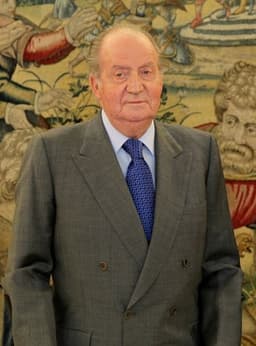
Juan Carlos I
Emperor · Modern
57.5Total

Napoleon Bonaparte
General · Modern
70.9Total
Basic Information
Born
1938
1769
Died
—
1821
Era
Modern
Modern
Nationality
Spain
France
Occupation
Emperor
General
Civilization
Western
Western
Score Comparison
Military (10%)
26.8
94.0
Political (20%)
75.0
72.0
Influence (20%)
55.0
40.0
Legacy (20%)
52.0
80.0
Leadership (15%)
72.0
78.0
Strategy (15%)
60.0
90.0
TOTAL
57.5
70.9
Juan Carlos I — Complete Timeline
1975 AD
King of Spain CoronationPolitical Action◆ Major
Juan Carlos I was crowned King of Spain on November 22, 1975, two days after Francisco Franco's death. He inherited a dictatorship and immediately began steering the country toward democratic reform.
CoronationTransitionDemocracy
Impact: nationalconstructive
1976 AD
Spanish Transition to DemocracyReform
Juan Carlos I appointed Adolfo Suarez as Prime Minister and supported the Political Reform Act of 1976, which dismantled Francoist institutions. He used his authority to push through democratic reforms, leading to free elections in 1977.
DemocratizationReformConstitution
Impact: nationalprogressive
1981 AD
1981 Spanish Coup d'état AttemptPolitical Action
On February 23, 1981, Civil Guard officers led by Antonio Tejero stormed the Spanish Congress. Juan Carlos I appeared on national television in military uniform, denouncing the coup and ordering the military to remain loyal, which ended the attempt.
Coup AttemptCrisisLeadership
Impact: nationalconstructive
2014 AD
Abdication in Favor of Felipe VIPolitical Action◆ Major
Juan Carlos I abdicated the throne on June 2, 2014, citing personal reasons and the need for generational renewal. His son Felipe VI succeeded him. The abdication followed years of declining popularity due to scandals and economic crisis.
AbdicationMonarchySuccession
Impact: national
2020 AD
Corruption Scandals and ExilePolitical Action◆ Major
In August 2020, Juan Carlos I left Spain for the United Arab Emirates amid investigations into alleged financial irregularities, including hidden bank accounts and commissions from a high-speed rail contract in Saudi Arabia. He remained in self-imposed exile.
CorruptionExileScandal
Impact: nationaldestructive
Napoleon Bonaparte — Complete Timeline
1799 AD
Coup of 18 BrumaireOther◆ Major
Napoleon Bonaparte, with support from his brother Lucien and key political figures, overthrew the Directory in a bloodless coup. He established the Consulate with himself as First Consul, effectively becoming the ruler of France. This event ended the French Revolution's most unstable period.
French RevolutionCoupRise to Power
Impact: regional
1804 AD
Promulgation of the Napoleonic CodeOther◆ Major
Napoleon enacted the Civil Code of the French, known as the Napoleonic Code, a comprehensive set of laws that replaced the fragmented feudal legal systems. The code established legal equality, protected property rights, and secularized law. It became the basis for legal systems in many European and world countries.
Legal ReformNapoleonic CodeCivil Law
Impact: globalconstructive
1805 AD
Battle of AusterlitzWar◆ Major
Napoleon's Grande Arm
Napoleonic WarsBattleDecisive Victory
Impact: global
1812 AD
Invasion of RussiaWar◆ Major
Napoleon led the Grande Arm
Napoleonic WarsInvasionDisaster
Impact: globaldestructive
1815 AD
Battle of WaterlooWar◆ Major
Napoleon's French army was defeated by the combined forces of the Duke of Wellington's Anglo-Allied army and Gebhard Leberecht von Bl
Napoleonic WarsBattleFinal Defeat
Impact: globaldestructive
Expert Analysis
juan-carlos-i-vs-napoleon-bonaparte
# The Emperor and the King: Two Faces of Power in Modern Europe
On a winter morning in 1814, Napoleon Bonaparte stood before his shattered Imperial Guard in the courtyard of Fontainebleau, tears streaming down his face as he bid them farewell before exile to Elba. One hundred and sixty-seven years later, on a February night in 1981, King Juan Carlos I of Spain donned his uniform as Captain General of the Armed Forces and faced down a coup that threatened his nation's fragile democracy. Both men held Europe's fate in their hands. One chose conquest; the other chose restraint. Their divergent paths reveal something profound about the nature of power—and the difference between a man who would remake the world and one who would merely save his country.
Origins
Napoleon Buonaparte was born in 1769 on the rugged island of Corsica, a place that had become French only a year before his birth. His father, Carlo, was a minor nobleman who scraped for influence; his mother, Letizia, raised eight children with iron discipline. Young Napoleon spoke Italian-accented French, was mocked by classmates at military school, and carried a burning resentment of the French aristocracy that looked down on him. He devoured history and military tactics, but also the works of Rousseau—a volatile mix of ambition and revolutionary idealism.
Juan Carlos Alfonso Víctor María de Borbón y Borbón was born in 1938 in Rome, into exile. His grandfather, King Alfonso XIII, had fled Spain in 1931, and the young prince grew up in hotels and rented villas, a king without a kingdom. His father, Don Juan, was the legitimate heir but was blocked from power by Francisco Franco. The boy was educated in military academies—first in Spain, by Franco’s design—and learned early that survival meant discretion. Where Napoleon learned to conquer, Juan Carlos learned to wait.
Rise to Power
Napoleon’s ascent was a matter of genius and opportunity. In 1793, at just twenty-four, he recaptured the port of Toulon from British forces with a bold artillery plan. By 1795, he saved the revolutionary government from a royalist uprising, earning command of the Army of Italy. Then, in a campaign that still dazzles military historians, he smashed the Austrian and Sardinian armies in 1796-1797, crossing the Alps in winter and forcing peace on his terms. By 1799, he was First Consul; by 1804, Emperor of the French. Each step was a gamble that paid off.
Juan Carlos’s rise was quieter, more constrained. Franco named him his successor in 1969, bypassing his father, and the prince accepted—a decision that many Spanish monarchists saw as betrayal. For six years, he played the role Franco demanded: attending ceremonies, smiling alongside the dictator, saying nothing. When Franco died on November 20, 1975, Juan Carlos was crowned king two days later. He inherited a country still haunted by civil war, with a military loyal to Franco’s memory and a population desperate for freedom. He had no army, no popular mandate—only a crown and a plan.
Leadership & Governance
Napoleon governed as he conquered: with relentless energy and total control. His Napoleonic Code, enacted in 1804, standardized French law, abolished feudal privileges, and established merit-based advancement. It was a genuine reform—clear, rational, and influential across Europe. But his political wisdom was undermined by his ambition. He appointed his brothers to thrones, suppressed dissent, and centralized power so completely that when he fell, his system collapsed with him. His military genius was undeniable—scores of 94 for military ability and 93 for strategy—but his political score of 75 reflected a man who could win battles but not sustain peace.
Juan Carlos governed through symbolism and restraint. His political score of 87.7 reflects his masterful handling of Spain’s transition. In 1976, he appointed Adolfo Suárez as Prime Minister and backed the Political Reform Act, which dismantled Franco’s institutions. He could have tried to rule as an autocrat; instead, he chose to make himself a constitutional monarch. When the 1981 coup attempt erupted, with Civil Guard officers storming the Spanish Congress, he appeared on national television in uniform, ordering the military to stand down. That single act—calm, authoritative, democratic—saved Spain’s democracy. His military score of 45 is irrelevant; his leadership score of 81.7 is the truer measure.
Triumph & Tragedy
Napoleon’s greatest moment was Austerlitz, December 2, 1805, where he crushed the combined armies of Austria and Russia, ending the Third Coalition. His tactics that day—feigning weakness, luring the enemy onto a frozen lake, then shattering their center—are still studied in war colleges. His tragedy was Russia, 1812. He marched 600,000 men into the vastness of winter and returned with fewer than 100,000. Then came Leipzig in 1813, then Elba, then Waterloo in 1815—a final defeat that ended an era.
Juan Carlos’s triumph was the night of February 23, 1981, when he faced down Tejero’s guns and saved the transition. His tragedy came decades later. In 2014, he abdicated amid declining health and waning popularity. Then, in 2020, corruption scandals erupted—allegations of hidden accounts, secret commissions, and a luxurious lifestyle funded by Saudi Arabian deals. He fled to the United Arab Emirates, a king in exile, his reputation in tatters. The man who saved Spanish democracy could not save his own moral legacy.
Character & Destiny
Napoleon’s character was a force of nature: brilliant, ruthless, insatiable. “I am a creature of circumstance,” he once said, but he created the circumstances. His destiny was to push Europe into modernity—through war, yes, but also through law and ideas. He could not stop, because stopping meant admitting limits. Waterloo was not just a defeat; it was the consequence of a character that could not compromise.
Juan Carlos’s character was shaped by suppression. He learned to smile when he wanted to scream, to wait when he wanted to act. His destiny was to be a bridge—between dictatorship and democracy, between Franco’s Spain and Europe. He succeeded because he understood that real power is not about dominating but about enabling. Yet the same discretion that made him effective also allowed corruption to flourish in the shadows. His tragedy is that the man who could resist a coup could not resist temptation.
Legacy
Napoleon’s legacy is immense and contradictory. He is remembered as a military genius, a reformer, a tyrant. The Napoleonic Code governs legal systems from France to Louisiana to Japan. His influence score of 82 reflects a man who reshaped Europe’s borders and ideas. But his ambition also cost millions of lives and ended in failure. He is a warning as much as an inspiration.
Juan Carlos’s legacy is more fragile. For a generation of Spaniards, he was the king who gave them freedom. His legacy score of 69.6, however, has eroded with each scandal. Young Spaniards today often see him as a symbol of privilege and corruption. Yet history may be kinder. When the moment came—when democracy hung by a thread—he did not hesitate. He chose the people over power.
Conclusion
Napoleon once wrote, “Glory is fleeting, but obscurity is forever.” He was wrong. Both men now live in the long shadow of their choices. Napoleon conquered Europe but could not keep it; Juan Carlos gave away power and saved his country. Which is the greater achievement? Perhaps it depends on whether one measures greatness by what is taken or what is given. In the end, the emperor and the king teach us the same lesson: that power reveals character, and character, in the end, writes history.
Rankings
🥇
Napoleon BonaparteLeader
Mil: 94.0Pol: 72.0Inf: 40.0
70.9
🥈
Juan Carlos I
Mil: 26.8Pol: 75.0Inf: 55.0
57.5
+13.4 behind
How This Comparison Works
Algorithm
Each figure is scored on 6 dimensions (0—100 scale) based on structured historical data: Military (10%), Political (20%), Influence (20%), Legacy (20%), Leadership (15%), Strategy (15%). The weighted total produces the final ranking.
Data Sources
Scores are computed from structured sub-indicators in the database. Scale factors adjust for era (Ancient ×0.85, Modern ×1.0) and civilization size (Eastern ×1.05, Other ×0.80) to account for differences in population and military scale.
Maximum 3 Figures
Comparisons are limited to 2—3 figures to ensure readability and statistical meaningfulness.
Error Margins
±5 points per dimension — Sub-scores are derived from historical records with inherent uncertainty. Two figures within 5 points on a dimension should be considered roughly equivalent in that area.
Total Score Accuracy
±3 points overall — The weighted combination of 6 dimensions produces a total score with approximately ±3 points of uncertainty. Differences of less than 3 points are not statistically significant— the figures are effectively tied.
Known Limitations
- Historical records are incomplete and uneven across civilizations
- Figures from oral-tradition societies may be underrepresented
- Occupation labels can misclassify multi-role figures
- Scores measure capability and impact, not moral character
- Quantitative scoring is a comparison tool, not absolute truth
Capability Radar
Military (10%) — Battles & Warfare
Battles
34
95
Win Rate
39
90
Expansion
41
95
Political (20%) — Governance & Reform
Reform
85
95
Diplomacy
80
80
Economy
60
85
Influence (20%) — Cultural & Global Reach
Cultural
55
85
Global
65
90
Legacy (20%) — Historical Impact
Historical
70
95
Longevity
60
90
Leadership (15%) — Power & Stability
Tenure
65
85
Stability
75
70
Strategy (15%) — Tactics & Innovation
Strategy
44
95
Tactics
46
98
Reform
52
92
Similar Comparisons
Comments & Discussion
No comments yet. Be the first to share your thoughts!