Loading...
Juan Carlos I of Spain vs Napoleon Bonaparte
Napoleon Bonaparte leads by 13.8 pts · 2 figures compared
…
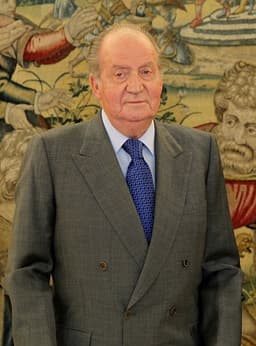
Juan Carlos I of Spain
Emperor · Modern
57.1Total

Napoleon Bonaparte
General · Modern
70.9Total
Basic Information
Born
1938
1769
Died
—
1821
Era
Modern
Modern
Nationality
Spain
France
Occupation
Emperor
General
Civilization
Western
Western
Score Comparison
Military (10%)
27.1
94.0
Political (20%)
75.0
72.0
Influence (20%)
55.0
40.0
Legacy (20%)
52.0
80.0
Leadership (15%)
72.0
78.0
Strategy (15%)
56.0
90.0
TOTAL
57.1
70.9
Juan Carlos I of Spain — Complete Timeline
1969 AD
Appointment as Franco's successorPolitical Action
Francisco Franco designated Juan Carlos as his successor, with the title of Prince of Spain. This decision was made to ensure the continuation of the regime after Franco's death, but Juan Carlos secretly worked to transition Spain to democracy.
SuccessionFrancoTransition
Impact: national
1975 AD
Proclamation as King of SpainPolitical Action
Juan Carlos I was proclaimed king two days after Franco's death. He inherited a dictatorial regime but quickly moved to dismantle it, initiating a process of political reform that would lead to democracy.
ProclamationMonarchyReform
Impact: nationalconstructive
1977 AD
Legalization of political partiesReform◆ Major
Under Juan Carlos I's guidance, the Spanish government legalized political parties, including the Communist Party. This was a key step in the transition to democracy, allowing for free elections and the establishment of a pluralistic political system.
DemocracyPolitical ReformLegalization
Impact: nationalprogressive
1978 AD
Approval of the 1978 ConstitutionReform
Juan Carlos I oversaw the drafting and approval of a new democratic constitution. The constitution established a parliamentary monarchy, guaranteed civil rights, and decentralized the state through autonomous communities, ending the Francoist centralization.
ConstitutionDemocracyDecentralization
Impact: nationalconstructive
1981 AD
Role in thwarting the 1981 coup attemptPolitical Action
During an attempted military coup, Juan Carlos I went on national television to denounce the coup and order the military to remain loyal to the democratic government. His decisive action helped defeat the coup and consolidate Spanish democracy.
CoupDemocracyLeadership
Impact: nationalconstructive
2014 AD
Abdication in favor of Felipe VIPolitical Action◆ Major
Juan Carlos I abdicated the throne, citing personal reasons and a desire to rejuvenate the monarchy. His abdication followed a series of scandals that had damaged the monarchy's reputation, and he handed over the crown to his son Felipe VI.
AbdicationSuccessionFelipe VI
Impact: national
Napoleon Bonaparte — Complete Timeline
1799 AD
Coup of 18 BrumaireOther◆ Major
Napoleon Bonaparte, with support from his brother Lucien and key political figures, overthrew the Directory in a bloodless coup. He established the Consulate with himself as First Consul, effectively becoming the ruler of France. This event ended the French Revolution's most unstable period.
French RevolutionCoupRise to Power
Impact: regional
1804 AD
Promulgation of the Napoleonic CodeOther◆ Major
Napoleon enacted the Civil Code of the French, known as the Napoleonic Code, a comprehensive set of laws that replaced the fragmented feudal legal systems. The code established legal equality, protected property rights, and secularized law. It became the basis for legal systems in many European and world countries.
Legal ReformNapoleonic CodeCivil Law
Impact: globalconstructive
1805 AD
Battle of AusterlitzWar◆ Major
Napoleon's Grande Arm
Napoleonic WarsBattleDecisive Victory
Impact: global
1812 AD
Invasion of RussiaWar◆ Major
Napoleon led the Grande Arm
Napoleonic WarsInvasionDisaster
Impact: globaldestructive
1815 AD
Battle of WaterlooWar◆ Major
Napoleon's French army was defeated by the combined forces of the Duke of Wellington's Anglo-Allied army and Gebhard Leberecht von Bl
Napoleonic WarsBattleFinal Defeat
Impact: globaldestructive
Expert Analysis
juan-carlos-i-of-spain-vs-napoleon-bonaparte
# The Emperor and the King
On a winter night in 1814, Napoleon Bonaparte stood in the courtyard of Fontainebleau, bidding farewell to his Old Guard as they wept and kissed his hands. Less than two centuries later, on a February evening in 1981, another monarch faced his own moment of truth: King Juan Carlos I of Spain sat in a military command post, listening to tanks rumble through the streets of Valencia, knowing that a single phone call could either save his country’s fragile democracy or doom it. Both men inherited thrones. Both faced revolutions. But where Napoleon chose glory and ended in exile, Juan Carlos chose humility and ended in history. Why?
Origins
Napoleon Bonaparte was born in 1769 on the island of Corsica, a year after France had purchased it from Genoa. His family were minor nobles, proud and impoverished, speaking Italian at home. The boy grew up with a chip on his shoulder—a foreigner in French schools, mocked for his accent, yet burning with ambition. The French Revolution, which erupted when he was twenty, shattered the old order and opened doors that birth alone could never have unlocked. In that chaos, a young artillery officer could rise to command armies.
Juan Carlos de Borbón y Borbón was born in 1938 in Rome, in exile. His grandfather, King Alfonso XIII, had fled Spain in 1931 when the monarchy was abolished. The boy grew up in a world of faded grandeur and political uncertainty, his family torn between nostalgia for the past and fear of the future. When Francisco Franco won the Spanish Civil War and restored the monarchy in name but not in power, Juan Carlos was sent back to Spain at age ten—not as a prince, but as a hostage. He was educated by the regime's tutors, watched by its spies, and trained to be a figurehead.
Rise to Power
Napoleon’s ascent was a bolt of lightning. In 1793, at age twenty-four, he drove the British from Toulon and was promoted to brigadier general. By 1796, he commanded the Army of Italy, where he transformed a starving, ragged force into an instrument of conquest. His victories in Italy forced Austria to sue for peace; his Egyptian campaign, though ultimately a strategic failure, made him a legend across Europe. In 1799, he returned to a France desperate for order, staged a coup, and made himself First Consul. By 1804, he crowned himself Emperor.
Juan Carlos’s rise was a slow, patient game of shadows. In 1969, Franco formally designated him as successor, with the title Prince of Spain. The old dictator believed he had molded a puppet. But Juan Carlos had been secretly preparing for a different role. He cultivated relationships with opposition figures, read liberal thinkers in private, and waited. When Franco finally died on November 20, 1975, Juan Carlos was proclaimed king two days later. The world watched nervously. Would he be another Francoist strongman, or something else entirely?
Leadership & Governance
Napoleon ruled as a genius of war and administration. His military strategy—the rapid movement of forces, the concentration of artillery, the decisive battle—redefined European warfare. His peak came at Austerlitz in 1805, where he crushed the combined armies of Austria and Russia, a victory so complete it ended the Holy Roman Empire. But his governance was a paradox: he spread revolutionary ideals of meritocracy and legal equality through the Napoleonic Code, yet he also crowned himself emperor, placed his brothers on thrones, and suppressed dissent with a secret police. His reforms were real, but they came wrapped in autocracy.
Juan Carlos governed through restraint. His military score of 45 reflects not weakness but wisdom: he never needed to fight because he knew when to step back. His political score of 87.7 reflects his true genius. In 1977, he pushed through the legalization of political parties, including the Communist Party that had been Franco’s sworn enemy. In 1978, he oversaw the drafting of a democratic constitution that transformed Spain from a dictatorship into a parliamentary monarchy. His greatest moment came on February 23, 1981, when rogue Civil Guard officers stormed parliament and held deputies at gunpoint. While others hesitated, Juan Carlos donned his uniform, went on national television, and ordered the military to stand down. “The Crown,” he said, “cannot tolerate in any form actions or attitudes of those who try to interrupt the democratic process by force.” The coup collapsed.
Triumph & Tragedy
Napoleon’s triumph was Europe at his feet. By 1810, his empire stretched from Spain to Poland, his brothers sat on thrones across the continent, and his marriage to the Austrian princess Marie Louise seemed to seal his dynasty. But hubris followed. The invasion of Russia in 1812 was his tragedy: 600,000 men marched east; fewer than 100,000 returned. The disaster shattered his aura of invincibility, and within two years, he was exiled to Elba. He escaped, rallied France one last time, and met his final defeat at Waterloo in 1815. He died seven years later on Saint Helena, a prisoner of the British, at age fifty-one.
Juan Carlos’s triumph was the consolidation of democracy. But his tragedy came later, in the quiet erosion of respect. After his heroic stand in 1981, he became the most beloved figure in Spain. Yet the same personality that made him a flexible politician—a love of luxury, a taste for adventure, a willingness to bend rules—led to scandals. In 2012, a luxury elephant-hunting trip to Botswana during Spain’s economic crisis enraged a suffering public. Allegations of hidden wealth and secret mistresses followed. In 2014, he abdicated in favor of his son, Felipe VI, citing personal reasons. He left not in defeat, but in disgrace.
Character & Destiny
Napoleon’s character was a furnace of ambition. “Impossible,” he once said, “is a word to be found only in the dictionary of fools.” He believed that destiny belonged to those who seized it, and for a decade, he was right. But that same relentless drive blinded him. He could not stop, could not compromise, could not share power. His personality built an empire and then burned it down.
Juan Carlos’s character was a mask of patience. He learned early that survival meant hiding his true thoughts. He smiled at Franco while planning his dismantlement. He waited for the right moment, then acted decisively. But the mask had a cost: the same man who could charm democrats could also evade accountability. His personality saved Spain’s democracy but could not save his own reputation.
Legacy
Napoleon’s legacy is written in law and memory. The Napoleonic Code still forms the basis of civil law across Europe and beyond. His military campaigns are studied in every war college. His name evokes both glory and tyranny. His legacy score of 78 reflects this ambivalence: he is remembered as both a liberator and a conqueror, a reformer and a despot.
Juan Carlos’s legacy is more fragile. For decades, he was hailed as the king who saved Spanish democracy. Today, many Spaniards view him with suspicion or indifference. His legacy score of 69.6 reflects the tragedy of a hero who outlived his heroic moment. Yet history may be kinder: without his courage in 1981, Spain might still be a dictatorship.
Conclusion
Napoleon and Juan Carlos both faced revolutions, but they chose opposite paths. Napoleon tried to master the storm and was consumed by it. Juan Carlos guided the storm and then stepped aside. One built an empire that collapsed; the other dismantled a dictatorship that endured. In the end, the emperor’s tragedy was that he could never stop fighting for power, while the king’s tragedy was that he could never stop enjoying it. Both men remind us that history judges not only what we do, but when we choose to stop.
Rankings
🥇
Napoleon BonaparteLeader
Mil: 94.0Pol: 72.0Inf: 40.0
70.9
🥈
Juan Carlos I of Spain
Mil: 27.1Pol: 75.0Inf: 55.0
57.1
+13.8 behind
How This Comparison Works
Algorithm
Each figure is scored on 6 dimensions (0—100 scale) based on structured historical data: Military (10%), Political (20%), Influence (20%), Legacy (20%), Leadership (15%), Strategy (15%). The weighted total produces the final ranking.
Data Sources
Scores are computed from structured sub-indicators in the database. Scale factors adjust for era (Ancient ×0.85, Modern ×1.0) and civilization size (Eastern ×1.05, Other ×0.80) to account for differences in population and military scale.
Maximum 3 Figures
Comparisons are limited to 2—3 figures to ensure readability and statistical meaningfulness.
Error Margins
±5 points per dimension — Sub-scores are derived from historical records with inherent uncertainty. Two figures within 5 points on a dimension should be considered roughly equivalent in that area.
Total Score Accuracy
±3 points overall — The weighted combination of 6 dimensions produces a total score with approximately ±3 points of uncertainty. Differences of less than 3 points are not statistically significant— the figures are effectively tied.
Known Limitations
- Historical records are incomplete and uneven across civilizations
- Figures from oral-tradition societies may be underrepresented
- Occupation labels can misclassify multi-role figures
- Scores measure capability and impact, not moral character
- Quantitative scoring is a comparison tool, not absolute truth
Capability Radar
Military (10%) — Battles & Warfare
Battles
35
95
Win Rate
37
90
Expansion
42
95
Political (20%) — Governance & Reform
Reform
85
95
Diplomacy
80
80
Economy
60
85
Influence (20%) — Cultural & Global Reach
Cultural
55
85
Global
65
90
Legacy (20%) — Historical Impact
Historical
70
95
Longevity
60
90
Leadership (15%) — Power & Stability
Tenure
65
85
Stability
75
70
Strategy (15%) — Tactics & Innovation
Strategy
48
95
Tactics
49
98
Reform
51
92
Similar Comparisons
Comments & Discussion
No comments yet. Be the first to share your thoughts!