Loading...
Joseph Stilwell vs Napoleon Bonaparte
Napoleon Bonaparte leads by 16.2 pts · 2 figures compared
…
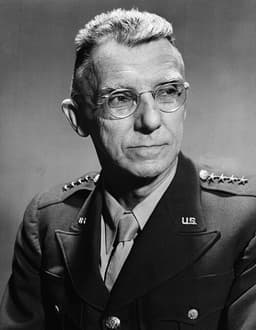
Joseph Stilwell
General · Modern
54.7Total

Napoleon Bonaparte
General · Modern
70.9Total
Basic Information
Born
1883
1769
Died
1946
1821
Era
Modern
Modern
Nationality
United States
France
Occupation
General
General
Civilization
Western
Western
Score Comparison
Military (10%)
40.0
94.0
Political (20%)
48.0
72.0
Influence (20%)
62.0
40.0
Legacy (20%)
50.0
80.0
Leadership (15%)
64.5
78.0
Strategy (15%)
58.0
90.0
TOTAL
54.7
70.9
Joseph Stilwell — Complete Timeline
1942 AD
Command of US Forces in China-Burma-India TheaterWar◆ Major
Stilwell was appointed commander of US forces in the China-Burma-India Theater and chief of staff to Chiang Kai-shek. He was responsible for coordinating Allied operations against Japan in the region and training Chinese forces.
World War IIChina-Burma-IndiaCommand
Impact: regional
Retreat from BurmaWar◆ Major
Stilwell led a group of 114 people on a 140-mile retreat through the Burmese jungle after the Japanese conquest of Burma. The retreat ended in India, and Stilwell famously stated 'We got a hell of a beating.'
World War IIBurmaRetreat
Impact: regionaltragic
Ledo Road ConstructionWar◆ Major
Stilwell initiated and oversaw the construction of the Ledo Road, a supply route from India to China. The road was built through difficult jungle and mountain terrain to bypass the Japanese blockade of Burma.
World War IILogisticsLedo Road
Impact: regionalconstructive
1944 AD
Myitkyina CampaignWar◆ Major
Stilwell directed the campaign to capture Myitkyina, a key Japanese-held town in northern Burma. The operation involved Chinese and American forces, including Merrill's Marauders, and resulted in the capture of the town after a prolonged siege.
World War IIBurmaMyitkyina
Impact: regional
Recall from ChinaPolitical Action◆ Major
Stilwell was recalled from China by President Roosevelt after a breakdown in relations with Chiang Kai-shek. The recall ended his command in the China-Burma-India Theater and marked a failure of US-China military cooperation.
World War IIChinaCommand
Impact: regional
Napoleon Bonaparte — Complete Timeline
1799 AD
Coup of 18 BrumaireOther◆ Major
Napoleon Bonaparte, with support from his brother Lucien and key political figures, overthrew the Directory in a bloodless coup. He established the Consulate with himself as First Consul, effectively becoming the ruler of France. This event ended the French Revolution's most unstable period.
French RevolutionCoupRise to Power
Impact: regional
1804 AD
Promulgation of the Napoleonic CodeOther◆ Major
Napoleon enacted the Civil Code of the French, known as the Napoleonic Code, a comprehensive set of laws that replaced the fragmented feudal legal systems. The code established legal equality, protected property rights, and secularized law. It became the basis for legal systems in many European and world countries.
Legal ReformNapoleonic CodeCivil Law
Impact: globalconstructive
1805 AD
Battle of AusterlitzWar◆ Major
Napoleon's Grande Arm
Napoleonic WarsBattleDecisive Victory
Impact: global
1812 AD
Invasion of RussiaWar◆ Major
Napoleon led the Grande Arm
Napoleonic WarsInvasionDisaster
Impact: globaldestructive
1815 AD
Battle of WaterlooWar◆ Major
Napoleon's French army was defeated by the combined forces of the Duke of Wellington's Anglo-Allied army and Gebhard Leberecht von Bl
Napoleonic WarsBattleFinal Defeat
Impact: globaldestructive
Expert Analysis
Origins
**Joseph Stilwell** was born on March 19, 1883, in Palatka, Florida, to a middle-class family of English descent. His father, a doctor, encouraged discipline and education. Stilwell attended the United States Military Academy at West Point, graduating in 1904. His early career included service in the Philippines and as a language student in China, where he became fluent in Mandarin and developed a deep understanding of Chinese culture and military affairs.
**Napoleon Bonaparte** was born on August 15, 1769, in Ajaccio, Corsica, to a minor noble family of Italian origin. His father, Carlo Buonaparte, was a lawyer who secured a scholarship for Napoleon to attend the Brienne Military Academy in France. Napoleon graduated from the École Militaire in Paris in 1785, becoming a second lieutenant in the artillery. His Corsican upbringing and French education shaped his ambition and strategic thinking.
Rise to Power
Stilwell rose through the ranks of the U.S. Army, serving in World War I and later as a military attaché in China. His expertise in Chinese affairs led to his appointment in 1942 as commander of U.S. forces in the China-Burma-India Theater and chief of staff to Chiang Kai-shek. His rise was marked by his blunt demeanor, earning the nickname "Vinegar Joe." He gained prominence during the retreat from Burma in 1942, where he led 114 people on a 140-mile trek through the jungle to India, a feat that boosted his reputation as a determined leader.
Napoleon's rise was meteoric. He gained fame during the Siege of Toulon in 1793, where his artillery tactics forced the British to evacuate. Promoted to brigadier general at 24, he later commanded the Army of Italy, winning a series of battles against the Austrians in 1796-1797. In 1799, he returned from Egypt and executed the Coup of 18 Brumaire, overthrowing the Directory and establishing the Consulate, with himself as First Consul. By 1804, he crowned himself Emperor of the French.
Leadership & Governance
Stilwell's leadership style was direct and confrontational. He believed in leading from the front, often visiting frontline troops. As commander in the CBI, he focused on training Chinese soldiers and building the Ledo Road to supply China. His governance approach was pragmatic but strained by his contentious relationship with Chiang Kai-shek, whom he criticized for corruption and inefficiency. Stilwell scored 80.4 in leadership, reflecting his ability to inspire troops but his failure to manage political alliances.
Napoleon's leadership was charismatic and authoritarian. He centralized power, reformed French administration, and introduced the Napoleonic Code in 1804, which standardized laws across Europe. His governance emphasized meritocracy, but he also suppressed dissent and curtailed freedoms. Napoleon scored 78.0 in leadership, slightly lower than Stilwell, but his political reforms had enduring influence. His leadership style was decisive, but his ambition led to overreach.
Triumph & Tragedy
Stilwell's greatest triumph was the construction of the Ledo Road, completed in 1945 after immense engineering challenges. This supply route from India to China proved vital for the Allied war effort against Japan. However, his greatest failure was his recall from China in 1944 after a breakdown in relations with Chiang. The recall ended his command and diminished his influence on U.S. China policy. Stilwell's military score of 64.3 reflects his limited operational successes compared to other generals.
Napoleon's triumphs include the Battle of Austerlitz in 1805, where he decisively defeated the Russian and Austrian armies, and the Napoleonic Code, which influenced legal systems worldwide. His tragedies include the disastrous invasion of Russia in 1812, where he lost over 400,000 men, and the final defeat at Waterloo in 1815. Napoleon's military score of 94.0 underscores his tactical genius, but his political score of 72.0 shows his inability to sustain his empire.
Character & Destiny
Stilwell was known for his bluntness and integrity. He often clashed with superiors and allies, refusing to compromise his principles. His character shaped his fate: his honesty earned him respect but also enemies. Historians view him as a capable but frustrated commander, constrained by geopolitical realities. His destiny was to be a key figure in a secondary theater, overshadowed by the European war.
Napoleon was driven by ambition and a belief in his own destiny. He was a master of propaganda and strategy, but his hubris led to overextension. His character—restless, calculating, and ruthless—drove him to conquer Europe but also to alienate potential allies. His fate was sealed by his refusal to accept limits, leading to exile and death on Saint Helena. Historical assessments note his genius but also his flaws.
Legacy
Stilwell's legacy is tied to the China-Burma-India Theater and the Ledo Road, which demonstrated American engineering and logistical capability. He influenced U.S. military engagement in Asia and is remembered for his advocacy of a more direct approach to defeating Japan. His influence score of 76.2 reflects his impact on military doctrine and U.S.-China relations. The Ledo Road remains a symbol of Allied cooperation.
Napoleon's legacy is vast. The Napoleonic Code shaped modern legal systems in Europe and beyond. His military innovations, such as the corps system and use of artillery, influenced warfare for generations. He also spread nationalism and liberal reforms across Europe, though his conquests caused widespread destruction. Napoleon's legacy score of 80.0 is higher than Stilwell's 70.0, reflecting his enduring impact on law, politics, and military strategy.
Conclusion
While Stilwell scored higher overall (73.1 to 70.9), Napoleon's impact on world history is far greater. Napoleon changed the political and legal landscape of Europe and influenced military tactics for centuries. Stilwell's contributions were significant but confined to a specific theater and time. Napoleon's military score of 94.0 dwarfs Stilwell's 64.3, and his legacy in law and governance is unmatched. The score gap is misleading due to the weighting of categories; in terms of historical impact, Napoleon is clearly the more consequential figure. Stilwell was a competent general, but Napoleon was a transformative leader who reshaped an era.
Rankings
🥇
Napoleon BonaparteLeader
Mil: 94.0Pol: 72.0Inf: 40.0
70.9
🥈
Joseph Stilwell
Mil: 40.0Pol: 48.0Inf: 62.0
54.7
+16.2 behind
How This Comparison Works
Algorithm
Each figure is scored on 6 dimensions (0—100 scale) based on structured historical data: Military (10%), Political (20%), Influence (20%), Legacy (20%), Leadership (15%), Strategy (15%). The weighted total produces the final ranking.
Data Sources
Scores are computed from structured sub-indicators in the database. Scale factors adjust for era (Ancient ×0.85, Modern ×1.0) and civilization size (Eastern ×1.05, Other ×0.80) to account for differences in population and military scale.
Maximum 3 Figures
Comparisons are limited to 2—3 figures to ensure readability and statistical meaningfulness.
Error Margins
±5 points per dimension — Sub-scores are derived from historical records with inherent uncertainty. Two figures within 5 points on a dimension should be considered roughly equivalent in that area.
Total Score Accuracy
±3 points overall — The weighted combination of 6 dimensions produces a total score with approximately ±3 points of uncertainty. Differences of less than 3 points are not statistically significant— the figures are effectively tied.
Known Limitations
- Historical records are incomplete and uneven across civilizations
- Figures from oral-tradition societies may be underrepresented
- Occupation labels can misclassify multi-role figures
- Scores measure capability and impact, not moral character
- Quantitative scoring is a comparison tool, not absolute truth
Capability Radar
Military (10%) — Battles & Warfare
Battles
55
95
Win Rate
40
90
Expansion
30
95
Political (20%) — Governance & Reform
Reform
35
95
Diplomacy
50
80
Economy
20
85
Influence (20%) — Cultural & Global Reach
Cultural
30
85
Global
50
90
Legacy (20%) — Historical Impact
Historical
55
95
Longevity
40
90
Leadership (15%) — Power & Stability
Tenure
45
85
Stability
25
70
Strategy (15%) — Tactics & Innovation
Strategy
70
95
Tactics
65
98
Reform
60
92
Similar Comparisons
Comments & Discussion
No comments yet. Be the first to share your thoughts!