Loading...
This comparison has not been analyzed yet.
One-time AI generation (~1 minute). Scores and timeline are already available below.
Joseph Gallieni vs Pazhassi Raja
Joseph Gallieni leads by 19.5 pts · 2 figures compared
…
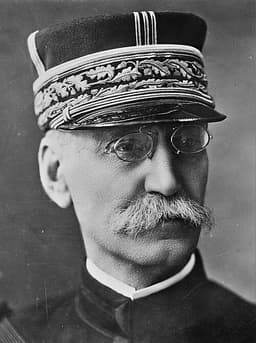
Joseph Gallieni
General · Modern
66.9Total
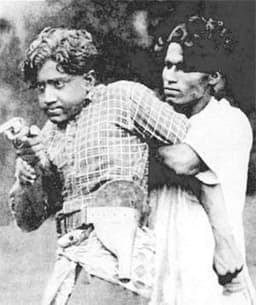
Pazhassi Raja
General · Modern
47.4Total
Basic Information
Born
1849
1753
Died
1916
1805
Era
Modern
Modern
Nationality
France
India
Occupation
General
General
Civilization
Western
Indian
Score Comparison
Military (10%)
61.7
10.0
Political (20%)
62.7
37.9
Influence (20%)
72.0
58.0
Legacy (20%)
55.0
48.3
Leadership (15%)
85.0
54.2
Strategy (15%)
68.0
60.0
TOTAL
66.9
47.4
Joseph Gallieni — Complete Timeline
1896 AD
Governor-General of MadagascarPolitical Action◆ Major
Joseph Gallieni was appointed Governor-General of Madagascar after the French conquest. He implemented a policy of 'pacification' through military force and administrative reforms, including the abolition of slavery, the construction of infrastructure, and the establishment of French colonial rule.
MadagascarColonialismPacification
Impact: regionaldestructive
1914 AD
Defense of Paris in 1914War
As Military Governor of Paris, Gallieni organized the defense of the city during the First Battle of the Marne. He famously requisitioned Parisian taxis to transport troops to the front, helping to halt the German advance. This action was crucial in saving Paris from capture.
World War IParisMilitary Strategy
Impact: globalconstructive
Battle of the MarneWar
Gallieni played a key role in the First Battle of the Marne (September 1914) by coordinating the French Sixth Army's counterattack against the German First Army. His timely reinforcement of the front lines helped achieve a decisive Allied victory that prevented a quick German victory in the West.
World War IBattleAllied Victory
Impact: globalconstructive
1915 AD
Minister of WarPolitical Action◆ Major
Gallieni served as French Minister of War from October 1915 to March 1916. He worked to improve the supply and organization of the French army but faced political opposition and health problems. He resigned due to disagreements over military strategy and died shortly after.
FranceWorld War IGovernment
Impact: national
Pazhassi Raja — Complete Timeline
1793 AD
Cotiote WarWar◆ Major
Pazhassi Raja initiated a guerrilla war against the British East India Company in the forests of Wayanad and Kottayam. He refused to pay tribute and resisted British annexation, using local terrain to ambush Company forces for over a decade.
British East India CompanyGuerrilla WarKerala
Impact: regional
1802 AD
Battle of PanamaramWar◆ Major
Pazhassi Raja's forces attacked and captured the British fort at Panamaram in Wayanad. The victory temporarily expelled British control from the region and boosted rebel morale, though the British later regrouped and retaliated.
BattleBritish East India CompanyWayanad
1805 AD
Death in BattleWar
Pazhassi Raja was killed in a skirmish with British forces near Mavila Thodu in Wayanad. His death ended the Cotiote War, and the British subsequently annexed Kottayam. He became a symbol of resistance in Kerala.
DeathBritish East India CompanyResistance
Impact: regionaltragic
This comparison has not been analyzed yet.
One-time AI generation (~1 minute). Scores and timeline are already available below.
Rankings
🥇
Joseph GallieniLeader
Mil: 61.7Pol: 62.7Inf: 72.0
66.9
🥈
Pazhassi Raja
Mil: 10.0Pol: 37.9Inf: 58.0
47.4
+19.5 behind
How This Comparison Works
Algorithm
Each figure is scored on 6 dimensions (0—100 scale) based on structured historical data: Military (10%), Political (20%), Influence (20%), Legacy (20%), Leadership (15%), Strategy (15%). The weighted total produces the final ranking.
Data Sources
Scores are computed from structured sub-indicators in the database. Scale factors adjust for era (Ancient ×0.85, Modern ×1.0) and civilization size (Eastern ×1.05, Other ×0.80) to account for differences in population and military scale.
Maximum 3 Figures
Comparisons are limited to 2—3 figures to ensure readability and statistical meaningfulness.
Error Margins
±5 points per dimension — Sub-scores are derived from historical records with inherent uncertainty. Two figures within 5 points on a dimension should be considered roughly equivalent in that area.
Total Score Accuracy
±3 points overall — The weighted combination of 6 dimensions produces a total score with approximately ±3 points of uncertainty. Differences of less than 3 points are not statistically significant— the figures are effectively tied.
Known Limitations
- Historical records are incomplete and uneven across civilizations
- Figures from oral-tradition societies may be underrepresented
- Occupation labels can misclassify multi-role figures
- Scores measure capability and impact, not moral character
- Quantitative scoring is a comparison tool, not absolute truth
Capability Radar
Military (10%) — Battles & Warfare
Battles
65
45
Win Rate
70
40
Expansion
60
25
Political (20%) — Governance & Reform
Reform
80
15
Diplomacy
75
35
Economy
65
20
Influence (20%) — Cultural & Global Reach
Cultural
50
40
Global
55
20
Legacy (20%) — Historical Impact
Historical
65
45
Longevity
55
35
Leadership (15%) — Power & Stability
Tenure
70
30
Stability
70
25
Strategy (15%) — Tactics & Innovation
Strategy
85
50
Tactics
80
55
Reform
75
20
Similar Comparisons
Comments & Discussion
No comments yet. Be the first to share your thoughts!