Loading...
Jochi vs Napoleon Bonaparte
Napoleon Bonaparte leads by 21.8 pts · 2 figures compared
…
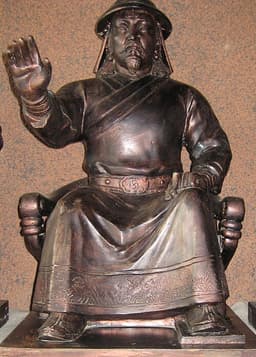
Jochi
Emperor · Medieval
49.1Total

Napoleon Bonaparte
General · Modern
70.9Total
Basic Information
Born
1182
1769
Died
1227
1821
Era
Medieval
Modern
Nationality
Mongol Empire
France
Occupation
Emperor
General
Civilization
Eastern
Western
Score Comparison
Military (10%)
40.0
94.0
Political (20%)
29.3
72.0
Influence (20%)
58.0
40.0
Legacy (20%)
54.0
80.0
Leadership (15%)
45.0
78.0
Strategy (15%)
60.0
90.0
TOTAL
49.1
70.9
Jochi — Complete Timeline
1219 AD
Participation in the Conquest of KhwarezmWar◆ Major
Jochi commanded a Mongol army during the invasion of the Khwarezmian Empire. He led campaigns in the northern regions, capturing cities such as Jand and Yangikent, and securing the Syr Darya basin for the Mongols.
Mongol ConquestKhwarezm
Impact: regional
1225 AD
Dispute over SuccessionPolitical Action◆ Major
Jochi's legitimacy as Genghis Khan's eldest son was questioned by his brothers, particularly Chagatai. This dispute led to Jochi being passed over for succession, with Ogedei chosen as Great Khan instead, fueling tensions.
Mongol SuccessionFamily Feud
Impact: globaldestructive
1227 AD
Appointed as Ruler of the Jochi UlusPolitical Action◆ Major
After Genghis Khan's death, Jochi's sons inherited his territories in the western Mongol Empire, forming the Jochi Ulus, which later became the Golden Horde. Jochi himself died before Genghis, so his sons ruled in his stead.
Mongol EmpireGolden HordeSuccession
Impact: regional
Napoleon Bonaparte — Complete Timeline
1799 AD
Coup of 18 BrumaireOther◆ Major
Napoleon Bonaparte, with support from his brother Lucien and key political figures, overthrew the Directory in a bloodless coup. He established the Consulate with himself as First Consul, effectively becoming the ruler of France. This event ended the French Revolution's most unstable period.
French RevolutionCoupRise to Power
Impact: regional
1804 AD
Promulgation of the Napoleonic CodeOther◆ Major
Napoleon enacted the Civil Code of the French, known as the Napoleonic Code, a comprehensive set of laws that replaced the fragmented feudal legal systems. The code established legal equality, protected property rights, and secularized law. It became the basis for legal systems in many European and world countries.
Legal ReformNapoleonic CodeCivil Law
Impact: globalconstructive
1805 AD
Battle of AusterlitzWar◆ Major
Napoleon's Grande Arm
Napoleonic WarsBattleDecisive Victory
Impact: global
1812 AD
Invasion of RussiaWar◆ Major
Napoleon led the Grande Arm
Napoleonic WarsInvasionDisaster
Impact: globaldestructive
1815 AD
Battle of WaterlooWar◆ Major
Napoleon's French army was defeated by the combined forces of the Duke of Wellington's Anglo-Allied army and Gebhard Leberecht von Bl
Napoleonic WarsBattleFinal Defeat
Impact: globaldestructive
Expert Analysis
Origins
Jochi (born c. 1182) was the eldest son of Genghis Khan and Börte. His paternity was questioned because Börte had been kidnapped by the Merkits shortly before his birth, leading to doubts about his legitimacy. This shadow haunted Jochi throughout his life. He grew up in the harsh steppe environment, learning archery and horsemanship from an early age. His father's rise to power provided him with military training and command experience.
Napoleon Bonaparte (born 1769 in Corsica) was the second surviving child of Carlo Buonaparte and Letizia Ramolino. His family was minor Corsican nobility. He studied at the Brienne Military Academy and later the École Militaire in Paris, graduating as a second lieutenant in artillery in 1785. The French Revolution provided opportunities for rapid advancement.
Rise to Power
Jochi's rise was tied to his father's conquests. He first distinguished himself in the 1206 campaign against the Forest Peoples of Siberia. During the invasion of the Khwarezmian Empire (1219-1221), Jochi commanded the left wing, capturing cities like Jand and Signak. His performance was competent but overshadowed by his brothers Chagatai and Ogedei. A dispute over succession with Chagatai, who questioned Jochi's legitimacy, led to Jochi being passed over as heir. Genghis Khan eventually designated Ogedei as successor, and Jochi died in 1225, possibly poisoned, before his father.
Napoleon rose through merit and political acumen. He first gained fame during the Siege of Toulon (1793), where he devised a successful plan to capture the port. Promoted to brigadier general, he then suppressed the 13 Vendémiaire royalist uprising in Paris (1795). His Italian campaign (1796-1797) made him a national hero, defeating Austrian and Piedmontese armies. The Coup of 18 Brumaire (1799) made him First Consul, effectively dictator of France. He crowned himself Emperor in 1804.
Leadership & Governance
Jochi's leadership was that of a Mongol prince: he commanded loyalty through clan ties and shared plunder. He ruled his ulus (territory) from the steppes of modern Kazakhstan, maintaining the traditional nomadic structure. He did not implement significant administrative reforms; his governance was a continuation of Mongol tribal customs. His military score of 19.2 reflects limited independent campaigns, but his political score of 45.5 shows some skill in managing relations with his father and brothers.
Napoleon was a transformative leader. He centralized the French state, established the Napoleonic Code (1804) which influenced legal systems worldwide, reformed education with lycées, and created the Bank of France. His governance was efficient but authoritarian. He scored 72.0 in political and 78.0 in leadership, reflecting his ability to control a vast empire. However, his micromanagement and refusal to delegate contributed to his downfall.
Triumph & Tragedy
Jochi's triumph was the establishment of the Jochi Ulus, which became the Golden Horde, a powerful khanate that dominated Russia and Central Asia for centuries. His legacy score of 68.6 reflects this enduring impact. His tragedy was his disputed paternity and exclusion from succession, leading to his early death. He never achieved the supreme power his father held.
Napoleon's triumphs include the Battle of Austerlitz (1805), his military masterpiece; the Napoleonic Code; and the spread of revolutionary ideals across Europe. His military score of 94.0 and strategy score of 90.0 place him among history's greatest commanders. His tragedies: the disastrous Invasion of Russia (1812), where he lost over 400,000 men; and the Battle of Waterloo (1815), ending his rule. He died in exile on Saint Helena.
Character & Destiny
Jochi was reportedly a capable but cautious commander, often at odds with his aggressive brother Chagatai. His perceived illegitimacy made him defensive and isolated. This character flaw likely led to his exclusion from succession, as Genghis Khan valued loyal and decisive heirs. His destiny was to be the progenitor of a major khanate but not its founder.
Napoleon was supremely confident, ambitious, and a workaholic. He made decisions rapidly and trusted his intuition. However, his arrogance and inability to compromise led to overreach. His character drove him to conquer Europe but also to alienate allies and underestimate enemies. His destiny was tied to his own hubris: he fell from power twice.
Legacy
Jochi's legacy is the Golden Horde, which ruled over the Rus' principalities for 200 years. His descendants, including Batu Khan, shaped Eurasian history. His influence score of 73.2 reflects this long-term impact, though his direct achievements are limited.
Napoleon's legacy is immense: the Napoleonic Code influenced civil law in many countries; he restructured European borders; he inspired modern warfare and nationalism. His legacy score of 80.0 is high, but his influence score of 40.0 (as per the data) may reflect the eventual containment of French power. Nonetheless, his total score of 70.9 exceeds Jochi's 54.2.
Conclusion
Napoleon Bonaparte had greater impact than Jochi. While Jochi founded a dynasty that lasted centuries, his personal achievements were limited; his score of 54.2 reflects a figure largely dependent on his father's legacy. Napoleon, with a total score of 70.9, independently reshaped Europe through military brilliance, legal reform, and administrative innovation. His military score of 94.0 dwarfs Jochi's 19.2. The data supports Napoleon as the more influential and accomplished figure.
Rankings
🥇
Napoleon BonaparteLeader
Mil: 94.0Pol: 72.0Inf: 40.0
70.9
🥈
Jochi
Mil: 40.0Pol: 29.3Inf: 58.0
49.1
+21.8 behind
How This Comparison Works
Algorithm
Each figure is scored on 6 dimensions (0—100 scale) based on structured historical data: Military (10%), Political (20%), Influence (20%), Legacy (20%), Leadership (15%), Strategy (15%). The weighted total produces the final ranking.
Data Sources
Scores are computed from structured sub-indicators in the database. Scale factors adjust for era (Ancient ×0.85, Modern ×1.0) and civilization size (Eastern ×1.05, Other ×0.80) to account for differences in population and military scale.
Maximum 3 Figures
Comparisons are limited to 2—3 figures to ensure readability and statistical meaningfulness.
Error Margins
±5 points per dimension — Sub-scores are derived from historical records with inherent uncertainty. Two figures within 5 points on a dimension should be considered roughly equivalent in that area.
Total Score Accuracy
±3 points overall — The weighted combination of 6 dimensions produces a total score with approximately ±3 points of uncertainty. Differences of less than 3 points are not statistically significant— the figures are effectively tied.
Known Limitations
- Historical records are incomplete and uneven across civilizations
- Figures from oral-tradition societies may be underrepresented
- Occupation labels can misclassify multi-role figures
- Scores measure capability and impact, not moral character
- Quantitative scoring is a comparison tool, not absolute truth
Capability Radar
Military (10%) — Battles & Warfare
Battles
40
95
Win Rate
45
90
Expansion
50
95
Political (20%) — Governance & Reform
Reform
15
95
Diplomacy
35
80
Economy
20
85
Influence (20%) — Cultural & Global Reach
Cultural
40
85
Global
50
90
Legacy (20%) — Historical Impact
Historical
55
95
Longevity
60
90
Leadership (15%) — Power & Stability
Tenure
30
85
Stability
25
70
Strategy (15%) — Tactics & Innovation
Strategy
40
95
Tactics
35
98
Reform
20
92
Similar Comparisons
Comments & Discussion
No comments yet. Be the first to share your thoughts!