Loading...
This comparison has not been analyzed yet.
One-time AI generation (~1 minute). Scores and timeline are already available below.
Jeongjo vs Maximilian III Joseph of Bavaria
Jeongjo leads by 6.0 pts · 2 figures compared
…

Jeongjo
Emperor · Modern
56.0Total
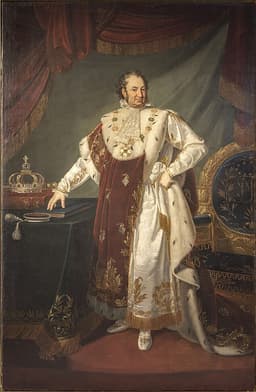
Maximilian III Joseph of Bavaria
Emperor · Modern
50.0Total
Basic Information
Born
1752
1727
Died
1800
1777
Era
Modern
Modern
Nationality
Korea
Bavaria
Occupation
Emperor
Emperor
Civilization
Eastern
Western
Score Comparison
Military (10%)
21.2
21.2
Political (20%)
72.0
60.0
Influence (20%)
58.0
55.7
Legacy (20%)
49.2
43.3
Leadership (15%)
80.0
66.0
Strategy (15%)
43.3
42.3
TOTAL
56.0
50.0
Jeongjo — Complete Timeline
1776 AD
Establishment of the Gyujanggak Royal LibraryCultural◆ Major
King Jeongjo founded the Gyujanggak, a royal library and research institute in Seoul. It housed a vast collection of books and served as a center for scholarly research and policy development, promoting practical learning (sirhak).
LibraryEducationScholarship
Impact: nationalconstructive
Promotion of the Sirhak (Practical Learning) MovementCultural◆ Major
King Jeongjo actively supported the Sirhak scholars, who advocated for practical reforms in agriculture, commerce, and technology. He appointed them to government positions and encouraged their research, fostering an intellectual renaissance in late Joseon.
Intellectual MovementReformScholarship
Impact: nationalconstructive
1791 AD
Execution of the Catholic PersecutionPolitical Action◆ Major
King Jeongjo ordered the suppression of Catholicism in Joseon, executing several converts and banning the religion. This action was motivated by concerns over foreign influence and the perceived threat to Confucian social order.
Religious PersecutionCatholicismSuppression
Impact: nationaldestructive
1793 AD
Reform of the Military System (Suyang System)Reform◆ Major
King Jeongjo implemented the Suyang system, a military reform that reorganized the royal guard and local defense forces. He also introduced new weapons and training methods, strengthening Joseon's military capabilities.
Military ReformDefenseTraining
Impact: nationalconstructive
1794 AD
Construction of Hwaseong FortressOther
King Jeongjo ordered the construction of Hwaseong Fortress in Suwon to honor his father Prince Sado and to establish a new administrative center. The fortress was built using advanced construction techniques and included a planned city. It is now a UNESCO World Heritage site.
ArchitectureFortressUrban Planning
Impact: nationalconstructive
Maximilian III Joseph of Bavaria — Complete Timeline
1745 AD
Accession as Elector of BavariaPolitical Action◆ Major
Maximilian III Joseph became Elector of Bavaria after the death of his father, Charles VII. He inherited a state devastated by the War of the Austrian Succession and faced significant financial and political challenges.
AccessionWar of the Austrian SuccessionFinancial Crisis
Impact: regional
Treaty of FüssenPolitical Action◆ Major
Maximilian III Joseph signed the Treaty of F
Treaty of FüssenWar of the Austrian SuccessionPragmatic Sanction
Impact: regional
1750 AD
Promotion of Enlightened Reforms in BavariaReform◆ Major
Maximilian III Joseph implemented enlightened reforms in Bavaria, including promoting education, reducing the influence of the Jesuits, and encouraging economic development. He supported the arts and sciences, making Munich a cultural center.
Enlightened ReformsEducationEconomic Development
Impact: regionalprogressive
1759 AD
Establishment of the Bavarian Academy of SciencesCultural
Maximilian III Joseph founded the Bavarian Academy of Sciences and Humanities in Munich. This institution promoted scientific research and intellectual discourse, contributing to the Enlightenment in Bavaria.
Academy of SciencesEnlightenmentIntellectual Life
constructive
This comparison has not been analyzed yet.
One-time AI generation (~1 minute). Scores and timeline are already available below.
Rankings
🥇
JeongjoLeader
Mil: 21.2Pol: 72.0Inf: 58.0
56.0
🥈
Maximilian III Joseph of Bavaria
Mil: 21.2Pol: 60.0Inf: 55.7
50.0
+6.0 behind
How This Comparison Works
Algorithm
Each figure is scored on 6 dimensions (0—100 scale) based on structured historical data: Military (10%), Political (20%), Influence (20%), Legacy (20%), Leadership (15%), Strategy (15%). The weighted total produces the final ranking.
Data Sources
Scores are computed from structured sub-indicators in the database. Scale factors adjust for era (Ancient ×0.85, Modern ×1.0) and civilization size (Eastern ×1.05, Other ×0.80) to account for differences in population and military scale.
Maximum 3 Figures
Comparisons are limited to 2—3 figures to ensure readability and statistical meaningfulness.
Error Margins
±5 points per dimension — Sub-scores are derived from historical records with inherent uncertainty. Two figures within 5 points on a dimension should be considered roughly equivalent in that area.
Total Score Accuracy
±3 points overall — The weighted combination of 6 dimensions produces a total score with approximately ±3 points of uncertainty. Differences of less than 3 points are not statistically significant— the figures are effectively tied.
Known Limitations
- Historical records are incomplete and uneven across civilizations
- Figures from oral-tradition societies may be underrepresented
- Occupation labels can misclassify multi-role figures
- Scores measure capability and impact, not moral character
- Quantitative scoring is a comparison tool, not absolute truth
Capability Radar
Military (10%) — Battles & Warfare
Battles
10
10
Win Rate
10
10
Expansion
10
10
Political (20%) — Governance & Reform
Reform
80
65
Diplomacy
60
55
Economy
70
60
Influence (20%) — Cultural & Global Reach
Cultural
60
55
Global
30
20
Legacy (20%) — Historical Impact
Historical
55
40
Longevity
50
30
Leadership (15%) — Power & Stability
Tenure
70
60
Stability
65
55
Strategy (15%) — Tactics & Innovation
Strategy
30
10
Tactics
30
10
Reform
60
15
Similar Comparisons
Comments & Discussion
No comments yet. Be the first to share your thoughts!