Loading...
Jeong Dojeon vs Xu Jie
Jeong Dojeon leads by 15.7 pts · 2 figures compared
…

Jeong Dojeon
Politician · Medieval
69.5Total
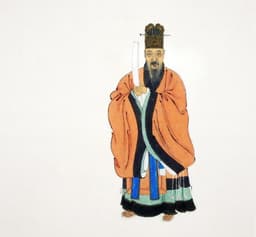
Xu Jie
Politician · Medieval
53.8Total
Basic Information
Born
1342
1503
Died
1398
1583
Era
Medieval
Medieval
Nationality
Korea
China
Occupation
Politician
Politician
Civilization
Eastern
Eastern
Score Comparison
Military (10%)
31.5
37.5
Political (20%)
78.0
65.0
Influence (20%)
82.0
53.3
Legacy (20%)
72.0
45.8
Leadership (15%)
72.0
78.0
Strategy (15%)
53.3
38.0
TOTAL
69.5
53.8
Jeong Dojeon — Complete Timeline
1392 AD
Drafting of the Joseon ConstitutionReform
Jeong Dojeon drafted the foundational laws and administrative structure for the new Joseon dynasty. His work established a centralized Confucian state with a strong monarchy, a merit-based bureaucracy, and a legal code based on neo-Confucian principles.
State BuildingLegal CodeConfucian Reform
Impact: nationalconstructive
Design of the Joseon Government SystemReform◆ Major
Jeong Dojeon designed the Joseon government structure, including the Uijeongbu (State Council) and six ministries. He also created the system of local administration and the censorate, ensuring checks on power.
BureaucracyGovernment DesignConfucian State
Impact: nationalconstructive
Promotion of Neo-Confucianism as State IdeologyCultural◆ Major
Jeong Dojeon established neo-Confucianism as the official state ideology of Joseon. He wrote influential texts that synthesized Confucian, Buddhist, and Daoist ideas, and suppressed Buddhism to promote Confucian values.
IdeologyConfucian ReformAnti-Buddhist
Impact: nationalprogressive
1398 AD
Execution of Jeong DojeonPolitical Action◆ Major
Jeong Dojeon was executed during the First Strife of Princes, a power struggle among King Taejo's sons. He was killed by supporters of Prince Yi Bang-won, who opposed his influence and his support for a different successor.
ExecutionPower StrugglePolitical Purge
Impact: nationaltragic
Xu Jie — Complete Timeline
1552 AD
Appointed Grand SecretaryPolitical Action◆ Major
Xu Jie was appointed to the Grand Secretariat. He initially maintained a low profile to survive the dominance of Yan Song, carefully building his own network of allies within the Ming court.
Ming DynastyAppointmentCourt Politics
Impact: national
1562 AD
Ousted Yan Song from PowerPolitical Action
Xu Jie orchestrated the downfall of Grand Secretary Yan Song. He manipulated court politics to turn the Jiajing Emperor against Yan Song, leading to Yan's dismissal and the execution of his son. Xu Jie then became the leading Grand Secretary.
Ming DynastyPolitical ManeuveringPower Shift
Impact: nationalconstructive
1567 AD
Implemented ReformsReform◆ Major
After the death of the Jiajing Emperor, Xu Jie used his influence to implement reforms. He reversed some of the previous regime's excesses, reduced government spending, and promoted capable officials, helping to stabilize the Ming state.
Ming DynastyReformStabilization
Impact: nationalconstructive
1568 AD
Retired from PoliticsPolitical Action
Xu Jie retired from his position as Grand Secretary. His retirement was prompted by conflicts with the new Longqing Emperor and rival officials. He returned to his hometown, where he lived until his death in 1583.
Ming DynastyRetirementCourt Politics
Impact: national
Expert Analysis
Origins
Jeong Dojeon was born in 1342 in the late Goryeo dynasty, into a family of scholar-officials. His father was a high-ranking official, but the family fell from favor due to political purges. Jeong studied under the great Confucian scholar Yi Saek, immersing himself in Neo-Confucian philosophy. He passed the civil service examination in 1362 and entered government service, but his reformist views put him at odds with the entrenched Goryeo aristocracy. His early experiences with corruption and factionalism fueled his desire to build a new, ideologically pure state.
Xu Jie was born in 1503 in Ming China, into a modest scholarly family. He passed the imperial examinations in 1523, achieving the jinshi degree, and entered the Hanlin Academy. His early career was marked by careful navigation of court politics. He served in various posts, including as a lecturer to the emperor, building a reputation for erudition and cautious ambition. The dominance of the Grand Secretary Yan Song shaped Xu Jie's early strategies, forcing him to adopt a low profile to survive.
Rise to Power
Jeong Dojeon's rise was tied to the military leader Yi Seonggye, who later became King Taejo of Joseon. Jeong became Yi's chief advisor and intellectual architect, advocating for a new dynasty based on Neo-Confucian principles. In 1392, Yi overthrew Goryeo, and Jeong was instrumental in drafting the new dynasty's constitution, the "Joseon Gyeonggukjeon" (Administrative Code of Joseon). He centralized power, abolished Buddhist privileges, and established a government modeled on Chinese systems but adapted to Korean conditions. His power peaked during the early years of Joseon, but his rivalry with Yi Bang-won (later King Taejong) set the stage for his downfall.
Xu Jie's rise was gradual and cautious. He became a Grand Secretary in 1552, but real power eluded him until he orchestrated the downfall of Yan Song in 1562. Xu Jie manipulated court factions, using the emperor's distrust of Yan Song and the death of Yan's son to turn the Jiajing Emperor against him. After Yan's dismissal, Xu Jie became the leading Grand Secretary, but his power was always constrained by the emperor's whims and rival officials. His rise was not a dramatic conquest but a patient accumulation of influence.
Leadership & Governance
Jeong Dojeon was a visionary reformer who designed a state from scratch. His governance model was based on Neo-Confucian ideology, with a strong central bureaucracy, a system of local administration, and a meritocratic examination system. He wrote extensively, including the "Three Principles of Governance" (Samjae), which outlined the moral basis of statecraft. His leadership was direct and ideological, but he lacked the political flexibility to survive factional struggles. For example, he alienated Yi Bang-won by supporting his brother as heir, leading to his execution.
Xu Jie was a pragmatic survivor. As Grand Secretary, he focused on restoring stability after Yan Song's corrupt regime. He reduced government spending, curbed eunuch power, and promoted capable officials. His leadership style was consensus-building and indirect, often working through proxies. He implemented reforms after the Jiajing Emperor's death in 1567, but his influence waned under the Longqing Emperor, who favored other advisors. His governance was effective but reactive, lacking a grand vision.
Triumph & Tragedy
Jeong Dojeon's greatest triumph was the creation of the Joseon dynasty's political and ideological framework, which lasted for over 500 years. He successfully institutionalized Neo-Confucianism, shaping Korean culture and governance. His tragedy was his execution in 1398 during the First Strife of Princes, at age 56. He miscalculated the ambitions of Yi Bang-won, who killed him and his faction. His death cut short his influence, though his ideas endured.
Xu Jie's triumph was ousting Yan Song, a feat many thought impossible. He then implemented reforms that reduced corruption and eased burdens on the people. His tragedy was his forced retirement in 1568 after conflicts with the Longqing Emperor and the eunuch Feng Bao. His legacy was overshadowed by later Grand Secretaries like Zhang Juzheng. Xu Jie's reforms were modest and did not fundamentally change the Ming system.
Character & Destiny
Jeong Dojeon was an ideological purist, confident in his vision but blind to political realities. His character drove him to create a lasting system, but also led to his downfall when he underestimated his enemies. Historical assessments view him as a brilliant theorist but a flawed politician. His score of 78.0 in political skill reflects his institutional design, but his 31.5 in military and 53.3 in strategy show his limitations in power struggles.
Xu Jie was a cautious, patient manipulator. He excelled at survival and timing, but lacked the boldness to effect deep change. His character was shaped by the dangerous Ming court, where open ambition was fatal. He scored 65.0 in politics and 78.0 in leadership, reflecting his ability to manage factions, but his 38.0 in strategy shows his reactive nature. Historians see him as a competent administrator who played the game well but left no lasting imprint.
Legacy
Jeong Dojeon's legacy is immense. His constitutional framework and ideological foundation defined Joseon Korea for centuries. His writings on statecraft influenced Korean Neo-Confucianism and governance. He is remembered as the "father of Joseon" and his scores reflect this: influence 82.0, legacy 72.0. However, his direct impact was limited by his early death.
Xu Jie's legacy is more modest. He is remembered as the man who ended Yan Song's tyranny, but his reforms were temporary and his influence faded. His scores of 53.3 in influence and 45.8 in legacy reflect his secondary role. He is a footnote in Ming history, overshadowed by more transformative figures.
Conclusion
Jeong Dojeon had a greater impact than Xu Jie. His total score of 69.5 vs Xu Jie's 53.8 reflects his superior contributions to state-building and ideology. While Xu Jie was a skilled political survivor, his achievements were ephemeral. Jeong Dojeon's vision shaped a nation for half a millennium, while Xu Jie's reforms barely outlasted his tenure. The data supports Jeong Dojeon as the more significant historical figure.
Rankings
🥇
Jeong DojeonLeader
Mil: 31.5Pol: 78.0Inf: 82.0
69.5
🥈
Xu Jie
Mil: 37.5Pol: 65.0Inf: 53.3
53.8
+15.7 behind
How This Comparison Works
Algorithm
Each figure is scored on 6 dimensions (0—100 scale) based on structured historical data: Military (10%), Political (20%), Influence (20%), Legacy (20%), Leadership (15%), Strategy (15%). The weighted total produces the final ranking.
Data Sources
Scores are computed from structured sub-indicators in the database. Scale factors adjust for era (Ancient ×0.85, Modern ×1.0) and civilization size (Eastern ×1.05, Other ×0.80) to account for differences in population and military scale.
Maximum 3 Figures
Comparisons are limited to 2—3 figures to ensure readability and statistical meaningfulness.
Error Margins
±5 points per dimension — Sub-scores are derived from historical records with inherent uncertainty. Two figures within 5 points on a dimension should be considered roughly equivalent in that area.
Total Score Accuracy
±3 points overall — The weighted combination of 6 dimensions produces a total score with approximately ±3 points of uncertainty. Differences of less than 3 points are not statistically significant— the figures are effectively tied.
Known Limitations
- Historical records are incomplete and uneven across civilizations
- Figures from oral-tradition societies may be underrepresented
- Occupation labels can misclassify multi-role figures
- Scores measure capability and impact, not moral character
- Quantitative scoring is a comparison tool, not absolute truth
Capability Radar
Military (10%) — Battles & Warfare
Battles
10
38
Win Rate
10
42
Expansion
30
43
Political (20%) — Governance & Reform
Reform
90
65
Diplomacy
70
80
Economy
70
60
Influence (20%) — Cultural & Global Reach
Cultural
80
40
Global
50
20
Legacy (20%) — Historical Impact
Historical
80
55
Longevity
70
30
Leadership (15%) — Power & Stability
Tenure
60
75
Stability
60
70
Strategy (15%) — Tactics & Innovation
Strategy
20
49
Tactics
10
50
Reform
40
52
Similar Comparisons
Comments & Discussion
No comments yet. Be the first to share your thoughts!