Loading...
Jean-Baptiste Colbert vs Philibert Tsiranana
Jean-Baptiste Colbert leads by 17.2 pts · 2 figures compared
…
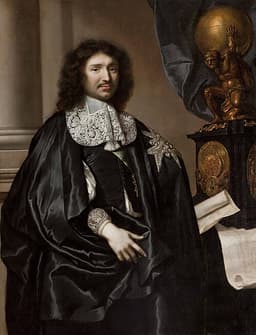
Jean-Baptiste Colbert
Politician · Modern
63.8Total

Philibert Tsiranana
Politician · Modern
46.6Total
Basic Information
Born
1619
1912
Died
1683
1978
Era
Modern
Modern
Nationality
France
Madagascar
Occupation
Politician
Politician
Civilization
Western
Other
Score Comparison
Military (10%)
55.0
28.7
Political (20%)
72.0
68.0
Influence (20%)
72.0
52.5
Legacy (20%)
55.0
43.3
Leadership (15%)
75.0
40.0
Strategy (15%)
45.0
35.6
TOTAL
63.8
46.6
Jean-Baptiste Colbert — Complete Timeline
1664 AD
Established the French East India CompanyPolitical Action◆ Major
Colbert founded the French East India Company to compete with Dutch and English trading companies. The company established French trading posts in India, though it never achieved the profitability of its rivals.
Colonial TradeFrench EmpireMercantilism
Impact: globalconstructive
1665 AD
Appointed Controller General of FinancesPolitical Action◆ Major
Colbert was appointed Controller General of Finances under Louis XIV. He implemented mercantilist policies to strengthen the French economy, including promoting manufacturing, reducing internal tariffs, and improving infrastructure.
MercantilismFrench EconomyLouis XIV
Impact: nationalconstructive
1669 AD
Reformed the French NavyReform◆ Major
Colbert became Secretary of State for the Navy and undertook a major expansion and modernization of the French fleet. He built new shipyards, improved naval administration, and increased the number of warships, making France a major naval power.
French NavyNaval ReformLouis XIV
Impact: globalconstructive
Philibert Tsiranana — Complete Timeline
1956 AD
Elected to the French National AssemblyPolitical Action◆ Major
Tsiranana was elected as a deputy for Madagascar to the French National Assembly. This position allowed him to advocate for Madagascar's autonomy within the French Community.
Political CareerFrench Colonial Politics
Impact: nationalconstructive
1958 AD
Became Prime Minister of MadagascarPolitical Action◆ Major
Tsiranana was appointed Prime Minister of the autonomous Malagasy Republic within the French Community. He led negotiations with France for full independence.
AutonomyIndependence Process
Impact: nationalconstructive
1960 AD
Proclaimed Independence of MadagascarPolitical Action
Tsiranana proclaimed Madagascar's independence from France on June 26, 1960, becoming the country's first president. He maintained close ties with France through cooperation agreements.
IndependenceFounding President
Impact: nationalconstructive
1971 AD
Suppressed 1971 peasant revoltPolitical Action◆ Major
Tsiranana's government violently suppressed a peasant uprising in the south led by the National Movement for the Independence of Madagascar (MONIMA). Hundreds were killed, and the revolt's leader, Monja Jaona, was imprisoned.
RepressionPeasant Uprising
Impact: nationaldestructive
1972 AD
Resigned as PresidentPolitical Action
Facing massive student and worker protests against his pro-French policies and authoritarian rule, Tsiranana resigned as president on May 18, 1972. He handed power to General Gabriel Ramanantsoa, ending the First Republic.
ResignationEnd of First Republic
Impact: nationaltragic
Expert Analysis
Origins
Jean-Baptiste Colbert was born in 1619 in Reims, France, into a family of wealthy merchants. His father was a wool merchant, and his uncle was a cardinal, providing Colbert with connections to the French court. He studied law and entered the service of Cardinal Mazarin, the chief minister of France, as an intendant. Philibert Tsiranana was born in 1910 in Ambarikorano, Madagascar, to a poor family of cattle herders. He attended missionary schools and later studied at the École Normale in Montpellier, France, becoming a teacher. His humble origins shaped his political career as a moderate leader.
Rise to Power
Colbert's rise began when he became the personal steward of Cardinal Mazarin, who entrusted him with his finances. After Mazarin's death in 1661, Colbert presented a report on the financial mismanagement of Nicolas Fouquet, the superintendent of finances, leading to Fouquet's arrest. Colbert was then appointed Controller General of Finances in 1665, becoming the chief minister of Louis XIV. He used his position to centralize economic control and promote mercantilism. Tsiranana rose through the political ranks in Madagascar as a deputy to the French National Assembly in 1956. He became Prime Minister of the autonomous Malagasy Republic in 1958 and led negotiations for independence. On June 26, 1960, Tsiranana proclaimed Madagascar's independence and became its first president, maintaining close ties with France.
Leadership & Governance
Colbert's leadership was characterized by state intervention and centralization. He implemented mercantilist policies to strengthen the French economy by promoting exports, reducing imports, and establishing state-owned manufactures. He founded the French East India Company in 1664 to compete with Dutch and English trading firms. He also reformed the French Navy, building new shipyards and arsenals, and increased the fleet from 18 to 276 ships. Colbert's governance extended to the colonies, where he drafted the Code Noir in 1685, regulating slavery in French colonies. This code defined the treatment of slaves but also codified their subjugation. Tsiranana's leadership was more moderate and pro-Western. He maintained strong ties with France, which provided economic aid and military support. His domestic policies focused on development but were marred by authoritarian tendencies. He suppressed the 1971 peasant revolt in the south violently, leading to hundreds of deaths. His political score of 68.0 reflects his ability to navigate independence, but his leadership score of 40.0 indicates his failure to build inclusive governance.
Triumph & Tragedy
Colbert's greatest success was transforming France into a major economic power. His mercantilist policies boosted manufacturing and trade, and his naval reforms made France a formidable maritime force. However, his policies also led to high taxes and state control that stifled innovation. The costs of Louis XIV's wars eventually undermined Colbert's achievements. Tsiranana's triumph was leading Madagascar to independence peacefully, a rare achievement in Africa. He also built infrastructure and expanded education. His tragedy was his authoritarian drift and violent suppression of dissent, culminating in his resignation in 1972 after massive protests. His legacy score of 43.3 reflects his mixed record.
Character & Destiny
Colbert was known for his diligence, frugality, and dedication to the state. He worked tirelessly, often sleeping only a few hours, and was intolerant of corruption. His character shaped his destiny: he died in 1683, exhausted and disillusioned as Louis XIV's wars drained the treasury. Tsiranana was a pragmatic moderate, but his reliance on French support alienated nationalists. His indecisiveness and authoritarian turn led to his downfall. Historians note that Tsiranana's political score of 68.0 was not matched by his leadership score of 40.0, indicating a gap between his diplomatic skills and his governance.
Legacy
Colbert's legacy is profound: he laid the foundations of French economic policy for centuries. The term "Colbertism" is synonymous with state-led mercantilism. His naval reforms helped France become a colonial power. The Code Noir influenced French colonial law until the 19th century. Colbert's influence score is 72.0, reflecting his lasting impact. Tsiranana's legacy is more ambiguous. He is remembered as the father of Malagasy independence, but his pro-French stance and authoritarian rule tarnish his image. His influence score of 52.5 indicates a moderate but contested legacy. Madagascar's subsequent political instability can be partly traced to his failure to build democratic institutions.
Conclusion
Jean-Baptiste Colbert had a greater impact than Philibert Tsiranana. Colbert's total score of 63.8 versus Tsiranana's 46.6 reflects his more enduring influence on global economic systems and statecraft. While Tsiranana led Madagascar to independence, his legacy is limited to one nation and is overshadowed by his authoritarianism. Colbert's policies shaped French economic power for centuries and influenced mercantilist thought worldwide. Therefore, Colbert is the more significant historical figure.
Rankings
🥇
Jean-Baptiste ColbertLeader
Mil: 55.0Pol: 72.0Inf: 72.0
63.8
🥈
Philibert Tsiranana
Mil: 28.7Pol: 68.0Inf: 52.5
46.6
+17.2 behind
How This Comparison Works
Algorithm
Each figure is scored on 6 dimensions (0—100 scale) based on structured historical data: Military (10%), Political (20%), Influence (20%), Legacy (20%), Leadership (15%), Strategy (15%). The weighted total produces the final ranking.
Data Sources
Scores are computed from structured sub-indicators in the database. Scale factors adjust for era (Ancient ×0.85, Modern ×1.0) and civilization size (Eastern ×1.05, Other ×0.80) to account for differences in population and military scale.
Maximum 3 Figures
Comparisons are limited to 2—3 figures to ensure readability and statistical meaningfulness.
Error Margins
±5 points per dimension — Sub-scores are derived from historical records with inherent uncertainty. Two figures within 5 points on a dimension should be considered roughly equivalent in that area.
Total Score Accuracy
±3 points overall — The weighted combination of 6 dimensions produces a total score with approximately ±3 points of uncertainty. Differences of less than 3 points are not statistically significant— the figures are effectively tied.
Known Limitations
- Historical records are incomplete and uneven across civilizations
- Figures from oral-tradition societies may be underrepresented
- Occupation labels can misclassify multi-role figures
- Scores measure capability and impact, not moral character
- Quantitative scoring is a comparison tool, not absolute truth
Capability Radar
Military (10%) — Battles & Warfare
Battles
0
25
Win Rate
0
29
Expansion
20
30
Political (20%) — Governance & Reform
Reform
90
45
Diplomacy
75
55
Economy
95
40
Influence (20%) — Cultural & Global Reach
Cultural
60
30
Global
65
25
Legacy (20%) — Historical Impact
Historical
75
35
Longevity
70
25
Leadership (15%) — Power & Stability
Tenure
85
60
Stability
80
35
Strategy (15%) — Tactics & Innovation
Strategy
0
32
Tactics
0
35
Reform
30
42
Similar Comparisons
Comments & Discussion
No comments yet. Be the first to share your thoughts!