Loading...
James I of Scotland vs Sarki Muhammadu Korau
Sarki Muhammadu Korau leads by 8.0 pts · 2 figures compared
…
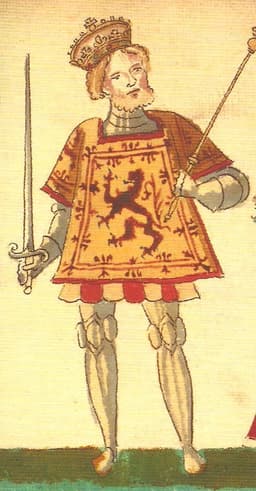
James I of Scotland
Emperor · Medieval
44.6Total

Sarki Muhammadu Korau
Emperor · Medieval
52.6Total
Basic Information
Born
1394
1490
Died
1437
1540
Era
Medieval
Medieval
Nationality
Scotland
Katsina
Occupation
Emperor
Emperor
Civilization
Western
Other
Score Comparison
Military (10%)
21.2
45.0
Political (20%)
43.7
45.1
Influence (20%)
54.9
54.9
Legacy (20%)
45.0
47.5
Leadership (15%)
48.4
65.0
Strategy (15%)
36.8
60.0
TOTAL
44.6
52.6
James I of Scotland — Complete Timeline
1406 AD
Capture by English PiratesOther
James I was captured by English pirates while traveling to France for safety. He was handed over to Henry IV of England and imprisoned in the Tower of London, remaining a captive for 18 years. His father Robert III died soon after, leaving Scotland without a king.
CaptureImprisonmentRegency
Impact: nationaltragic
1424 AD
Release and Return to ScotlandPolitical Action◆ Major
James I was released from English captivity after the Treaty of London, which required a ransom of 40,000 pounds. He returned to Scotland and was crowned at Scone, beginning his personal rule after 18 years of regency.
ReleaseCoronationRansom
Impact: nationalconstructive
Publication of The Kingis QuairCultural
James I wrote The Kingis Quair, a poetic allegory of his imprisonment and love for Joan Beaufort. The poem is considered a major work of Middle Scots literature and reflects the influence of Chaucer on Scottish poetry.
PoetryLiteratureImprisonment
Impact: nationalconstructive
1425 AD
Execution of Albany StewartsPolitical Action◆ Major
James I executed Murdoch Stewart, Duke of Albany, and his sons at Stirling Castle for treason. The executions eliminated the powerful Albany family, who had ruled as regents during James's captivity, and consolidated royal power.
ExecutionNoble PurgeCentralization
Impact: nationaldestructive
1437 AD
Assassination at PerthPolitical Action
James I was assassinated by a group of nobles led by Sir Robert Graham at the Blackfriars monastery in Perth. The murder was a response to James's centralizing policies and harsh treatment of the nobility. His death plunged Scotland into another period of regency.
AssassinationNoble RevoltRegency
Impact: nationaltragic
Sarki Muhammadu Korau — Complete Timeline
1513 AD
Conquest of Katsina by SonghaiWar◆ Major
Sarki Muhammadu Korau, the warrior king of Katsina, was defeated by the Songhai Empire under Askia Mohammed I. Katsina was incorporated into the Songhai Empire as a vassal state, ending its independence.
ConquestSonghaiKatsina
Impact: regionaltragic
1520 AD
Rebellion Against Songhai RuleWar◆ Major
Sarki Muhammadu Korau led a rebellion against Songhai rule in Katsina. The rebellion was suppressed by the Songhai forces, and Korau was likely killed or captured, solidifying Songhai control over the region.
RebellionSonghaiKatsina
Impact: regionaldestructive
Expert Analysis
Origins
James I of Scotland was born in December 1394 at Dunfermline Abbey, the third son of King Robert III. His early years were overshadowed by the political machinations of his uncle, Robert Stewart, Duke of Albany, who effectively ruled Scotland. In 1406, at age 11, James was sent to France for safety but was captured by English pirates off Flamborough Head. He was handed over to Henry IV of England and spent the next 18 years imprisoned in the Tower of London and other English castles. During his captivity, he received a thorough education, including instruction in literature and poetry, which shaped his later literary output.
Sarki Muhammadu Korau was a warrior king of Katsina, a Hausa city-state in what is now northern Nigeria. His exact birth date is unknown, but he reigned in the late 15th to early 16th century. He belonged to the Hausa ruling elite and rose to power through military prowess. Katsina was a major center of trade and Islamic learning, and Korau's reign was marked by efforts to consolidate power and resist external threats, particularly from the expanding Songhai Empire.
Rise to Power
James I's rise to power was accidental. After his elder brother David died in 1402, James became heir to the throne. Following his father's death in 1406, he became king while still a prisoner in England. For 18 years, Scotland was ruled by regents, first his uncle Albany and then Albany's son Murdoch. James was finally released in 1424 after the Treaty of London, which required a ransom of 40,000 pounds. He returned to Scotland and was crowned at Scone Abbey.
Muhammadu Korau rose to power through military campaigns. He became Sarki (king) of Katsina likely by overthrowing or succeeding the previous ruler. His leadership was tested early by the encroaching Songhai Empire under Askia Mohammed I. In the early 16th century, Songhai forces invaded Hausaland, and Korau led Katsina's resistance. His military score of 45.0 reflects his prowess, though he ultimately failed to prevent conquest.
Leadership & Governance
James I's leadership style was authoritarian and centralizing. He sought to reduce the power of the nobility and strengthen the crown. Upon his return, he executed Murdoch Stewart, Duke of Albany, and his sons for treason, eliminating a major rival family. He also reformed the Scottish parliament, making it more subservient to royal authority. His governance was marked by financial reforms, including the collection of taxes and the strengthening of royal finances. However, his heavy-handed approach alienated many nobles. His political score of 43.7 reflects moderate effectiveness.
Muhammadu Korau's governance was typical of a Hausa warrior king. He relied on military strength and the support of his cavalry. He likely maintained the traditional Hausa administrative system, with appointed officials overseeing districts. His resistance to Songhai rule suggests a determination to preserve Katsina's independence. His leadership score of 65.0 indicates strong command, but his political score of 45.1 shows limited state-building beyond military defense.
Triumph & Tragedy
James I's greatest triumph was his literary work, "The Kingis Quair," a poem written during his imprisonment. It is considered a masterpiece of Middle Scots poetry and provides insight into his intellect and emotions. His greatest tragedy was his assassination in 1437 at the Blackfriars monastery in Perth, orchestrated by nobles led by Sir Robert Graham. The murder was a direct response to his centralizing policies and attacks on noble power. His total score of 44.6 reflects a mixed legacy.
Muhammadu Korau's triumph was his spirited defense of Katsina against the Songhai Empire, a major power of the time. He led a rebellion against Songhai rule after the initial conquest, demonstrating resilience. His tragedy was his defeat and likely death in that rebellion, as Katsina was incorporated into the Songhai Empire. His total score of 52.6 reflects his stronger military and leadership scores.
Character & Destiny
James I was a cultured, intelligent, and determined ruler. His long imprisonment shaped his worldview: he valued order and central authority, but his lack of political experience in Scotland led to miscalculations. He underestimated the resentment his reforms would cause. His character combined poetic sensitivity with ruthless pragmatism, a mix that ultimately led to his downfall.
Muhammadu Korau was a warrior king in the tradition of Hausa military leaders. His character was defined by courage and defiance. He chose to resist a larger empire rather than submit, a decision that led to his death but also cemented his reputation as a symbol of resistance. His strategic score of 60.0 indicates competent military planning, but his political score of 45.1 suggests limited ability to build alliances or adapt to changing circumstances.
Legacy
James I's legacy is twofold. Politically, his centralization efforts laid groundwork for later Stewart kings, though his assassination set back royal power temporarily. Culturally, his poetry is a lasting contribution to Scottish literature. He is remembered as the "poet king," a unique figure in Scottish history. His influence score of 54.9 reflects this cultural impact.
Muhammadu Korau's legacy is as a symbol of Hausa resistance. He is remembered in oral traditions as a heroic king who fought against foreign domination. His defeat by Songhai marked a turning point for Katsina, which later regained independence but was then absorbed by the Sokoto Caliphate. His legacy score of 47.5 reflects his regional significance.
Conclusion
Sarki Muhammadu Korau had a greater impact in his immediate context than James I. Korau scored 52.6 total compared to James I's 44.6, a gap of 8.0 points. Korau's leadership score of 65.0 far exceeds James's 48.4, and his strategic score of 60.0 versus 36.8 shows superior military acumen. While James I's poetry endures, his political reforms were ultimately undone by his assassination. Korau's defiant resistance against a major empire left a lasting cultural memory in Hausaland. Therefore, Korau emerges as the more effective and impactful leader.
Rankings
🥇
Sarki Muhammadu KorauLeader
Mil: 45.0Pol: 45.1Inf: 54.9
52.6
🥈
James I of Scotland
Mil: 21.2Pol: 43.7Inf: 54.9
44.6
+8.0 behind
How This Comparison Works
Algorithm
Each figure is scored on 6 dimensions (0—100 scale) based on structured historical data: Military (10%), Political (20%), Influence (20%), Legacy (20%), Leadership (15%), Strategy (15%). The weighted total produces the final ranking.
Data Sources
Scores are computed from structured sub-indicators in the database. Scale factors adjust for era (Ancient ×0.85, Modern ×1.0) and civilization size (Eastern ×1.05, Other ×0.80) to account for differences in population and military scale.
Maximum 3 Figures
Comparisons are limited to 2—3 figures to ensure readability and statistical meaningfulness.
Error Margins
±5 points per dimension — Sub-scores are derived from historical records with inherent uncertainty. Two figures within 5 points on a dimension should be considered roughly equivalent in that area.
Total Score Accuracy
±3 points overall — The weighted combination of 6 dimensions produces a total score with approximately ±3 points of uncertainty. Differences of less than 3 points are not statistically significant— the figures are effectively tied.
Known Limitations
- Historical records are incomplete and uneven across civilizations
- Figures from oral-tradition societies may be underrepresented
- Occupation labels can misclassify multi-role figures
- Scores measure capability and impact, not moral character
- Quantitative scoring is a comparison tool, not absolute truth
Capability Radar
Military (10%) — Battles & Warfare
Battles
10
45
Win Rate
10
50
Expansion
10
55
Political (20%) — Governance & Reform
Reform
50
40
Diplomacy
30
45
Economy
40
40
Influence (20%) — Cultural & Global Reach
Cultural
50
40
Global
20
30
Legacy (20%) — Historical Impact
Historical
40
45
Longevity
30
40
Leadership (15%) — Power & Stability
Tenure
40
50
Stability
20
50
Strategy (15%) — Tactics & Innovation
Strategy
10
45
Tactics
10
40
Reform
10
35
Similar Comparisons
Comments & Discussion
No comments yet. Be the first to share your thoughts!