Loading...
This comparison has not been analyzed yet.
One-time AI generation (~1 minute). Scores and timeline are already available below.
Jacinda Ardern vs Prudente de Morais
Jacinda Ardern leads by 6.3 pts · 2 figures compared
…
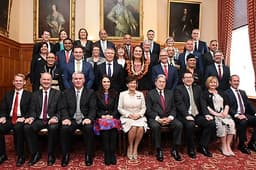
Jacinda Ardern
Politician · Modern
57.5Total

Prudente de Morais
Politician · Modern
51.2Total
Basic Information
Born
1980
1841
Died
—
1902
Era
Modern
Modern
Nationality
New Zealand
Brazil
Occupation
Politician
Politician
Civilization
Western
Western
Score Comparison
Military (10%)
50.0
42.4
Political (20%)
65.0
54.7
Influence (20%)
56.7
49.4
Legacy (20%)
49.2
43.3
Leadership (15%)
80.0
64.0
Strategy (15%)
42.9
60.0
TOTAL
57.5
51.2
Jacinda Ardern — Complete Timeline
2017 AD
Became Prime Minister of New ZealandPolitical Action◆ Major
Jacinda Ardern became Prime Minister after the Labour Party formed a coalition government with New Zealand First, supported by the Green Party. At 37, she was the youngest female head of government in the world at the time.
ElectionGender MilestoneGovernment Formation
Impact: nationalconstructive
2019 AD
Response to the Christchurch Mosque ShootingsPolitical Action
Following the terrorist attack on two mosques in Christchurch that killed 51 people, Ardern's government swiftly enacted gun law reforms, banning military-style semi-automatic weapons. Her empathetic leadership and wearing of a headscarf gained international praise.
TerrorismGun ControlCrisis Management
Impact: globalconstructive
2020 AD
COVID-19 Pandemic ResponsePolitical Action
Ardern's government implemented a strict nationwide lockdown and border closure in response to the COVID-19 pandemic. New Zealand successfully eliminated community transmission for several months, with low case numbers and deaths compared to many countries.
Public HealthPandemicLockdown
Impact: globalconstructive
2023 AD
Resigned as Prime MinisterPolitical Action◆ Major
Jacinda Ardern announced her resignation as Prime Minister, stating she no longer had 'enough in the tank' to lead. Her departure marked the end of a transformative but increasingly challenging tenure.
ResignationPolitical Career
Impact: national
Prudente de Morais — Complete Timeline
1894 AD
Election as President of BrazilPolitical Action◆ Major
Prudente de Morais was elected President of Brazil in 1894, the first civilian to hold the office. He took office on November 15, 1894, marking the end of military rule in the early republic.
ElectionCivilian Rule
Impact: nationalprogressive
1895 AD
End of the Federalist RevolutionPolitical Action◆ Major
Prudente de Morais negotiated a peace agreement ending the Federalist Revolution in Rio Grande do Sul. The conflict, which had raged since 1893, was resolved through amnesty and political reconciliation.
PeaceCivil War
Impact: regionalconstructive
1896 AD
Canudos WarWar◆ Major
Prudente de Morais ordered military campaigns against the Canudos settlement in Bahia, a religious community led by Ant
WarRebellion
Impact: nationaldestructive
1897 AD
Assassination Attempt on PresidentPolitical Action◆ Major
Prudente de Morais survived an assassination attempt on November 5, 1897, during a military ceremony. The attack, by a soldier, killed War Minister Carlos Machado Bittencourt but missed the president.
Assassination AttemptViolence
Impact: nationaltragic
This comparison has not been analyzed yet.
One-time AI generation (~1 minute). Scores and timeline are already available below.
Rankings
🥇
Jacinda ArdernLeader
Mil: 50.0Pol: 65.0Inf: 56.7
57.5
🥈
Prudente de Morais
Mil: 42.4Pol: 54.7Inf: 49.4
51.2
+6.3 behind
How This Comparison Works
Algorithm
Each figure is scored on 6 dimensions (0—100 scale) based on structured historical data: Military (10%), Political (20%), Influence (20%), Legacy (20%), Leadership (15%), Strategy (15%). The weighted total produces the final ranking.
Data Sources
Scores are computed from structured sub-indicators in the database. Scale factors adjust for era (Ancient ×0.85, Modern ×1.0) and civilization size (Eastern ×1.05, Other ×0.80) to account for differences in population and military scale.
Maximum 3 Figures
Comparisons are limited to 2—3 figures to ensure readability and statistical meaningfulness.
Error Margins
±5 points per dimension — Sub-scores are derived from historical records with inherent uncertainty. Two figures within 5 points on a dimension should be considered roughly equivalent in that area.
Total Score Accuracy
±3 points overall — The weighted combination of 6 dimensions produces a total score with approximately ±3 points of uncertainty. Differences of less than 3 points are not statistically significant— the figures are effectively tied.
Known Limitations
- Historical records are incomplete and uneven across civilizations
- Figures from oral-tradition societies may be underrepresented
- Occupation labels can misclassify multi-role figures
- Scores measure capability and impact, not moral character
- Quantitative scoring is a comparison tool, not absolute truth
Capability Radar
Military (10%) — Battles & Warfare
Battles
27
45
Win Rate
30
53
Expansion
37
51
Political (20%) — Governance & Reform
Reform
70
40
Diplomacy
75
50
Economy
60
35
Influence (20%) — Cultural & Global Reach
Cultural
60
20
Global
65
15
Legacy (20%) — Historical Impact
Historical
55
35
Longevity
40
25
Leadership (15%) — Power & Stability
Tenure
65
45
Stability
70
30
Strategy (15%) — Tactics & Innovation
Strategy
41
57
Tactics
42
61
Reform
41
64
Similar Comparisons
Comments & Discussion
No comments yet. Be the first to share your thoughts!