Loading...
Jaber al-Ahmad al-Sabah vs Napoleon Bonaparte
Napoleon Bonaparte leads by 25.5 pts · 2 figures compared
…
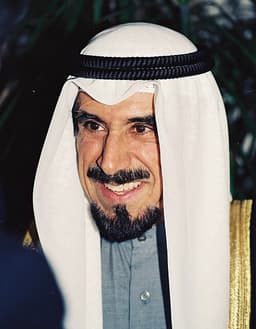
Jaber al-Ahmad al-Sabah
Emperor · Modern
45.4Total

Napoleon Bonaparte
General · Modern
70.9Total
Basic Information
Born
1926
1769
Died
—
1821
Era
Modern
Modern
Nationality
Kuwait
France
Occupation
Emperor
General
Civilization
Middle Eastern
Western
Score Comparison
Military (10%)
12.2
94.0
Political (20%)
68.0
72.0
Influence (20%)
56.4
40.0
Legacy (20%)
44.2
80.0
Leadership (15%)
40.0
78.0
Strategy (15%)
28.2
90.0
TOTAL
45.4
70.9
Jaber al-Ahmad al-Sabah — Complete Timeline
1990 AD
Iraqi Invasion of KuwaitWar◆ Major
Iraqi forces invaded and occupied Kuwait under Saddam Hussein. Jaber al-Ahmad al-Sabah fled to Saudi Arabia and established a government-in-exile. The invasion led to the Gulf War and a seven-month occupation of Kuwait.
Gulf WarIraqi InvasionKuwaiti Occupation
Impact: globaltragic
1991 AD
Liberation of KuwaitWar◆ Major
A US-led coalition launched Operation Desert Storm, liberating Kuwait from Iraqi occupation. Jaber al-Ahmad al-Sabah returned to Kuwait as emir. The liberation restored Kuwaiti sovereignty but left the country with extensive damage and environmental destruction.
Gulf WarKuwaiti LiberationCoalition
Impact: globalconstructive
Reconstruction of Kuwait After Gulf WarReform◆ Major
Jaber al-Ahmad al-Sabah oversaw the massive reconstruction of Kuwait's infrastructure, oil fields, and economy after the Gulf War. The rebuilding cost billions of dollars and restored Kuwait's status as a major oil exporter. He also restored the National Assembly.
ReconstructionPost-War RecoveryKuwaiti Economy
Impact: nationalconstructive
Napoleon Bonaparte — Complete Timeline
1799 AD
Coup of 18 BrumaireOther◆ Major
Napoleon Bonaparte, with support from his brother Lucien and key political figures, overthrew the Directory in a bloodless coup. He established the Consulate with himself as First Consul, effectively becoming the ruler of France. This event ended the French Revolution's most unstable period.
French RevolutionCoupRise to Power
Impact: regional
1804 AD
Promulgation of the Napoleonic CodeOther◆ Major
Napoleon enacted the Civil Code of the French, known as the Napoleonic Code, a comprehensive set of laws that replaced the fragmented feudal legal systems. The code established legal equality, protected property rights, and secularized law. It became the basis for legal systems in many European and world countries.
Legal ReformNapoleonic CodeCivil Law
Impact: globalconstructive
1805 AD
Battle of AusterlitzWar◆ Major
Napoleon's Grande Arm
Napoleonic WarsBattleDecisive Victory
Impact: global
1812 AD
Invasion of RussiaWar◆ Major
Napoleon led the Grande Arm
Napoleonic WarsInvasionDisaster
Impact: globaldestructive
1815 AD
Battle of WaterlooWar◆ Major
Napoleon's French army was defeated by the combined forces of the Duke of Wellington's Anglo-Allied army and Gebhard Leberecht von Bl
Napoleonic WarsBattleFinal Defeat
Impact: globaldestructive
Expert Analysis
jaber-al-ahmad-al-sabah-vs-napoleon-bonaparte
# The Emperor and the Emir: Two Visions of Power in a Turbulent Age
On a June morning in 1815, Napoleon Bonaparte stood on a muddy field near Waterloo, watching his Imperial Guard march into cannon fire for the last time. One hundred and seventy-five years later, another ruler—Jaber al-Ahmad al-Sabah—boarded a helicopter in Kuwait City as Iraqi tanks rolled across his border, leaving behind a palace he would not see for eight months. Both men faced annihilation. One chose to fight until the ground ran red; the other chose to wait, to negotiate, to rebuild. The question that lingers across centuries is not who was greater, but why their paths diverged so radically—and what that tells us about the nature of leadership itself.
Origins
Napoleon Bonaparte was born in 1769 on the rugged island of Corsica, a place that had only recently become French. His family was minor nobility, poor enough that he wore patched uniforms to military school, where classmates mocked his accent. This outsider status forged something in him: a hunger to prove that talent could shatter birthright. When the French Revolution erupted in 1789, it was his ladder. The old aristocracy fell; the Corsican artillery officer rose.
Jaber al-Ahmad al-Sabah arrived in 1926 into a very different world. He was born into the ruling family of Kuwait, a small British protectorate whose wealth came from pearl diving and trade, not conquest. His father, Ahmad al-Jaber al-Sabah, ruled as Emir, and young Jaber was raised not in barracks but in the *diwaniya*—the traditional meeting hall where Kuwaiti men gathered to debate, petition, and gossip. Where Napoleon learned to command, Jaber learned to consult. Where Napoleon saw the world as a battlefield to be won, Jaber saw it as a web of relationships to be managed.
Rise to Power
Napoleon’s ascent was a series of explosions. At twenty-four, he recaptured Toulon from British forces. At twenty-six, he crushed a royalist uprising in Paris with what he called “a whiff of grapeshot.” By thirty, he had conquered Italy and Egypt, sending dispatches back to France that read like epic poems. His political genius matched his military: in 1799, he staged a coup and made himself First Consul; by 1804, he crowned himself Emperor in Notre Dame, taking the crown from the Pope’s hands and placing it on his own head.
Jaber’s rise was a slow, patient climb. He served as Minister of Finance and later Prime Minister under his cousin, Emir Sabah III. He learned statecraft in the shadows, managing Kuwait’s oil wealth through the boom years of the 1950s and 1960s. When he became Emir in 1977, he was fifty-one—older than Napoleon at his death. He had no dramatic seizure of power, no coup, no coronation. He simply inherited a throne and began the quiet work of governance.
Leadership & Governance
Napoleon governed like he fought: with relentless energy and total control. He centralized the French state, creating the Napoleonic Code—a legal system that enshrined equality before the law, property rights, and secular administration. He built roads, founded the Bank of France, and reformed education. But he also censored the press, suppressed dissent, and placed his brothers on European thrones. His reforms were brilliant; his ambition, boundless. By 1812, he ruled an empire of over seventy million people, from Spain to Poland.
Jaber governed like a sheikh in a boardroom. He modernized Kuwait’s infrastructure, expanded its welfare state, and invested its oil revenues in education and healthcare. He navigated the turbulent politics of the Middle East with caution, balancing ties to the West with relations with Arab neighbors. He had no Napoleonic Code, but he did something Napoleon never attempted: he restored Kuwait’s parliament after suspending it, allowing elected representatives to debate policy. His style was consensus, not command.
And then came 1990. When Saddam Hussein’s Iraq invaded Kuwait on August 2, Jaber fled to Saudi Arabia. He did not lead a counterattack; he did not stand and fight. Instead, he worked the phones, lobbying the United Nations, the Arab League, and the United States. He understood something Napoleon never could: that in the modern world, survival often depends not on the size of your army but on the strength of your alliances.
Triumph & Tragedy
Napoleon’s greatest moment was Austerlitz in 1805, where he destroyed the combined armies of Russia and Austria. His greatest failure was the invasion of Russia in 1812—a catastrophic campaign that cost half a million lives and shattered his Grand Army. He was exiled to Elba, escaped, and returned for one hundred days before Waterloo ended it all. His tragedy was that he could not stop. Victory demanded more victory; power demanded more power. When he finally fell, he fell alone, a prisoner on a remote Atlantic island.
Jaber’s greatest moment was the liberation of Kuwait in 1991, when a US-led coalition expelled Iraqi forces. His greatest failure was arguably the same event: he had failed to prevent the invasion, failed to anticipate Saddam’s ambitions, and fled while his people suffered. Yet he returned in March 1991 to a devastated country—oil fields burning, infrastructure destroyed—and oversaw its reconstruction. By 1993, Kuwait was pumping oil again. By 2000, it was one of the wealthiest nations per capita on Earth. His tragedy was not defeat but dependence: Kuwait survived because others fought for it.
Character & Destiny
Napoleon’s personality was a force of nature—restless, arrogant, magnetic. He slept four hours a night, dictated letters to multiple secretaries simultaneously, and believed he was destiny’s chosen instrument. “I am not a man,” he once said, “but a thing.” This conviction drove him to conquer Europe, but it also blinded him. He could not compromise, could not share power, could not accept limits. His character was his engine and his anchor.
Jaber was the opposite—patient, pragmatic, almost invisible. He rarely gave speeches, avoided the spotlight, and delegated authority. He was not charismatic; he was reliable. Where Napoleon saw himself as the sun around which the world revolved, Jaber saw himself as a steward, a caretaker for a small country in a dangerous neighborhood. His character was not destiny in the grand sense; it was survival in the practical sense.
Legacy
Napoleon’s legacy is written in stone and law. The Napoleonic Code still shapes legal systems across Europe, Latin America, and beyond. His military innovations—corps organization, rapid movement, artillery tactics—are studied at war colleges to this day. He is remembered as a genius and a tyrant, a liberator and a conqueror. His tomb in Les Invalides is a monument to ambition.
Jaber’s legacy is quieter. He is remembered in Kuwait as the Emir who rebuilt the country, who restored its parliament, who kept it stable through crisis. He has no grand tomb, no code named after him, no battles that schoolchildren memorize. But his legacy is also written in institutions: a functioning democracy in the Gulf, a welfare state that works, a foreign policy that kept Kuwait independent. He is remembered not as a conqueror but as a survivor.
Conclusion
What separates these two men is not talent or ambition but scale and context. Napoleon lived in an age of empires, when one man could reshape the world with an army. Jaber lived in an age of nations, when survival depended on diplomacy and oil. Napoleon’s tragedy was that he could not adapt to limits; Jaber’s triumph was that he never forgot them. One tried to conquer the world and lost everything; the other tried to preserve a country and succeeded. In the end, perhaps the greatest lesson is this: power is not measured by how much you take, but by how much you keep.
Rankings
🥇
Napoleon BonaparteLeader
Mil: 94.0Pol: 72.0Inf: 40.0
70.9
🥈
Jaber al-Ahmad al-Sabah
Mil: 12.2Pol: 68.0Inf: 56.4
45.4
+25.5 behind
How This Comparison Works
Algorithm
Each figure is scored on 6 dimensions (0—100 scale) based on structured historical data: Military (10%), Political (20%), Influence (20%), Legacy (20%), Leadership (15%), Strategy (15%). The weighted total produces the final ranking.
Data Sources
Scores are computed from structured sub-indicators in the database. Scale factors adjust for era (Ancient ×0.85, Modern ×1.0) and civilization size (Eastern ×1.05, Other ×0.80) to account for differences in population and military scale.
Maximum 3 Figures
Comparisons are limited to 2—3 figures to ensure readability and statistical meaningfulness.
Error Margins
±5 points per dimension — Sub-scores are derived from historical records with inherent uncertainty. Two figures within 5 points on a dimension should be considered roughly equivalent in that area.
Total Score Accuracy
±3 points overall — The weighted combination of 6 dimensions produces a total score with approximately ±3 points of uncertainty. Differences of less than 3 points are not statistically significant— the figures are effectively tied.
Known Limitations
- Historical records are incomplete and uneven across civilizations
- Figures from oral-tradition societies may be underrepresented
- Occupation labels can misclassify multi-role figures
- Scores measure capability and impact, not moral character
- Quantitative scoring is a comparison tool, not absolute truth
Capability Radar
Military (10%) — Battles & Warfare
Battles
3
95
Win Rate
10
90
Expansion
13
95
Political (20%) — Governance & Reform
Reform
40
95
Diplomacy
55
80
Economy
50
85
Influence (20%) — Cultural & Global Reach
Cultural
30
85
Global
50
90
Legacy (20%) — Historical Impact
Historical
45
95
Longevity
30
90
Leadership (15%) — Power & Stability
Tenure
60
85
Stability
35
70
Strategy (15%) — Tactics & Innovation
Strategy
12
95
Tactics
18
98
Reform
23
92
Similar Comparisons
Comments & Discussion
Napoleon'sGhost6/17/2026
Calling this a comparison is like comparing a hurricane to a sand dune. Napoleon fought his way from Corsican outsider to master of Europe through sheer military genius—he revolutionized warfare with the corps system and lived by the sword. Al-Sabah inherited an oil fortune and fled when Iraq invaded. Waterloo was a tragedy of ambition; Kuwait City was a failure of deterrence. One shaped continents, the other was shaped by geography. Not equal forces. Not equal men.
油井哲学家6/17/2026
拿皇把欧洲当棋盘,沙尘酋长守着石油罐跑路——这能用同一杆秤称?拿破仑在奥斯特里茨用炮兵把沙俄联军轰成渣,三十年后科西嘉人让全欧君主发抖。而萨巴赫?1990年伊拉克坦克还没进科威特城,他抢先登上直升机流亡沙特。沙漠君主不配和统御大陆的帝王相提并论。政治正确蒙不了人:一个在泥里杀出血路,一个在油管上滑走。
BattleByte6/17/2026
Data shows Napoleon fought over 60 battles, lost only 7 major ones, and reformed legal systems across Europe. Al-Sabah’s Kuwait had the 10th largest GDP per capita by 1989 but couldn’t mobilize a credible defense against an army half its population size. The numbers aren’t neutral: one man built an empire with blood and bureaucracy; the other watched his country burn while waiting for foreign rescue. Metrics don’t lie about who had agency.
儒将判官6/17/2026
说什么“两种权力的愿景”,根本是生存策略对颜面工程。拿破仑临死前还编排法典,萨巴赫复国后搞的是财务重建。滑铁卢失败了也是史诗级败仗;科威特没输战斗,输了主权。前者敢把自己押在每一发炮弹上,后者把国运托付给美国外交信道和联合国决议。你要选谁当领袖?那得看你信命运还是信存款保险。