Loading...
Izzat Ibrahim al-Douri vs Nikolai Vatutin
Nikolai Vatutin leads by 17.5 pts · 2 figures compared
…

Izzat Ibrahim al-Douri
General · Modern
39.5Total
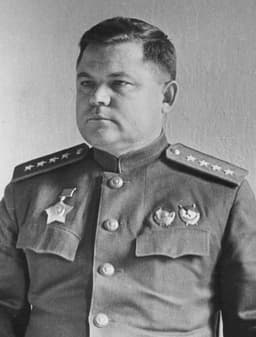
Nikolai Vatutin
General · Modern
57.0Total
Basic Information
Born
1942
1901
Died
—
1944
Era
Modern
Modern
Nationality
Iraq
USSR
Occupation
General
General
Civilization
Middle Eastern
Western
Score Comparison
Military (10%)
25.9
72.0
Political (20%)
26.4
42.2
Influence (20%)
48.6
57.2
Legacy (20%)
40.0
50.0
Leadership (15%)
51.9
61.1
Strategy (15%)
30.3
75.0
TOTAL
39.5
57.0
Izzat Ibrahim al-Douri — Complete Timeline
1968 AD
Role in the 1968 Ba'athist coupPolitical Action◆ Major
Al-Douri was a founding member of the Ba'ath Party and participated in the 1968 coup that brought the party to power. He became a close associate of Saddam Hussein and held various security and party positions.
CoupBa'ath PartySaddam Regime
Impact: national
1979 AD
Vice Chairman of the Revolutionary Command CouncilPolitical Action◆ Major
Al-Douri was appointed Vice Chairman of the Revolutionary Command Council, making him the second-highest ranking official in Iraq after Saddam Hussein. He held this position until the fall of the regime in 2003.
Vice ChairmanRCCSaddam Regime
Impact: national
1988 AD
Role in the Anfal campaignWar◆ Major
Al-Douri was a key commander in the Anfal campaign against Iraqi Kurds. He oversaw military operations that included the use of chemical weapons, mass executions, and the destruction of villages, resulting in tens of thousands of deaths.
AnfalWar CrimesKurds
Impact: regionaldestructive
2003 AD
Fugitive after the 2003 invasionPolitical Action◆ Major
Al-Douri evaded capture after the US-led invasion of Iraq. He became the most wanted Ba'athist fugitive, leading an insurgency against coalition forces. He was reported dead several times but remained at large for years.
FugitiveInsurgencyPost-2003 Iraq
Impact: national
Nikolai Vatutin — Complete Timeline
1943 AD
Battle of KurskWar◆ Major
Vatutin commanded the Voronezh Front during the Battle of Kursk. His forces defended the southern sector against the German offensive, then participated in the counteroffensive that recaptured Kharkov and pushed German forces back.
World War IIEastern FrontBattle of Kursk
Impact: regional
Battle of the DnieperWar◆ Major
Vatutin led the 1st Ukrainian Front in crossing the Dnieper River and liberating Kiev on November 6, 1943. This operation broke the German defensive line and established a strategic bridgehead for further advances into Ukraine.
World War IIEastern FrontLiberation of Kiev
Impact: regional
1944 AD
Mortally wounded by Ukrainian insurgentsOther◆ Major
On February 29, 1944, Vatutin was ambushed and shot by Ukrainian Insurgent Army (UPA) partisans near Rovno. He died of his wounds on April 15, 1944, becoming the highest-ranking Soviet general killed in action during World War II.
DeathWorld War IIUkrainian Insurgency
Impact: nationaltragic
Expert Analysis
Origins
Izzat Ibrahim al-Douri was born in 1942 in the village of al-Dour near Tikrit, Iraq, into a poor Sunni Arab family. He joined the Ba'ath Party in the early 1960s and participated in the 1968 coup that brought the party to power. His early career was shaped by his loyalty to Saddam Hussein and his rise through party ranks.
Nikolai Vatutin was born in 1901 in Chepukhino, Voronezh Governorate, Russian Empire, into a peasant family. He joined the Red Army in 1920 and graduated from the Frunze Military Academy in 1937. His early career was marked by staff assignments and command roles in the Soviet Far East, where he developed expertise in operational planning.
Rise to Power
Al-Douri's rise was tied to the Ba'ath Party's internal dynamics. After the 1968 coup, he became a member of the Revolutionary Command Council and, by 1979, Vice Chairman under Saddam. He was a key figure in the 1991 suppression of the Shia uprising and the Anfal campaign (1986-1989), where he commanded operations that included chemical weapons use. His power derived from his loyalty and role in internal security.
Vatutin's rise came during World War II. He served as Chief of Staff of the Northwestern Front in 1941, then commanded the Voronezh Front from 1942. His strategic acumen was recognized by Stalin, leading to his appointment as commander of the 1st Ukrainian Front in 1943. He played a central role in the Battle of Kursk and the liberation of Kiev.
Leadership & Governance
Al-Douri's leadership style was authoritarian and secretive. He oversaw internal party security and military operations with a focus on suppressing dissent. His governance approach mirrored Saddam's: centralized, brutal, and reliant on clan loyalty. He was not a strategic thinker but an executor of orders, scoring 30.3 in strategy vs. Vatutin's 75.0.
Vatutin was a professional soldier who emphasized operational planning and combined arms tactics. He commanded large-scale offensives, coordinating infantry, armor, and air power. His leadership score of 61.1 reflects his ability to inspire troops, though he was criticized for being overly cautious at times. He focused on breaking German defenses through rapid exploitation, as at the Battle of the Dnieper.
Triumph & Tragedy
Al-Douri's greatest success was evading capture after the 2003 invasion and leading a Ba'athist insurgency that lasted years. He remained a symbol of resistance for Sunni insurgents. His greatest failure was the Anfal campaign, which resulted in the deaths of up to 182,000 Kurds and his indictment for war crimes. His legacy is tainted by genocide.
Vatutin's greatest success was the liberation of Kiev in November 1943, a major blow to German morale. He also contributed to the Soviet victory at Kursk, where his front destroyed significant German armor. His tragedy was his death: he was mortally wounded by Ukrainian Insurgent Army partisans on February 29, 1944, and died on April 15. This cut short a promising career.
Character & Destiny
Al-Douri was known for his cunning and tenacity. He blended into the population after 2003, using a network of loyalists to evade US forces. His character was shaped by survival instinct and ideological commitment to Ba'athism. His destiny was to be a fugitive and, eventually, reported dead in 2020.
Vatutin was a dedicated communist and professional soldier. He was known for his calm demeanor and analytical mind. His character led him to take calculated risks, but his death was a result of being in the wrong place at the wrong time. Historians regard him as one of the USSR's top commanders, with a legacy score of 50.0.
Legacy
Al-Douri's legacy is that of a brutal enforcer and insurgency leader. He is remembered as the "King of Clubs" in the US most-wanted deck and as a symbol of the old regime. His impact is limited to Iraq, where his insurgency caused continued instability but failed to restore Ba'athist rule.
Vatutin's legacy is as a key architect of Soviet victory in World War II. His operations at Kursk and the Dnieper are studied in military academies. He is honored with monuments in Russia and Ukraine, though his name was removed from some after 2014 due to decommunization laws. His strategic influence endures.
Conclusion
Nikolai Vatutin had greater impact. His military score of 72.0 dwarfs al-Douri's 25.9, and his strategic contributions to the defeat of Nazi Germany shaped world history. Al-Douri's role as a war criminal and insurgent leader was significant regionally but not comparable. Vatutin's legacy in military doctrine and history is enduring, while al-Douri's is one of failure and atrocity.
Rankings
🥇
Nikolai VatutinLeader
Mil: 72.0Pol: 42.2Inf: 57.2
57.0
🥈
Izzat Ibrahim al-Douri
Mil: 25.9Pol: 26.4Inf: 48.6
39.5
+17.5 behind
How This Comparison Works
Algorithm
Each figure is scored on 6 dimensions (0—100 scale) based on structured historical data: Military (10%), Political (20%), Influence (20%), Legacy (20%), Leadership (15%), Strategy (15%). The weighted total produces the final ranking.
Data Sources
Scores are computed from structured sub-indicators in the database. Scale factors adjust for era (Ancient ×0.85, Modern ×1.0) and civilization size (Eastern ×1.05, Other ×0.80) to account for differences in population and military scale.
Maximum 3 Figures
Comparisons are limited to 2—3 figures to ensure readability and statistical meaningfulness.
Error Margins
±5 points per dimension — Sub-scores are derived from historical records with inherent uncertainty. Two figures within 5 points on a dimension should be considered roughly equivalent in that area.
Total Score Accuracy
±3 points overall — The weighted combination of 6 dimensions produces a total score with approximately ±3 points of uncertainty. Differences of less than 3 points are not statistically significant— the figures are effectively tied.
Known Limitations
- Historical records are incomplete and uneven across civilizations
- Figures from oral-tradition societies may be underrepresented
- Occupation labels can misclassify multi-role figures
- Scores measure capability and impact, not moral character
- Quantitative scoring is a comparison tool, not absolute truth
Capability Radar
Military (10%) — Battles & Warfare
Battles
15
85
Win Rate
10
80
Expansion
5
75
Political (20%) — Governance & Reform
Reform
5
30
Diplomacy
20
35
Economy
5
20
Influence (20%) — Cultural & Global Reach
Cultural
10
30
Global
10
35
Legacy (20%) — Historical Impact
Historical
20
55
Longevity
10
40
Leadership (15%) — Power & Stability
Tenure
40
40
Stability
5
25
Strategy (15%) — Tactics & Innovation
Strategy
15
85
Tactics
20
88
Reform
5
70
Similar Comparisons
Comments & Discussion
No comments yet. Be the first to share your thoughts!