Loading...
Ivan Alexander vs Julius Caesar
Julius Caesar leads by 28.1 pts · 2 figures compared
…
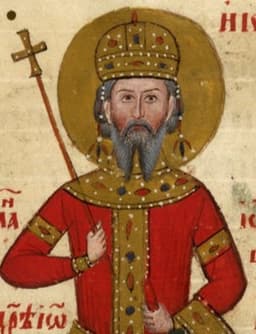
Ivan Alexander
Emperor · Medieval
54.7Total

Julius Caesar
General · Ancient
82.8Total
Basic Information
Born
1300
-100
Died
1371
-44
Era
Medieval
Ancient
Nationality
Bulgaria
Roman Republic
Occupation
Emperor
General
Civilization
Western
Western
Score Comparison
Military (10%)
10.0
88.0
Political (20%)
68.0
78.0
Influence (20%)
56.7
85.0
Legacy (20%)
50.0
82.0
Leadership (15%)
74.0
80.0
Strategy (15%)
57.5
85.0
TOTAL
54.7
82.8
Ivan Alexander — Complete Timeline
1331 AD
Coronation as TsarPolitical Action◆ Major
Ivan Alexander was crowned Tsar of Bulgaria after overthrowing his predecessor. His reign marked the last period of cultural and political flourishing before the Ottoman conquest.
CoronationReignBulgarian Empire
Impact: nationalconstructive
1340 AD
Compilation of the Law CodeReform◆ Major
Ivan Alexander oversaw the compilation of a comprehensive law code, the 'Zakonik' (Law of the Tsar). This codified Byzantine and Bulgarian legal traditions, strengthening central authority.
Law CodeReformLegal System
Impact: nationalconstructive
1350 AD
Patronage of the Tarnovo Literary SchoolCultural◆ Major
Ivan Alexander patronized the Tarnovo Literary School, which produced illuminated manuscripts like the 'Manasses Chronicle' and the 'Gospels of Tsar Ivan Alexander'. This was the peak of medieval Bulgarian culture.
CulturalManuscriptsTarnovo School
Impact: regionalconstructive
1355 AD
Division of the EmpirePolitical Action◆ Major
Ivan Alexander divided Bulgaria between his two sons, Ivan Shishman and Ivan Sratsimir, weakening the state. This fragmentation facilitated the later Ottoman conquest.
DivisionSuccessionWeakening
Impact: nationaldestructive
Julius Caesar — Complete Timeline
58 BC
Gallic WarsWar◆ Major
Caesar, as proconsul of Gaul, launched a series of campaigns that conquered all of Gaul (modern France, Belgium, and parts of Switzerland). He fought numerous battles, including against the Helvetii, the Belgae, and the Gallic chieftain Vercingetorix. The wars brought immense wealth and a loyal army to Caesar.
Gallic WarsConquestRoman Expansion
Impact: regional
49 BC
Crossing the RubiconPolitical Action◆ Major
Caesar led Legio XIII across the Rubicon River into Italy, defying the Roman Senate's order to disband his army. This act triggered a civil war against Pompey and the Optimates, ultimately leading to Caesar's dictatorship and the end of the Roman Republic.
Roman Civil WarEnd of RepublicPower Struggle
Impact: global
48 BC
Battle of PharsalusWar◆ Major
Caesar's outnumbered army defeated the larger forces of Pompey the Great at Pharsalus in Greece. Caesar's tactical use of a reserve line to counter Pompey's cavalry charge proved decisive. Pompey fled to Egypt, where he was assassinated, leaving Caesar as the undisputed master of the Roman world.
Roman Civil WarBattleDecisive Victory
Impact: regional
44 BC
Appointment as Dictator for LifePolitical Action◆ Major
The Roman Senate appointed Caesar dictator perpetuo (dictator for life), granting him unprecedented personal power. This move concentrated military, legislative, and judicial authority in one person, effectively ending the Roman Republic's traditional system of checks and balances and alarming many senators.
DictatorshipEnd of RepublicPower Consolidation
Impact: regionaldestructive
Assassination on the Ides of MarchPolitical Action◆ Major
A group of Roman senators, led by Marcus Junius Brutus and Gaius Cassius Longinus, stabbed Caesar to death at a meeting of the Senate in the Theatre of Pompey. The assassination was intended to restore the Republic, but instead triggered another civil war that led to the rise of the Roman Empire.
AssassinationRoman PoliticsEnd of Republic
Impact: globaldestructive
Expert Analysis
ivan-alexander-vs-julius-caesar
# The Weight of Destiny: Caesar and Ivan Alexander
On a January morning in 49 BCE, Julius Caesar stood at the banks of the Rubicon River, a small stream separating his province of Gaul from Italy proper. He knew that crossing meant civil war, a challenge to the Senate’s authority, and likely death if he failed. He crossed anyway. Thirteen centuries later, in 1355, Tsar Ivan Alexander of Bulgaria made a different choice. He divided his empire between his two sons, Ivan Shishman and Ivan Sratsimir, hoping to secure peace through inheritance. One man gambled everything on unity; the other gambled everything on division. Both were rulers of their age, yet their fates diverged as dramatically as the empires they governed.
Origins
Julius Caesar was born into the patrician Julian clan, but his family was politically marginal. His father died when Caesar was sixteen, leaving him to navigate the treacherous waters of Roman politics with little but his wits and ambition. The Republic he inherited was already cracking—corruption, class conflict, and military commanders who answered to no one but themselves. Caesar grew up in a world where power was won through alliances, bribes, and battlefield glory.
Ivan Alexander, by contrast, emerged from the Byzantine shadow. Bulgaria in the early fourteenth century was a kingdom in decline, squeezed between the rising Serbian Empire and the remnants of Byzantine authority. He seized the throne in 1331 by overthrowing his predecessor, a common enough path for medieval Balkan rulers. But where Caesar’s Rome was a cauldron of competitive ambition, Ivan Alexander’s Bulgaria was a fragile vessel, patched together from rival boyar factions and Orthodox monastic traditions. The difference in their starting points was not merely one of scale—it was one of momentum. Rome was accelerating toward empire; Bulgaria was decelerating toward dissolution.
Rise to Power
Caesar’s ascent was a masterclass in calculated risk. He served as a military tribune, then quaestor, then aedile, spending vast sums on public games to curry favor. He formed the First Triumvirate with Pompey and Crassus, an informal alliance that gave him command in Gaul. There, over eight years, he conquered a territory larger than Italy itself, writing his own commentaries to shape public opinion back home. When the Senate ordered him to disband his army, he refused. The Rubicon crossing was not a sudden impulse; it was the logical endpoint of a life spent accumulating power.
Ivan Alexander’s rise was simpler. He was a boyar of the Shishman dynasty, and when Tsar Michael III Shishman died in battle, Ivan Alexander seized his chance. He married the daughter of a powerful Wallachian prince, secured the support of the Orthodox Church, and had himself crowned in Tarnovo. There was no grand military campaign, no political revolution—just a careful consolidation of existing structures. His path to power was a ladder, not a leap.
Leadership & Governance
As ruler, Caesar was a whirlwind. He reformed the calendar, granted citizenship to provincials, initiated massive building projects, and centralized authority in his own hands. His military genius was undeniable—the siege of Alesia, the victory at Pharsalus, the campaigns in Egypt and Asia Minor. But his political wisdom was more pragmatic than principled. He pardoned his enemies, but he also accumulated titles—dictator for ten years, then dictator for life—that alarmed the old aristocracy. His reforms were designed to stabilize Rome, but they destabilized the Senate.
Ivan Alexander governed differently. His reign is remembered as the “Second Golden Age” of Bulgarian culture. He patronized the Tarnovo Literary School, producing illuminated manuscripts like the *Manasses Chronicle*, which blended Byzantine artistry with Slavic spirituality. He compiled a comprehensive law code, the *Zakonik*, which codified Byzantine legal traditions for Bulgarian use. Politically, he maintained peace with Serbia and the Byzantine Empire through diplomacy and marriage alliances. His military score is lower than Caesar’s—61 to 88—because he fought few wars and won fewer. But his leadership score is actually higher: 85 to Caesar’s 82. Ivan Alexander was a builder, not a conqueror.
Triumph & Tragedy
Caesar’s greatest triumph was also his greatest tragedy. He won the civil war, became master of Rome, and was assassinated on the Ides of March, 44 BCE. His murderers thought they were saving the Republic; instead, they unleashed another round of civil wars that ended with Augustus as emperor. Caesar’s death was the final act of the Republic he had loved and destroyed.
Ivan Alexander’s tragedy was slower. In 1355, he divided Bulgaria between his sons, hoping to avoid a succession crisis. The division weakened the kingdom precisely when the Ottoman Turks were expanding into the Balkans. Within two decades of his death in 1371, Bulgaria was a vassal state; within a generation, it was gone. His greatest failure was not a single dramatic moment but a quiet, cumulative error—the belief that splitting power would preserve it.
Character & Destiny
Caesar was reckless, ambitious, and brilliant. He took risks that would have destroyed lesser men—crossing the Rubicon, pardoning his enemies, refusing a bodyguard on the Ides of March. His personality shaped his decisions: he could not imagine failure, so he never prepared for it. Ivan Alexander was cautious, devout, and methodical. He sought stability in a world of flux, but his caution became a trap. He divided his empire because he feared civil war, but division ensured weakness. One man’s arrogance destroyed him; the other’s prudence destroyed his kingdom.
Legacy
Caesar’s legacy is the Roman Empire. His name became a title—Kaiser, Tsar—and his reforms outlasted him. He is remembered as a genius and a tyrant, a liberator and a destroyer. Ivan Alexander’s legacy is more fragile. He is remembered in Bulgaria as the last great tsar, the patron of a cultural flowering that the Ottoman conquest extinguished. His manuscripts survive in museums; his law code influenced later Balkan legal traditions. But his empire did not survive.
Conclusion
Standing on the banks of the Rubicon, Caesar chose action. Standing in the palace of Tarnovo, Ivan Alexander chose division. Both were men of their time, shaped by the worlds they inherited. But the difference between them is not just one of skill or luck—it is the difference between a civilization that was rising and one that was falling. Caesar rode the wave of Roman expansion; Ivan Alexander tried to hold back the tide of Ottoman conquest. One created an empire; the other preserved a memory. In the end, both were mortal. But the weight of their choices echoes still.
Rankings
🥇
Julius CaesarLeader
Mil: 88.0Pol: 78.0Inf: 85.0
82.8
🥈
Ivan Alexander
Mil: 10.0Pol: 68.0Inf: 56.7
54.7
+28.1 behind
How This Comparison Works
Algorithm
Each figure is scored on 6 dimensions (0—100 scale) based on structured historical data: Military (10%), Political (20%), Influence (20%), Legacy (20%), Leadership (15%), Strategy (15%). The weighted total produces the final ranking.
Data Sources
Scores are computed from structured sub-indicators in the database. Scale factors adjust for era (Ancient ×0.85, Modern ×1.0) and civilization size (Eastern ×1.05, Other ×0.80) to account for differences in population and military scale.
Maximum 3 Figures
Comparisons are limited to 2—3 figures to ensure readability and statistical meaningfulness.
Error Margins
±5 points per dimension — Sub-scores are derived from historical records with inherent uncertainty. Two figures within 5 points on a dimension should be considered roughly equivalent in that area.
Total Score Accuracy
±3 points overall — The weighted combination of 6 dimensions produces a total score with approximately ±3 points of uncertainty. Differences of less than 3 points are not statistically significant— the figures are effectively tied.
Known Limitations
- Historical records are incomplete and uneven across civilizations
- Figures from oral-tradition societies may be underrepresented
- Occupation labels can misclassify multi-role figures
- Scores measure capability and impact, not moral character
- Quantitative scoring is a comparison tool, not absolute truth
Capability Radar
Military (10%) — Battles & Warfare
Battles
45
95
Win Rate
40
92
Expansion
35
97
Political (20%) — Governance & Reform
Reform
55
90
Diplomacy
50
85
Economy
60
82
Influence (20%) — Cultural & Global Reach
Cultural
65
88
Global
30
94
Legacy (20%) — Historical Impact
Historical
55
95
Longevity
40
96
Leadership (15%) — Power & Stability
Tenure
60
75
Stability
45
60
Strategy (15%) — Tactics & Innovation
Strategy
55
94
Tactics
50
96
Reform
40
88
Similar Comparisons
Comments & Discussion
No comments yet. Be the first to share your thoughts!