Loading...
Ishwari Singh vs Napoleon Bonaparte
Napoleon Bonaparte leads by 35.0 pts · 2 figures compared
…
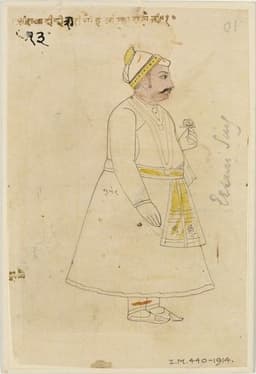
Ishwari Singh
Emperor · Modern
35.9Total

Napoleon Bonaparte
General · Modern
70.9Total
Basic Information
Born
1721
1769
Died
1750
1821
Era
Modern
Modern
Nationality
India
France
Occupation
Emperor
General
Civilization
Indian
Western
Score Comparison
Military (10%)
21.2
94.0
Political (20%)
26.4
72.0
Influence (20%)
46.3
40.0
Legacy (20%)
34.2
80.0
Leadership (15%)
38.1
78.0
Strategy (15%)
39.6
90.0
TOTAL
35.9
70.9
Ishwari Singh — Complete Timeline
1747 AD
Conflict with Madho SinghPolitical Action◆ Major
Ishwari Singh faced a succession dispute with his half-brother Madho Singh, who claimed the throne. The conflict led to civil war and Maratha intervention, weakening Jaipur.
Succession CrisisCivil WarJaipur
Impact: regionaldestructive
1748 AD
Battle of BagruWar◆ Major
Ishwari Singh fought the Maratha army under Malhar Rao Holkar at Bagru. He was defeated, leading to the loss of territory and increased Maratha influence in Jaipur.
Maratha InvasionBattleJaipur
Impact: regional
1750 AD
SuicidePolitical Action◆ Major
After losing the support of his nobles and facing defeat by the Marathas, Ishwari Singh committed suicide by consuming poison. His death ended the Kachwaha rule in Jaipur temporarily.
SuicideEnd of ReignJaipur
Impact: regionaltragic
Napoleon Bonaparte — Complete Timeline
1799 AD
Coup of 18 BrumaireOther◆ Major
Napoleon Bonaparte, with support from his brother Lucien and key political figures, overthrew the Directory in a bloodless coup. He established the Consulate with himself as First Consul, effectively becoming the ruler of France. This event ended the French Revolution's most unstable period.
French RevolutionCoupRise to Power
Impact: regional
1804 AD
Promulgation of the Napoleonic CodeOther◆ Major
Napoleon enacted the Civil Code of the French, known as the Napoleonic Code, a comprehensive set of laws that replaced the fragmented feudal legal systems. The code established legal equality, protected property rights, and secularized law. It became the basis for legal systems in many European and world countries.
Legal ReformNapoleonic CodeCivil Law
Impact: globalconstructive
1805 AD
Battle of AusterlitzWar◆ Major
Napoleon's Grande Arm
Napoleonic WarsBattleDecisive Victory
Impact: global
1812 AD
Invasion of RussiaWar◆ Major
Napoleon led the Grande Arm
Napoleonic WarsInvasionDisaster
Impact: globaldestructive
1815 AD
Battle of WaterlooWar◆ Major
Napoleon's French army was defeated by the combined forces of the Duke of Wellington's Anglo-Allied army and Gebhard Leberecht von Bl
Napoleonic WarsBattleFinal Defeat
Impact: globaldestructive
Expert Analysis
ishwari-singh-vs-napoleon-bonaparte
# The Emperor and the Prince: Two Paths to Ruin
In the winter of 1750, a desperate ruler sat alone in his palace in Jaipur, watching the walls that had once seemed so secure. Thousands of miles away, on a windswept island in the South Atlantic, another man would soon begin his final exile. Both had risen to power through ambition and the accident of birth. Both would end their days in crushing defeat. But the chasm between them—between Napoleon Bonaparte, the Corsican artilleryman who reshaped Europe, and Ishwari Singh, the Rajput prince who could not hold his own kingdom—tells us something profound about the interplay of character, circumstance, and the terrible mathematics of power.
Origins
Napoleon was born in 1769 on Corsica, an island that had just passed from Genoese to French control. His family belonged to the minor nobility, but they were poor, proud, and resentful of French authority. Young Napoleon spoke Italian-accented French, was mocked by his classmates at military school, and carried a chip on his shoulder the size of the Mediterranean. He devoured books on military history and artillery science, and by the age of sixteen he was a second lieutenant. His rise would come through talent, not inheritance.
Ishwari Singh was born in 1721 into the Kachwaha Rajput dynasty, rulers of the prosperous kingdom of Jaipur. He was the eldest son of Maharaja Sawai Jai Singh II, a legendary ruler who had founded the city of Jaipur and built the Jantar Mantar observatory. Ishwari Singh inherited not just a throne but a system of succession that was dangerously ambiguous—Rajput tradition allowed multiple wives, and half-brothers could claim equal legitimacy. His father had designated him heir, but the seeds of conflict were sown at his birth.
Both men were shaped by their era. Napoleon lived in a Europe convulsed by revolution, where old hierarchies were collapsing and a young man of genius could rise to command armies. Ishwari Singh ruled in an India where the Mughal Empire was fragmenting and the Maratha Confederacy was filling the power vacuum. The Rajput kingdoms, once proud allies of the Mughals, now found themselves caught between Maratha expansion and internal dynastic feuds.
Rise to Power
Napoleon’s ascent was a masterpiece of timing and audacity. He first distinguished himself at the Siege of Toulon in 1793, where his artillery plan drove the British from the port. He was only twenty-four. By 1796, he was commanding the Army of Italy, and his lightning campaign against the Austrians stunned Europe. He did not inherit power—he seized it, first as First Consul in 1799, then as Emperor in 1804. His path was forged by victory after victory: Austerlitz in 1805, Jena in 1806, Friedland in 1807. He was the man who made his own luck.
Ishwari Singh’s rise was quieter and more fraught. He became Maharaja of Jaipur in 1743 after his father’s death. The transition seemed smooth, but his half-brother Madho Singh immediately began plotting. Madho had been raised by his mother, who belonged to a different faction within the court. The succession dispute was not merely personal—it reflected deeper tensions between noble families and the shifting alliances of the Maratha powers. Ishwari Singh had inherited a throne, but he had not inherited the means to keep it.
Leadership & Governance
Napoleon’s leadership was a paradox: he was a military genius who understood the revolutionary power of mass armies, but his political wisdom was uneven. He reformed French law through the Napoleonic Code, establishing principles of equality before the law and meritocracy that endure to this day. He centralized administration, created the Bank of France, and built schools. But he also suppressed dissent, restored slavery in the colonies, and surrounded himself with sycophants. His military strategy was brilliant—he used speed, concentration of force, and the exploitation of enemy mistakes. His political strategy was less subtle: conquer, install family members on thrones, demand obedience.
Ishwari Singh ruled in a different key. As a Rajput king, his legitimacy rested on dharma—the sacred duty to protect his kingdom and his honor. He maintained the administrative structures his father had built, but he could not match the military power of the Marathas. When Madho Singh allied with Malhar Rao Holkar, the Maratha general, Ishwari Singh was forced to fight at Bagru in 1748. He lost. The Marathas demanded tribute and territory. His nobles began to desert him. He was a ruler trapped between an external enemy he could not defeat and an internal rival he could not neutralize.
Triumph & Tragedy
Napoleon’s greatest triumph was Austerlitz, where he destroyed the combined armies of Russia and Austria in a single day. His greatest tragedy was the invasion of Russia in 1812, where hubris and logistics combined to destroy his Grand Army. He was exiled to Elba, escaped, raised another army, and was finally defeated at Waterloo in 1815. His tragedy was that of a man who could not stop—who mistook his own momentum for destiny.
Ishwari Singh’s triumph was brief: he held his throne for seven years against immense pressure. His tragedy was absolute. In 1750, with his nobles defecting and the Marathas closing in, he saw no way out. He consumed poison and died, a suicide that his culture considered both dishonorable and a final assertion of control over his own fate. He was twenty-nine years old.
Character & Destiny
Napoleon’s character was forged by insecurity and ambition. He needed to prove himself constantly, to dominate every room, to rewrite the map of Europe. His famous saying—"Impossible is a word to be found only in the dictionary of fools"—captures his relentless drive. But that same drive led him to overreach. He could not delegate, could not compromise, could not accept limits. His destiny was shaped by his refusal to accept any boundary.
Ishwari Singh’s character was shaped by tradition and honor. He was not a military innovator or a political reformer. He was a Rajput prince who believed that ruling meant protecting his kingdom, his family, and his reputation. When all three were lost, he chose death over submission. His suicide was not weakness—it was a desperate act of defiance in a world where his options had narrowed to zero. "Better to die on one’s own feet than live on one’s knees" might have been his epitaph.
Legacy
Napoleon’s legacy is immense. He reshaped Europe’s borders, spread the ideals of the French Revolution, and left a legal and administrative framework that still influences half the world. He is remembered as a genius and a tyrant, a liberator and a conqueror. His scores in military strategy (93) and leadership (80) reflect his extraordinary abilities, but his political score (75) shows the limits of his vision.
Ishwari Singh’s legacy is local and tragic. He is remembered in Rajasthan as a prince who could not hold his throne, who died by his own hand. His scores—military 20.4, political 41.4, leadership 36.7—tell the story of a man overwhelmed by forces he could not control. He left no code, no reforms, no enduring institutions. He left only a cautionary tale about the fragility of inherited power.
Conclusion
The difference between Napoleon and Ishwari Singh is not simply one of talent. Both faced impossible odds at critical moments. Napoleon at Toulon, outnumbered and untested, found a way through. Ishwari Singh at Bagru, with the Marathas advancing and his half-brother plotting, found none. The difference lies in the age they inhabited and the tools they could wield. Napoleon lived in a time of revolutionary change, where a man of genius could remake the world. Ishwari Singh lived in a time of imperial decay, where even a legitimate king could be crushed by forces beyond his control.
Napoleon’s tragedy was that he could not stop conquering. Ishwari Singh’s tragedy was that he could not start. One died in exile, the other by poison. Both were consumed by the very power they had sought. Their stories remind us that history is not a meritocracy—it is a lottery of time and place, where the same ambition that makes a man emperor in one era makes him a footnote in another.
Rankings
🥇
Napoleon BonaparteLeader
Mil: 94.0Pol: 72.0Inf: 40.0
70.9
🥈
Ishwari Singh
Mil: 21.2Pol: 26.4Inf: 46.3
35.9
+35.0 behind
How This Comparison Works
Algorithm
Each figure is scored on 6 dimensions (0—100 scale) based on structured historical data: Military (10%), Political (20%), Influence (20%), Legacy (20%), Leadership (15%), Strategy (15%). The weighted total produces the final ranking.
Data Sources
Scores are computed from structured sub-indicators in the database. Scale factors adjust for era (Ancient ×0.85, Modern ×1.0) and civilization size (Eastern ×1.05, Other ×0.80) to account for differences in population and military scale.
Maximum 3 Figures
Comparisons are limited to 2—3 figures to ensure readability and statistical meaningfulness.
Error Margins
±5 points per dimension — Sub-scores are derived from historical records with inherent uncertainty. Two figures within 5 points on a dimension should be considered roughly equivalent in that area.
Total Score Accuracy
±3 points overall — The weighted combination of 6 dimensions produces a total score with approximately ±3 points of uncertainty. Differences of less than 3 points are not statistically significant— the figures are effectively tied.
Known Limitations
- Historical records are incomplete and uneven across civilizations
- Figures from oral-tradition societies may be underrepresented
- Occupation labels can misclassify multi-role figures
- Scores measure capability and impact, not moral character
- Quantitative scoring is a comparison tool, not absolute truth
Capability Radar
Military (10%) — Battles & Warfare
Battles
15
95
Win Rate
10
90
Expansion
5
95
Political (20%) — Governance & Reform
Reform
10
95
Diplomacy
10
80
Economy
10
85
Influence (20%) — Cultural & Global Reach
Cultural
10
85
Global
5
90
Legacy (20%) — Historical Impact
Historical
10
95
Longevity
5
90
Leadership (15%) — Power & Stability
Tenure
20
85
Stability
5
70
Strategy (15%) — Tactics & Innovation
Strategy
10
95
Tactics
10
98
Reform
5
92
Similar Comparisons
Comments & Discussion
CANNONFODDER_critic6/17/2026
Let's be real—comparing Ishwari Singh to Napoleon isn't history, it's a category error. Napoleon raised armies from scratch, rewrote European law, and only fell when the entire continent ganged up on him. Ishwari lost his throne because his half-brother had a bigger faction and he couldn't pay his troops. One was a military genius fighting coalition forces, the other was a local prince who's barely a footnote outside Rajputana fan forums. Apples and oranges.|
数据龙卷风6/17/2026
别被浪漫故事骗了。拿破仑的资产产值是印度王子的一百倍,还有大西洋贸易红利支撑。Ishwari Singh 可不是输给家族内斗,是输给了殖民经济结构——马拉塔人索要的贡金就相当于他两年税收总和。你们赞美天才将军,我觉得他只是生在资源更丰富的舞台上而已。|
DOUBTING_DECIMA6/17/2026
People love the 'tragic prince' narrative, but Ishwari's story is just a squabble between two claimants, not a clash of empires. Napoleon was exiled to St. Helena after ruling half of Europe; Ishwari was poisoned in his own palace by a rival faction that barely controlled a few districts. Scale matters. If you need a Napoleonic parallel for India, try Tipu Sultan—he at least fought the British on multiple fronts.|
翻案老蔡6/17/2026
好一个“双雄悲剧”!分明是硬扯关系。Ishwari Singh 败在没跟上时代——马拉塔人用现代化军饷制度收买他部下,他还守着封建骑士荣誉。拿破仑呢?他才不会为“尊严”等死,他会在战前收买对方军官、放谣言升级内战。一个是16世纪头脑,一个是19世纪手腕,根本不在一个层次。话说回来,Jaipur 宫殿确实漂亮,这点拿破仑比不了。|
MAPMEISTER_NEIN6/17/2026
The analysis frames this as "character vs circumstance," but it misses the brutal geography angle. Napoleon commanded the French heartland—compact, rich, defensible. Ishwari ruled a kingdom surrounded by Marathas, Mughal remnants, and rival Rajputs, all crosscut by desert and hills. His resource base was a fraction of Napoleon's, and his enemies were already inside the walls. It's not a moral lesson; it's a logistics lesson. One man had a winning hand and botched it. The other was dealt deuces f