Loading...
Ishbi-Erra vs Julius Caesar
Julius Caesar leads by 35.9 pts · 2 figures compared
…
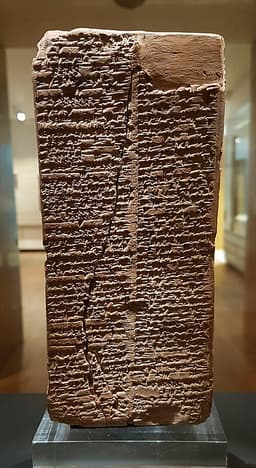
Ishbi-Erra
Emperor · Ancient
46.9Total

Julius Caesar
General · Ancient
82.8Total
Basic Information
Born
-2017
-100
Died
-1985
-44
Era
Ancient
Ancient
Nationality
Isin
Roman Republic
Occupation
Emperor
General
Civilization
Middle Eastern
Western
Score Comparison
Military (10%)
25.0
88.0
Political (20%)
43.7
78.0
Influence (20%)
49.4
85.0
Legacy (20%)
40.8
82.0
Leadership (15%)
74.0
80.0
Strategy (15%)
41.7
85.0
TOTAL
46.9
82.8
Ishbi-Erra — Complete Timeline
2017 BC
Founded the First Dynasty of IsinPolitical Action◆ Major
Ishbi-Erra established the First Dynasty of Isin after the collapse of the Ur III empire. He seized control of Isin and gradually expanded his territory, becoming the dominant power in southern Mesopotamia and claiming the title 'King of Sumer and Akkad'.
DynastyIsinSumer
Impact: regional
2015 BC
Defeated the Elamites and expelled them from UrWar◆ Major
Ishbi-Erra led a military campaign against the Elamites who had occupied Ur after the fall of the Ur III dynasty. He defeated them and drove them out, restoring Sumerian control over the city and its important religious sites.
WarElamUr
Impact: regional
2010 BC
Consolidated control over Nippur and other Sumerian citiesPolitical Action
Ishbi-Erra extended his rule over key Sumerian cities including Nippur, the religious center of Mesopotamia. This consolidation allowed him to claim legitimacy as the successor to the Ur III kings and control trade routes.
ConsolidationNippurSumer
Impact: regional
Issued royal inscriptions and building projectsCultural
Ishbi-Erra commissioned royal inscriptions and building projects, including temples and fortifications in Isin and Ur. These works served to legitimize his rule and demonstrate his piety to the gods, following Sumerian traditions.
InscriptionsBuildingReligion
constructive
Julius Caesar — Complete Timeline
58 BC
Gallic WarsWar◆ Major
Caesar, as proconsul of Gaul, launched a series of campaigns that conquered all of Gaul (modern France, Belgium, and parts of Switzerland). He fought numerous battles, including against the Helvetii, the Belgae, and the Gallic chieftain Vercingetorix. The wars brought immense wealth and a loyal army to Caesar.
Gallic WarsConquestRoman Expansion
Impact: regional
49 BC
Crossing the RubiconPolitical Action◆ Major
Caesar led Legio XIII across the Rubicon River into Italy, defying the Roman Senate's order to disband his army. This act triggered a civil war against Pompey and the Optimates, ultimately leading to Caesar's dictatorship and the end of the Roman Republic.
Roman Civil WarEnd of RepublicPower Struggle
Impact: global
48 BC
Battle of PharsalusWar◆ Major
Caesar's outnumbered army defeated the larger forces of Pompey the Great at Pharsalus in Greece. Caesar's tactical use of a reserve line to counter Pompey's cavalry charge proved decisive. Pompey fled to Egypt, where he was assassinated, leaving Caesar as the undisputed master of the Roman world.
Roman Civil WarBattleDecisive Victory
Impact: regional
44 BC
Appointment as Dictator for LifePolitical Action◆ Major
The Roman Senate appointed Caesar dictator perpetuo (dictator for life), granting him unprecedented personal power. This move concentrated military, legislative, and judicial authority in one person, effectively ending the Roman Republic's traditional system of checks and balances and alarming many senators.
DictatorshipEnd of RepublicPower Consolidation
Impact: regionaldestructive
Assassination on the Ides of MarchPolitical Action◆ Major
A group of Roman senators, led by Marcus Junius Brutus and Gaius Cassius Longinus, stabbed Caesar to death at a meeting of the Senate in the Theatre of Pompey. The assassination was intended to restore the Republic, but instead triggered another civil war that led to the rise of the Roman Empire.
AssassinationRoman PoliticsEnd of Republic
Impact: globaldestructive
Expert Analysis
ishbi-erra-vs-julius-caesar
# The Conqueror and the Kingmaker
On a spring morning in 44 BCE, Julius Caesar walked into the Senate chamber in Rome, knowing full well that daggers might await him. He had been warned. But the man who had crossed the Rubicon, who had defeated Pompey’s armies from Spain to Egypt, who had made himself dictator for life—that man could not show fear. Within minutes, he lay bleeding on the marble floor, stabbed twenty-three times by men he had pardoned, promoted, and trusted. Across the gulf of nearly two thousand years, another ruler faced his own moment of truth. Ishbi-Erra, a man of Amorite blood in a Sumerian world, watched the Ur III empire crumble around him like a mud-brick wall in a flood. Where Caesar chose to stride forward into danger, Ishbi-Erra chose to wait, to build, and to seize opportunity when the moment was ripe. Why did one die at the height of his power while the other founded a dynasty that would last for generations? The answer lies not merely in their circumstances, but in the deepest contours of their character.
Origins
Julius Caesar was born into the twilight of the Roman Republic, a world of senatorial intrigue, civil wars, and restless legions. He came from the patrician Julian clan, but his family was not wealthy—a fact that would drive him for the rest of his life. The Rome of his youth was a crucible of ambition, where a man could rise by military glory, political cunning, or both. Caesar absorbed this atmosphere like a sponge, learning early that in Rome, reputation was currency and audacity was capital.
Ishbi-Erra emerged from a very different world. He was an Amorite, a member of a Semitic people who had long been viewed by Sumerians as uncivilized outsiders. When he first appears in the historical record around 2017 BCE, the Ur III empire—the last great Sumerian state—was collapsing under the weight of Elamite invasions, internal decay, and economic crisis. Ishbi-Erra had no noble lineage to rely on. He had only his wits, his leadership, and the desperate loyalty of men who saw in him a chance for survival. Where Caesar was born into the game of power, Ishbi-Erra had to invent himself to play it.
Rise to Power
Caesar’s path to dominance was a masterclass in calculated risk. He borrowed fortunes to fund his political campaigns, formed the First Triumvirate with Pompey and Crassus, and then spent eight years conquering Gaul—a campaign of breathtaking brutality and brilliance that gave him a veteran army and unimaginable wealth. When the Senate ordered him to disband his legions and return to Rome as a private citizen, Caesar made his choice: he crossed the Rubicon River in 49 BCE, igniting a civil war that would end the Republic. "The die is cast," he reportedly said, and he meant it. There was no turning back.
Ishbi-Erra’s rise was quieter but no less decisive. As the Ur III empire dissolved, he was stationed in Isin, a city that had been a provincial center. He began by securing grain supplies for the city during a famine, winning the gratitude of its people. Then, as the Elamites sacked Ur and carried off the last Ur III king, Ishbi-Erra made his move. He declared himself ruler of Isin in 2017 BCE, founding the First Dynasty of Isin. Two years later, he led an army against the Elamites and expelled them from Ur—a victory that gave him control of the great religious and commercial center. He did not cross a river to start a war; he crossed a threshold of opportunity when the old order had already fallen.
Leadership & Governance
Caesar ruled as a reformer and a revolutionary. As dictator, he overhauled the Roman calendar, granted citizenship to provincials, initiated public works projects, and centralized power in his own hands. His military genius was undeniable—he wrote commentaries on his campaigns that are still studied today, and his siege of Alesia remains a textbook example of tactical brilliance. But Caesar’s political wisdom was flawed by his arrogance. He pardoned his enemies, but he also humiliated them. He sought to be loved, but he made himself feared. He centralized power, but he destroyed the institutions that could have stabilized his rule.
Ishbi-Erra governed as a consolidator and a builder. His inscriptions speak not of conquest but of restoration—rebuilding temples in Ur, fortifying Isin, and reestablishing trade routes. He understood that in Mesopotamia, legitimacy came from the gods and from tradition. So he styled himself as the restorer of order, the protector of Nippur, the religious heart of Sumer. He did not try to conquer the entire region; he focused on holding the core cities of Isin, Ur, and Nippur, and on keeping the Elamites at bay. His strategy was defensive and incremental, not audacious and expansive. Where Caesar sought to transform the world, Ishbi-Erra sought to preserve what he could from the wreckage.
Triumph & Tragedy
Caesar’s greatest triumph was his conquest of Gaul, which added a vast territory to the Roman sphere and made him the richest man in the Republic. His greatest tragedy was the Ides of March—a death that came not from a foreign enemy but from the senators he had spared. His assassination plunged Rome into another civil war, and it was only after his adopted heir Octavian defeated all rivals that the Republic finally died and the Empire was born. Caesar’s tragedy was that he could imagine a new world but could not convince enough people to follow him there.
Ishbi-Erra’s greatest triumph was his victory over the Elamites at Ur in 2015 BCE, which secured his dynasty and gave him control of a city that had been the capital of the old empire. His tragedy is more subtle: he founded a dynasty, but it would not last. The Isin dynasty would eventually be eclipsed by Larsa and then by Babylon. Ishbi-Erra’s achievement was not eternal empire but something more modest: he kept Sumerian civilization alive during a dark age, preserving traditions that would later influence Hammurabi and the great empires to come.
Character & Destiny
Caesar was driven by an insatiable hunger for glory. He lived by a code of personal honor that demanded he never back down, never show weakness, never accept second place. This made him magnificent—and it made him blind. He could not imagine that his generosity to his enemies would be repaid with daggers. He could not imagine that the Republic he had conquered would resist being transformed. His character was his destiny: he died because he could not stop being Caesar.
Ishbi-Erra was driven by a different force: survival. He was a pragmatist, not a visionary. He did not seek to conquer the world; he sought to build a stable kingdom in a chaotic time. His character was cautious, patient, and opportunistic. He waited for the right moment, struck when he could win, and then consolidated. His destiny was to be a founder, not a legend—a king who kept the lights on during a long night, rather than one who set the world on fire.
Legacy
Caesar’s legacy is immeasurable. His name became a title for emperors—Kaiser, Tsar—and his reforms shaped Western civilization. He is remembered as a military genius, a master politician, and a cautionary tale about ambition. His story is taught in schools, dramatized in plays, and debated by historians. He is, in every sense, a titan of history.
Ishbi-Erra’s legacy is quieter but real. He is remembered by specialists as the founder of the Isin dynasty, a ruler who preserved Sumerian culture during the Isin-Larsa period. His inscriptions survive in museums, his name appears in king lists, and his victory over the Elamites is recorded as a turning point in Mesopotamian history. But he does not have a Shakespeare play. He does not have a month named after him. He is a footnote in the grand narrative of civilization—but a necessary one.
Conclusion
Two men, two worlds, two fates. Caesar died in a blaze of glory and betrayal, his life a tragedy of overreach. Ishbi-Erra died in his bed, his life a success story of measured ambition. One changed the world forever; the other kept a civilization alive. Which is greater? The question is perhaps unanswerable. But as we look back across the millennia, we can see that history needs both kinds of men: the ones who dare everything and the ones who build something that lasts. Caesar gave us the drama; Ishbi-Erra gave us the continuity. In the end, the conqueror and the kingmaker are both essential to the story of human civilization.
Rankings
🥇
Julius CaesarLeader
Mil: 88.0Pol: 78.0Inf: 85.0
82.8
🥈
Ishbi-Erra
Mil: 25.0Pol: 43.7Inf: 49.4
46.9
+35.9 behind
How This Comparison Works
Algorithm
Each figure is scored on 6 dimensions (0—100 scale) based on structured historical data: Military (10%), Political (20%), Influence (20%), Legacy (20%), Leadership (15%), Strategy (15%). The weighted total produces the final ranking.
Data Sources
Scores are computed from structured sub-indicators in the database. Scale factors adjust for era (Ancient ×0.85, Modern ×1.0) and civilization size (Eastern ×1.05, Other ×0.80) to account for differences in population and military scale.
Maximum 3 Figures
Comparisons are limited to 2—3 figures to ensure readability and statistical meaningfulness.
Error Margins
±5 points per dimension — Sub-scores are derived from historical records with inherent uncertainty. Two figures within 5 points on a dimension should be considered roughly equivalent in that area.
Total Score Accuracy
±3 points overall — The weighted combination of 6 dimensions produces a total score with approximately ±3 points of uncertainty. Differences of less than 3 points are not statistically significant— the figures are effectively tied.
Known Limitations
- Historical records are incomplete and uneven across civilizations
- Figures from oral-tradition societies may be underrepresented
- Occupation labels can misclassify multi-role figures
- Scores measure capability and impact, not moral character
- Quantitative scoring is a comparison tool, not absolute truth
Capability Radar
Military (10%) — Battles & Warfare
Battles
30
95
Win Rate
35
92
Expansion
40
97
Political (20%) — Governance & Reform
Reform
40
90
Diplomacy
45
85
Economy
35
82
Influence (20%) — Cultural & Global Reach
Cultural
20
88
Global
15
94
Legacy (20%) — Historical Impact
Historical
30
95
Longevity
25
96
Leadership (15%) — Power & Stability
Tenure
55
75
Stability
50
60
Strategy (15%) — Tactics & Innovation
Strategy
30
94
Tactics
25
96
Reform
20
88
Similar Comparisons
Comments & Discussion
数据猎人6/17/2026
拿两位相隔两千年的统治者比较?这本身就是逻辑谬误。Ishbi-Erra时期的原始记录少得可怜,我们连他具体几岁即位都不知道。而凯撒有几十位同时代作家记述,光是《高卢战记》就写了8卷。你们用不完整的石碑碎片对比帝王传记,本质是在对比史料质量,而非人物本身。这种比较最多是历史速写,不是实质分析。|
Gilgamesh's Ghost6/17/2026
You're comparing a man who crossed the literal Rubicon with one who crossed the metaphorical river of time without leaving more than a few clay tablets. Caesar's ambition was Mediterranean-wide—he reordered the calendar, reformed provincial administration, and planned campaigns to Parthia. Ishbi-Erra's greatest achievement was... keeping Isin independent for 33 years? Let's be honest: one reshaped Western civilization; the other maintained a Mesopotamian city-state during a chaotic period. Scale
春秋笔法6/17/2026
你们忽略了关键差异:凯撒面对制度性权力结构(元老院),而Ishbi-Erra面对的是权力真空。前者改革共和制,后者直接填满空白。凯撒的死证明固化利益集团比征服战场更难对付。Ishbi-Erra的"智慧"不过是时代红利——当旧帝国崩溃时,任何有点政治嗅觉的军阀都能建立新王朝。换个时代,他恐怕连高卢总督都当不上。|
Gladiator's Calculus6/17/2026
The real lesson here isn't about caution vs. boldness—it's about risk management. Caesar knew the Ides of March plot existed and dismissed his Spanish bodyguard days before. That's not courage; that's catastrophic misjudgment. Ishbi-Erra survived because he treated power like a chess game, not a heroic saga. He exploited Ur's famine, waited for Ibbi-Sin to weaken himself, then struck. Caesar ignored intelligence reports, walked into a trap, and got filleted. That's not a character flaw—it's a ta
Historian6936/17/2026
Caesar's fatal flaw wasn't arrogance—it was his refusal to adapt his playbook after crossing the Rubicon. He conquered like a general but governed like a warlord, handing out pardons to enemies who'd later stab him. Ishbi-Erra understood something Caesar never did: consolidating power means building institutions, not just winning battles. The Isin dynasty lasted 200+ years because he created a tax system and loyal governors, not just a cult of personality. Caesar's dictatorship crumbled because